RFC

Pendle
2026-08-25 16:19:44

Pendle Oracle Move Triggers $36.1 Million in Morpho Liquidations

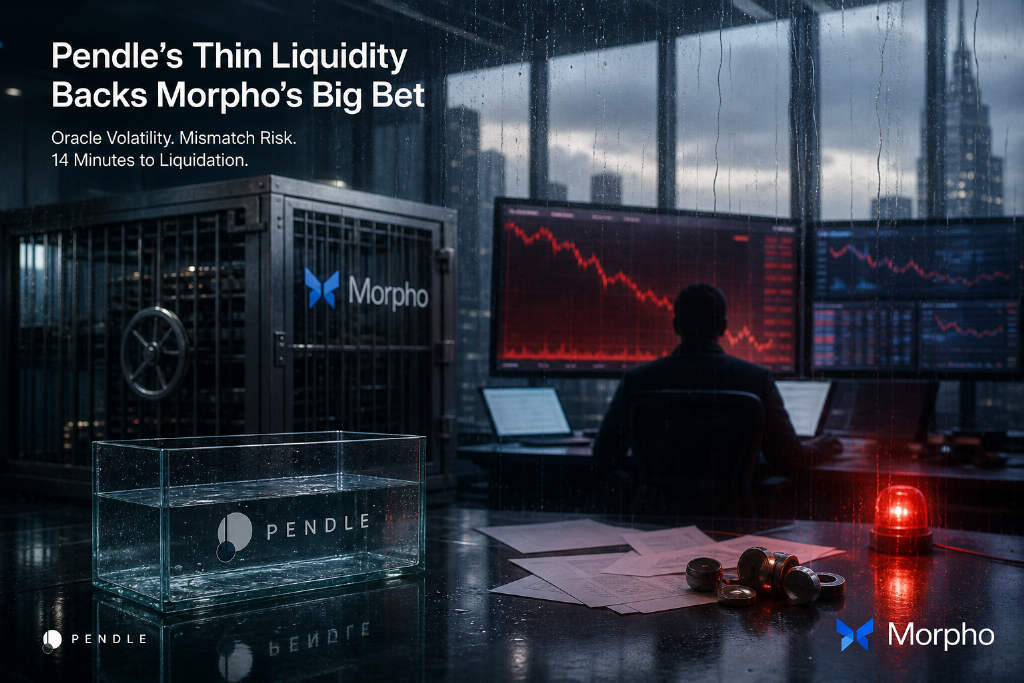
A thinly traded Pendle yield market triggered $36.1 million in liquidations on Morpho early Tuesday, closing leveraged positions in roughly 14 minutes while lenders were left whole. Pendle and Steakhouse Financial said the oracle worked as designed, not as a misconfiguration. The episode centered on a maturity-linked reUSD pool, a large mismatch between collateral and liquidity, and a sequence of onchain trades that PeckShield and analyst 0scar say pushed principal-token prices lower. Re Protocol said it is investigating whether the PT market price was intentionally manipulated, while no protocol involved has said manipulation occurred. The incident also revived attention on earlier public warnings about the size gap in the market and on Steakhouse’s prior comments that market-based oracles can be thinly traded and susceptible to manipulation.
380
Pendle Oracle Move Triggers $36.1 Million in Morpho Liquidations
Aave
2026-08-19 14:35:01

Securitize proposes adding HINC tokenized fund to Aave Horizon as collateral

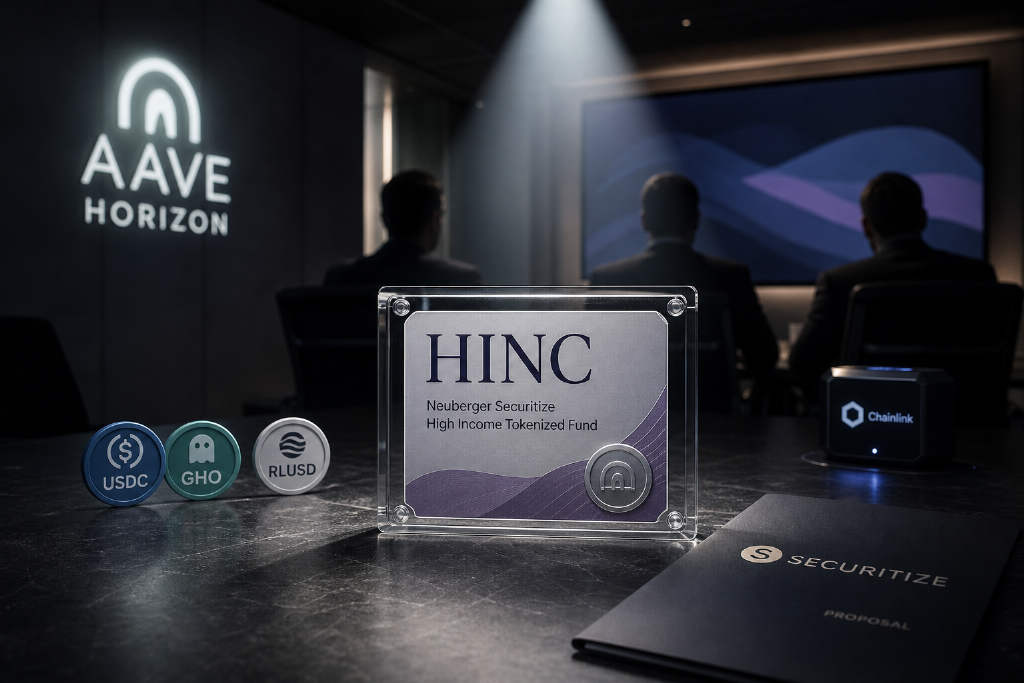
Aave said on X that Securitize has submitted an ARFC proposal on the Aave governance forum to onboard tokenized shares of the Neuberger Securitize High Income Tokenized Fund, or HINC, to Aave Horizon as collateral. If the proposal moves forward, users would be able to borrow USDC, GHO, and RLUSD against the asset. The proposal describes HINC as the first below-investment-grade credit collateral considered for Horizon and argues that its expected yield is meaningfully higher than stablecoin borrowing rates, which could support two ongoing use cases: arbitrage trades and balance sheet financing. At the same time, the filing lays out several risks. It says the fund has no actual operating history and carries liquidity mismatch and credit risk. For pricing, the design would use a Chainlink net asset value oracle with a capped growth rate. For liquidations, the proposal calls for a window-based process rather than instant liquidation. HINC’s investment adviser is Securitize Capital LLC, with Neuberger Berman Investment Advisers serving as sub-adviser. The fund mainly invests in fixed-income assets including high-yield corporate debt and CLO tranches, and its shares are issued on Ethereum as permissioned DSTokens using the same issuance structure as VBILL, the VanEck Treasury fund already onboarded to Horizon. Securitize also disclosed a direct commercial interest through its roles in the product.

450
Securitize proposes adding HINC tokenized fund to Aave Horizon as collateral
Uniswap
2026-07-19 03:08:07

Uniswap opens on-chain vote on v4 fee switch and Robinhood Chain expansion

Uniswap governance has opened an on-chain vote running from July 19 to July 26 on two proposals that would broaden the protocol’s fee framework and feed more revenue into the UNI burn mechanism created under UNIfication. The first proposal would activate protocol fees for selected Uniswap v4 pools. The second, submitted by founder Hayden Adams, would extend the existing v2 and v3 fee system to Robinhood Chain. Adams said on X that, based on current trading activity — especially the volume seen on Robinhood Chain — the impact on UNI burns could be substantial. Proposal text says Uniswap deployed all protocol versions from v2 through v3 on Robinhood Chain when the network launched its mainnet on July 1, and that cumulative volume across those deployments had already surpassed $6 billion as of July 10. The v4 proposal covers three pool categories across Ethereum, Arbitrum, Base, BNB Chain, Polygon, Optimism and Robinhood Chain. Because the GovernorBravo governance contract can execute only up to 10 on-chain actions in a single proposal, the remaining five chains will be handled through a separate proposal. The final result of the vote is due on July 26.

1230
Uniswap opens on-chain vote on v4 fee switch and Robinhood Chain expansion
Private AI
2026-07-14 01:32:50

IOSG says private AI is gaining ground as open models close the gap in high-value enterprise work

IOSG argues that private AI is moving from a niche concern to a practical deployment choice for both enterprises and consumers. The report says the core issue is no longer abstract model safety, but where plaintext prompts, internal data, and company-specific judgment end up once they leave a user’s device. It reviews the current privacy stack, from contractual zero-data-retention and anonymous relays to trusted execution environments, end-to-end encrypted inference, fully homomorphic encryption, and local inference, and finds that costs and performance penalties are falling for several of these approaches. A central example comes from a June 30 case study by Bridgewater’s AIA Labs and Thinking Machines. In that work, an expert-tuned open model based on Qwen3-235B outperformed frontier models in both accuracy and inference cost on investment-related tasks, scoring 84.7% versus 78.2% for the best frontier setup using expert prompts, while cutting inference cost by 13.8x. IOSG’s argument is not that privacy AI is solved. Tool calls in agent workflows, encrypted search, and private post-training remain major gaps. But the report says the infrastructure needed to train and run open models inside controlled, attestable environments is arriving piece by piece, giving companies a clearer path to keep their own alpha inside their own boundary.

1670
IOSG says private AI is gaining ground as open models close the gap in high-value enterprise work
IOSG
2026-07-14 01:32:50

IOSG says private AI is moving from theory to deployment as open models gain ground in cost and accuracy

IOSG argues that private AI is no longer a niche technical preference but an emerging requirement for enterprises and power users that do not want proprietary data, internal workflows, or high-value judgment calls exposed to model providers. In its report, the firm lays out how the privacy problem starts the moment a prompt leaves a user’s device and reaches a server in plaintext, and why contractual protections such as zero-data-retention terms can only go so far. The piece links that risk to corporate restrictions on ChatGPT, shadow AI leaks, and a series of legal cases in which user chats became discoverable evidence. The report also maps the trade-offs across today’s privacy stack, from contract-based retention promises and OHTTP relays to trusted execution environments, end-to-end encryption, fully homomorphic encryption, and local inference. Its central case study comes from Bridgewater’s AIA Labs and Thinking Machines, which showed that a fine-tuned open model, Qwen3-235B, beat frontier models on both accuracy and cost in financial judgment tasks. IOSG’s conclusion is narrow but clear: for execution-heavy agent workflows, trust-based setups still dominate because tool calls expose plaintext to downstream services; for high-value strategic reasoning and domain-specific alpha, verified private infrastructure around open models is becoming a practical path.

1150
IOSG says private AI is moving from theory to deployment as open models gain ground in cost and accuracy