SKU

Pantera Capit
2026-09-10 23:55:00

Pantera Capital says compute could become a hard currency for the AI economy

Pantera Capital partner Jay Yu argues that GPU compute is still in the early stages of financialization, but its market structure may develop in ways that resemble electricity and other physical commodities. In his view, compute is constrained by chip type, time, and geography, which makes it heterogeneous rather than perfectly fungible, yet still capable of evolving into a globally traded asset class over the next five to 10 years. The article maps the sector through layers including hardware providers, compute service operators, clusters, inference platforms, application companies, brokers, OTC desks, index builders, and derivatives venues. Yu draws repeated comparisons with U.S. power markets, where physical delivery, benchmark formation, and risk transfer tools emerged over time. He suggests compute markets may follow a similar path, with physical GPU delivery venues anchoring index construction and futures trading. The piece also describes Nvidia as a possible “central bank” for the compute economy because of its control over chip release cycles, utilization dynamics, and residual-value support policies. It identifies four broad product categories already taking shape: physical delivery, index products, derivatives exchanges, and financing tools such as lending, treasury structures, synthetic stablecoins, insurance, and other risk-transfer products. At the same time, it says the sector still faces major issues around transparency, basis risk, standardization, and quality verification.

810
Pantera Capital says compute could become a hard currency for the AI economy
Pantera Capit
2026-09-10 06:39:30

Pantera Says AI Compute Could Follow Oil and Power Into Finance, With Nvidia as a ‘Central Bank’

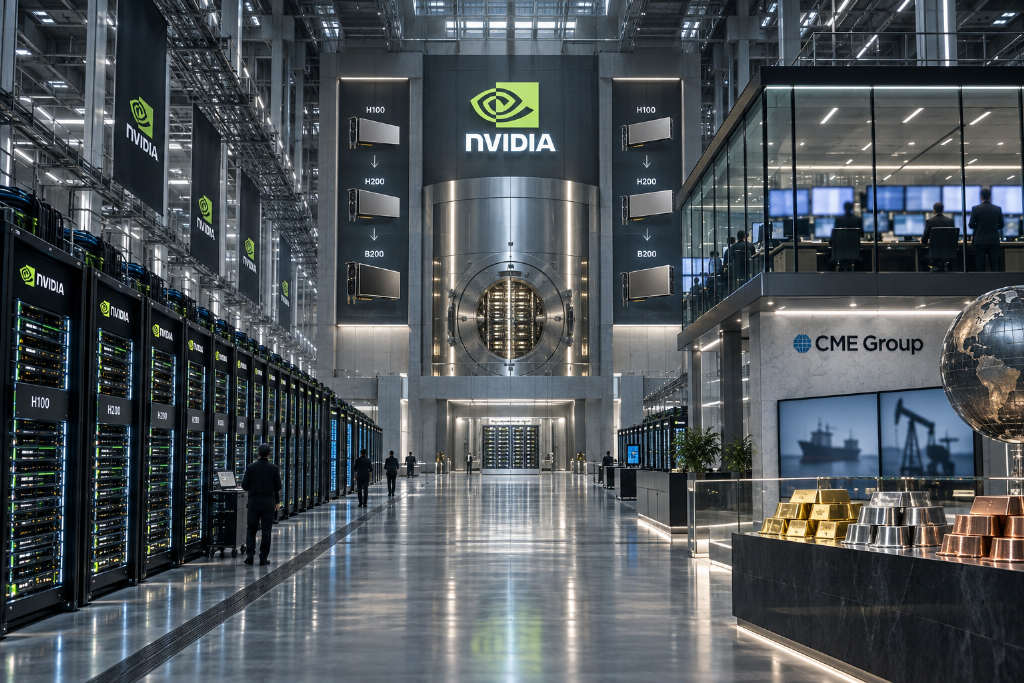
Pantera Capital investor Jay Yu argues that the market for AI compute is still traded in a highly primitive way despite trillion-dollar spending on data centers and compute infrastructure. In his view, GPU rentals and purchases still rely heavily on chat groups, OTC brokers, and one-to-one enterprise agreements, even as platforms such as SF Compute, Vast AI, and Runpod have emerged. He compares the current stage of the compute market to the early development of U.S. power and oil markets, where large physical demand came first and standardized contracts, pricing indices, futures, and hedging tools followed later. Yu says that over the next five to 10 years, compute represented by GPUs such as the H100, H200, and B200 could evolve from an internal IT expense into a standalone asset class that can be priced, traded, financed, and hedged. He also outlines a market structure spanning physical settlement platforms, pricing indices, derivative exchanges, and broader financialization vehicles. The report notes that CME Group has already announced a partnership with Silicon Data to plan futures products tied to GPU compute prices. Yu adds that Nvidia may sit above this system like a “central bank” because its product roadmap and residual value support can shape depreciation curves, financing conditions, and expectations around the future value of installed compute assets.

1080
Pantera Says AI Compute Could Follow Oil and Power Into Finance, With Nvidia as a ‘Central Bank’
Pantera Capit
2026-09-10 00:17:22

Pantera's Jay Yu says compute markets are still early, with GPU trading largely off-exchange

Pantera Capital junior partner Jay Yu said in his essay, The Rise of Compute Markets, that compute and data center spending has already become a trillion-dollar category, yet GPU procurement still happens mostly through group chats, over-the-counter brokers, and bilateral agreements. He argued that the financialization of compute remains at an early stage because markets are constrained by SKU differences, time, and location. Over the next five to 10 years, he said, compute could evolve into a commodity-like asset class comparable to electricity or oil. Yu also outlined a possible market structure modeled on the power sector, describing a future stack of hardware, suppliers, and clusters. In that framework, he characterized new cloud providers as structurally short GPUs, while on-demand platforms and the application layer are long. He added that for every $100 spent by the application layer on inference, about $45 goes to the on-demand layer, about $50 goes to new cloud providers or the GPU layer, and about $5 goes to routing layers such as OpenRouter.

700
Pantera's Jay Yu says compute markets are still early, with GPU trading largely off-exchange
Intel
2026-09-09 03:05:01

Intel said to raise CPU prices again from Oct. 5, with low-margin chip lines at risk

Intel is preparing another increase in official CPU prices starting Oct. 5, according to a DigiTimes report citing supply-chain sources. The report said the hike could exceed 10%, marking Intel’s third round of price increases since late 2025 and the biggest one yet. It added that the impact may extend beyond mainstream desktop processors, with entry-level "Small Core" chips used in industrial PCs, IoT devices and embedded systems reportedly facing possible discontinuation. The report said Intel had already raised CPU pricing several times, including a near-10% increase in the first quarter of 2026 and a second round on July 2 that ranged from tens of dollars to more than $1,000 depending on SKU, with server chips seeing the sharpest moves. It cited examples including Core Ultra 7 270K Plus, which moved from $299 to $349, and Core Ultra 5 250K Plus, from $199 to $229. Intel has not officially confirmed the latest timing or price increase. DigiTimes said supply-chain sources linked the move to capacity being prioritized for higher-margin server CPUs, while low-margin products may be cut back. The report also said Qualcomm and MediaTek could gain an opening in industrial and embedded markets if Intel retreats from those segments.

350
Intel said to raise CPU prices again from Oct. 5, with low-margin chip lines at risk
Intel
2026-09-07 23:29:44

Intel Reportedly to Hike CPU Prices by 10% in October, Opening Door for Arm Rivals

Supply chain sources indicate Intel (INTC.O) plans another 10% price increase on PC CPUs in early October, following multiple rounds of hikes over the past year due to rising costs. Despite an expected slight decline in the PC terminal market in 2027, Intel is prioritizing gross margin improvement over the previous strategy of price competition. Analysts suggest that if Intel uses low gross margin as a criterion for discontinuing products, some SKUs may exit the market, potentially channeling demand to Arm-based players such as MediaTek and Qualcomm, particularly in the IPC (Industrial PC), edge computing, and IoT sectors where Arm SoCs offer higher integration and lower power consumption.

770
Intel Reportedly to Hike CPU Prices by 10% in October, Opening Door for Arm Rivals
AI Native
2026-08-28 10:03:16

Ramp’s $44 Billion Valuation and Stripe’s Reported $7 Billion+ OpenRouter Deal Reflect an AI-Native Fintech Bet

A BlockTempo report citing Simon Taylor argues that Ramp’s $750 million raise at a $44 billion valuation, along with Stripe’s reported purchase of OpenRouter for more than $7 billion, is being driven by something larger than conventional payments growth. The core thesis is that investors are assigning value to new customer jobs created by AI rather than to legacy fintech products alone. Taylor says those new jobs include managing token spend, verifying agent identity, routing inference requests across hundreds of models, and building interfaces that software agents can use efficiently. In his framing, companies such as Ramp and Stripe sit in a favorable position because they already have existing businesses and can add new revenue layers beside them as AI creates adjacent demand. The column also sketches a broader competitive map. Some firms are merely adopting AI to improve old tasks, while others exist only because modern models created entirely new markets. Taylor argues that the next strategic question for fintech is not just whether to add AI features, but whether to own orchestration, control a trusted layer such as identity or settlement, or become the easiest product for outside agent shells to call through APIs and CLI tools.

950
Ramp’s $44 Billion Valuation and Stripe’s Reported $7 Billion+ OpenRouter Deal Reflect an AI-Native Fintech Bet
Nvidia
2026-08-26 03:05:09

JPMorgan Previews Nvidia Earnings: October Quarter Guidance May Hit $107B as China H200 Shipments Emerge as Key Upside Variable

JPMorgan released its fiscal Q2 2027 preview for Nvidia on August 24, reiterating an Overweight rating with a $280 price target. The bank expects July-quarter revenue of $94–95 billion and October-quarter guidance of $107–108 billion, roughly 3% above the Street consensus of $104.5 billion. Yet with the stock averaging a 3% decline in the seven days following each of the past four guidance beats, JPMorgan argues that numbers alone no longer move the stock. The real catalysts hinge on management's responses to four structural questions: competition from AI ASICs, China H200 shipments, HBM supply constraints, and AI infrastructure spending durability.

1000
JPMorgan Previews Nvidia Earnings: October Quarter Guidance May Hit $107B as China H200 Shipments Emerge as Key Upside Variable
Binance
2026-08-25 04:33:00

Binance Futures to list several USDT-margined perpetual contracts on Aug. 25

Binance Futures will begin rolling out several USDT-margined perpetual contracts at 17:00 on Aug. 25, according to ChainCatcher. The contracts named in the update are SKUUUSDT, SKDDUSDT, RAMUSDT, DJTUSDT, and MRNAUSDT. The maximum leverage for these products will be up to 20x. No other listing details were disclosed in the brief notice.

950
Binance Futures to list several USDT-margined perpetual contracts on Aug. 25