SSO

Stripe
2026-09-22 03:03:00

Stripe’s OpenRouter Bet Centers on Control, Not Just Routing

Stripe said on Aug. 19, 2026 that it had reached an agreement to acquire OpenRouter in what would be the company’s largest acquisition to date. The final price was not disclosed, though media reports placed the deal at more than $7 billion to $8 billion, with The New York Times citing roughly $7.5 billion. That figure stands in sharp contrast to OpenRouter’s roughly $1.3 billion Series B valuation just 83 days earlier, implying a near sixfold repricing in less than three months. The PANews analysis argues that OpenRouter has already proved one thing at scale: inference demand can be aggregated across hundreds of models and dozens of compute providers. The company says it handles more than 400 trillion monthly tokens, serves more than 10 million global users, connects 80-plus suppliers and 500-plus models, and supports more than 250,000 apps reaching over 4.2 million end users. Yet the same OpenAI-compatible standard that helped OpenRouter grow also keeps switching costs extremely low, since developers can often leave by changing a base URL and API key. In that framing, Stripe is not simply buying an API gateway. It is betting that OpenRouter can evolve from a replaceable middleware layer into a control point that links model routing, telemetry, agent identity, budgeting, metering and settlement. Whether that transition happens is presented as the central question behind the deal.

110
Stripe’s OpenRouter Bet Centers on Control, Not Just Routing
OpenAI
2026-09-20 04:36:05

Hacktron says it used Claude and an SSO misconfiguration to reach OpenAI’s internal code repository

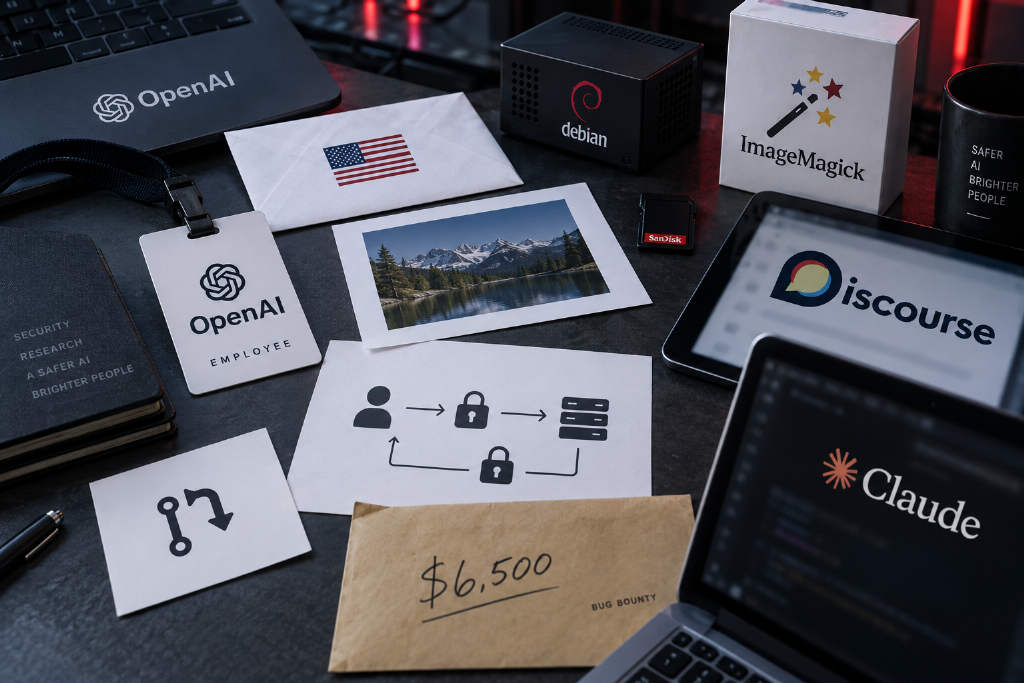
Security startup Hacktron said its three-member team chained together a libheif heap buffer overflow, an OpenAI single sign-on misconfiguration, and exploit code written with help from Claude Opus 5 to gain access to an OpenAI employee account and the company’s internal main code repository in under 72 hours. The group said it did not touch sensitive source code and instead opened a harmless pull request to prove access. OpenAI later paid a $6,500 bounty. According to Hacktron’s account, the attack began with an image uploaded to community.openai.com, a Discourse-based forum that processed HEIC and HEIF files through ImageMagick and libheif. The team said it moved from remote code execution in the production forum environment to admin access, then into an employee account whose Codex instance was connected to OpenAI’s GitHub organization. Hacktron argues the more serious issue was not the hosted forum alone, but the SSO setup that linked multiple services under the same login framework. The team also framed the incident as part of a broader shift in offensive capability, saying AI tools sharply increased what a small group could do with limited spending.

110
Hacktron says it used Claude and an SSO misconfiguration to reach OpenAI’s internal code repository
Perplexity
2026-09-11 17:05:23

Perplexity Computer in 2026: product forms, credit pricing, and where it fits

Perplexity Computer, launched on Feb. 25, 2026, is positioned by Perplexity as a general-purpose AI worker that can turn a single goal into a multi-step workflow handled by more than 20 models and sub-agents. According to ABMedia’s guide, the product now spans three forms: the original cloud-based Computer, Personal Computer for Mac and Windows, and Portable Computer, a fully local version introduced with NVIDIA support in late August. The system can return reports, spreadsheets, slide decks, dashboards, or websites, and in some cases run for hours or even months. The guide also lays out how the product is priced. Computer is bundled with paid Perplexity plans, but task execution consumes credits, with 100 credits equal to $1. The article lists reference ranges from 100 to 350 credits for lighter work up to 2,400 to 9,800 credits for large projects. It also details feature rollouts across Slack, Teams, Microsoft 365, email-based tasking, Deep Research, Model Council, Projects, Brain memory, and licensed financial data sources. ABMedia also highlights constraints. Credit usage is variable, Portable Computer does not support Apple silicon, broader service access increases permission risk, and legal or platform limits around agent actions on third-party sites remain unsettled.

970
Perplexity Computer in 2026: product forms, credit pricing, and where it fits
OpenAI
2026-09-11 00:09:08

OpenAI launches ChatGPT for Financial Services with built-in market data and GPT-6 Astra

OpenAI on Sept. 10, 2026 introduced ChatGPT for Financial Services, a version of ChatGPT Work tailored for the financial services industry. The product combines built-in financial datasets with the reasoning capabilities of GPT-6 Astra to help teams handle research, financial modeling, and customized client materials. OpenAI said the product was shaped through design collaborations with Morgan Stanley and Evercore. The offering includes data from providers such as Daloopa, PitchBook, LSEG News, and Crunchbase. According to the announcement, the datasets cover earnings call transcripts, financial statements, company fundamentals, and information on private companies. OpenAI indexes and hosts the data and provides granular citations inside the product. ChatGPT for Financial Services also comes with native access to models including GPT-6 Astra, along with enterprise security and governance controls. Administrators can publish Excel, Word, and PowerPoint templates. OpenAI said customer data is not used for model training by default, and the product supports encryption, SSO, and SCIM. The initial rollout is focused on investment banking and equity research, and the service is available to eligible financial institutions.

770
OpenAI launches ChatGPT for Financial Services with built-in market data and GPT-6 Astra
Grok Bot
2026-08-13 07:08:46

Grok Bot first look: how a cloud-based AI agent takes over everyday digital chores

Matt Palmer, head of developer experience and education at Cursor, outlined how Grok Bot works in an early beta write-up, describing it as an AI agent with its own always-on cloud computer. Rather than acting only inside a chat window, the system can open webpages and apps, access files, take screenshots, reuse browser sessions, and hand control back to the user when it hits login walls such as SSO, 2FA, captchas, or payments. Palmer said the setup felt closer to what a personal agent should actually be, compared with earlier tools that required too much deployment work, account management, and constant maintenance. The article breaks the product into several parts: persistent cloud execution on a Linux VM, layered memory across users, agents, and projects, trigger-based automation through messages, schedules, Slack, and git events, plus integrations with the same connectors and skills used by Cursor, including Notion, Slack, GitHub, MCP servers, Cursor Cloud Agents, and GitHub MCP. Palmer also described guardrails such as natural-language rules, a separate review agent, and allow/block lists. He gave examples ranging from demo generation and internal content monitoring to grocery comparison across Instacart and Amazon delivery, and DoorDash group-order navigation. After several weeks of use, he said the system had gradually earned his trust.

2960
Grok Bot first look: how a cloud-based AI agent takes over everyday digital chores
Datadog
2026-08-10 07:32:35

Bernstein Says Datadog’s Q2 May Mark a Growth Peak as H2 Slowdown Comes Into View

Datadog posted a strong second quarter in 2026, with revenue reaching $1.121 billion, up 35.6% year over year and accelerating 340 basis points sequentially, its fastest pace since 2022. The company beat guidance by $46 million and lifted the midpoint of its full-year outlook by more than three times. Even so, Bernstein argues the strength may represent a near-term top rather than the start of another leg higher. In Bernstein’s view, Datadog’s growth is likely to slow modestly in the second half, with revenue expansion falling about 200 basis points to roughly 33%. The firm points to lower usage from what it believes is Datadog’s largest AI customer, OpenAI, after a nine-figure renewal signed early in Q3. Management, according to the report, fully de-risked that account in Q4 guidance by assuming only the contractual minimum spend and no overage. The note also flags softer AWS SSO web traffic data as a possible sign of a temporary Q4 air pocket in non-AI demand. Bernstein still frames that issue as one-off rather than structural. It kept an Market Perform rating on Datadog with a $237 price target, saying the main concern is not business quality but valuation and crowded positioning. The report’s bottom line is simple: Datadog remains a good company, but the stock may already reflect most of the good news expected over the next 12 to 18 months.

460
Bernstein Says Datadog’s Q2 May Mark a Growth Peak as H2 Slowdown Comes Into View
OpenAI
2026-08-10 03:03:21

OpenAI shutters Atlas as the stand-alone AI browser thesis runs into a wall

OpenAI has shut down Atlas, the AI browser it launched with fanfare in October 2025, ending the product in less than 10 months. Atlas never expanded beyond macOS, and the promised Windows, iOS and Android versions were never released. Users also need to export bookmarks, tabs, browsing history and saved passwords manually before service ends, because that data will not move automatically. According to OpenAI, Atlas’s core AI capabilities will be folded into the ChatGPT desktop app, Chrome extensions and Codex. The article argues that Atlas’s collapse says more about the category than about a single product. Its core pitch was to turn browsing into a conversation by embedding ChatGPT directly into the browser and letting an agent read pages, click, fill forms, compare prices and place orders. But that required users to switch browsers, a high-friction move in a market where Chrome holds roughly 65% to 70% share and where bookmarks, password managers, extensions, work accounts and enterprise SSO are already tied to existing setups. The piece also points to prompt injection as a persistent security issue and says the industry is converging on a different model: not replacing Chrome, but layering AI on top of it or outside it. Google is integrating Gemini into Chrome, Anthropic is using a Chrome extension and pushing Computer Use, and OpenAI is now pulling Atlas capabilities back into ChatGPT Work and extensions instead of keeping a separate browser alive.

1880
OpenAI shutters Atlas as the stand-alone AI browser thesis runs into a wall
Denmark
2026-08-09 04:32:19

Denmark Orders Oral Defenses for Take-Home High School Assignments in AI Cheating Crackdown

Denmark is tightening controls on AI use in secondary education after a 2024 survey by the Danish Evaluation Institute found that nearly 9 in 10 high school students had used AI for homework. The Danish Ministry of Education said on Thursday, Aug. 6, that students in the country’s HF upper secondary track will now be required to complete an oral defense for major written assignments done at home, with the rule taking effect as soon as the next school term begins. The move is part of a broader three-part package. Alongside mandatory oral examinations tied to take-home written work, schools will be required to introduce screen-monitoring tools during on-campus written tests to track access to unauthorized websites, messaging apps, or AI services. The ministry also plans to deploy firewalls during classes and exams to restrict what students can reach online, while encouraging more assignments to be completed at school under supervision. Education Minister Magnus Heunicke said the problem of students using AI to cheat in high school is real and requires immediate action. According to the ministry, officials will work closely with schools on how to implement the changes.

360
Denmark Orders Oral Defenses for Take-Home High School Assignments in AI Cheating Crackdown