SWIFT
Sep 14, 2026

SWIFT launches pilot with 17 banks to test tokenized deposit cross-border payments

SWIFT has started a pilot project with 17 banks to test cross-border payments using tokenized deposits, according to a report by Nikkei. The participating institutions include Citibank, Mitsubishi UFJ, Wells Fargo, BNY Mellon, UBS and BNP Paribas. The trial is aimed at enabling 24/7 instant transfers between different banks while also reducing the cost of cross-border payments. The move centers on payment infrastructure testing rather than a commercial rollout, based on the information provided. No additional details on the pilot’s timeline, transaction volumes or technical design were disclosed in the source material.

1760

SWIFT launches pilot with 17 banks to test tokenized deposit cross-border payments
India
Sep 11, 2026

India backs BRICS CBDC links over a unified payments network at New Delhi summit

India is expected to push for interoperability between central bank digital currencies at the BRICS summit in New Delhi on Sept. 12-13, while holding back from endorsing a single cross-border payments network that could be seen as a challenge to SWIFT and the U.S. dollar, according to Bloomberg, citing people familiar with the matter. The report said Prime Minister Narendra Modi favors bilateral CBDC-based settlement among member states instead of a bloc-wide system. The issue comes as BRICS countries keep looking for ways to reduce dependence on existing global payments rails, especially after several Russian banks were cut off from SWIFT following Russia’s 2022 invasion of Ukraine. India, however, is said to be wary of any structure that could frame the bloc as explicitly anti-dollar or anti-Western. Indian officials publicly struck a cautious tone. Foreign Ministry spokesperson Jaiswal said it was too early to draw conclusions from meetings among finance ministers and central bank governors and urged media to wait for a joint statement. Meanwhile, local-currency settlement has already advanced in practice, with a Sberbank executive saying roughly 96% of India-Russia trade is being settled in rupees and rubles.

1890
India backs BRICS CBDC links over a unified payments network at New Delhi summit
Bolivia
Sep 10, 2026

Bolivia’s dollar shortage is pushing importers to El Dorado’s stablecoin-backed transfer rails

Bolivia’s shortage of physical U.S. dollars is spilling far beyond retail FX counters and into trade settlement, where small and mid-sized importers are struggling to pay overseas suppliers. A Forbes report says El Dorado is using stablecoins as back-end settlement infrastructure while selling something more familiar to businesses: access to dollar accounts and cross-border transfers. The company’s pitch is not cash dollars, but the ability to send money abroad through SWIFT, ACH, and wires when banks either refuse smaller clients or charge steep fees. The backdrop is a long-running exchange-rate regime that held the boliviano near 6.86/6.96 per dollar from 2011 until June 26, 2026, when Bolivia moved to a floating rate. Forbes says net international reserves had at one point dropped to about $30 million in mid-2025, while street rates approached 20 bolivianos per dollar and stablecoin premiums reached 70.5% in a fourth-quarter 2025 index. El Dorado announced a $9 million Series A in June 2026, led by Paradigm with participation from Coinbase Ventures, and launched El Dorado Business. The product offers company-name U.S. dollar accounts and supports SWIFT, ACH, and wire transfers, with wire coverage in more than 120 countries, according to its official materials.

2430
Bolivia’s dollar shortage is pushing importers to El Dorado’s stablecoin-backed transfer rails
Chainlink
Sep 10, 2026

How Chainlink founder Sergey Nazarov went from New York classrooms to a White House stage

On Aug. 19, Chainlink founder Sergey Nazarov spoke at a White House technology leaders summit about tokenization and its impact on the U.S. economy, standing beside Donald Trump with the chairs of the U.S. Securities and Exchange Commission and the Commodity Futures Trading Commission also in attendance. The MarsBit profile traces how Nazarov, born in the Soviet Union and later raised in New York, moved from studying philosophy and management at New York University into venture capital at FirstMark Capital, where he worked under Lawrence Lenihan and also served as a teaching assistant at NYU Stern around 2010. The piece follows a string of early ventures, including ExistLocal, QED Capital, CryptaMail and Secure Asset Exchange, before focusing on SmartContract, the predecessor to Chainlink, which Nazarov built with Steve Ellis. It highlights how SmartContract won SWIFT Innotribe’s 2016 Industry Challenge, presented at Sibos, and later demonstrated a workflow that used oracle-delivered LIBOR data, ISO 20022 messaging and the SWIFT network. The article argues that Chainlink’s rise came not from shortcuts, but from repeated experimentation, institutional credibility and a long-running effort to solve the problem of connecting smart contracts with external data for financial institutions.

2080
How Chainlink founder Sergey Nazarov went from New York classrooms to a White House stage
Policy and Regulation
Sep 8, 2026

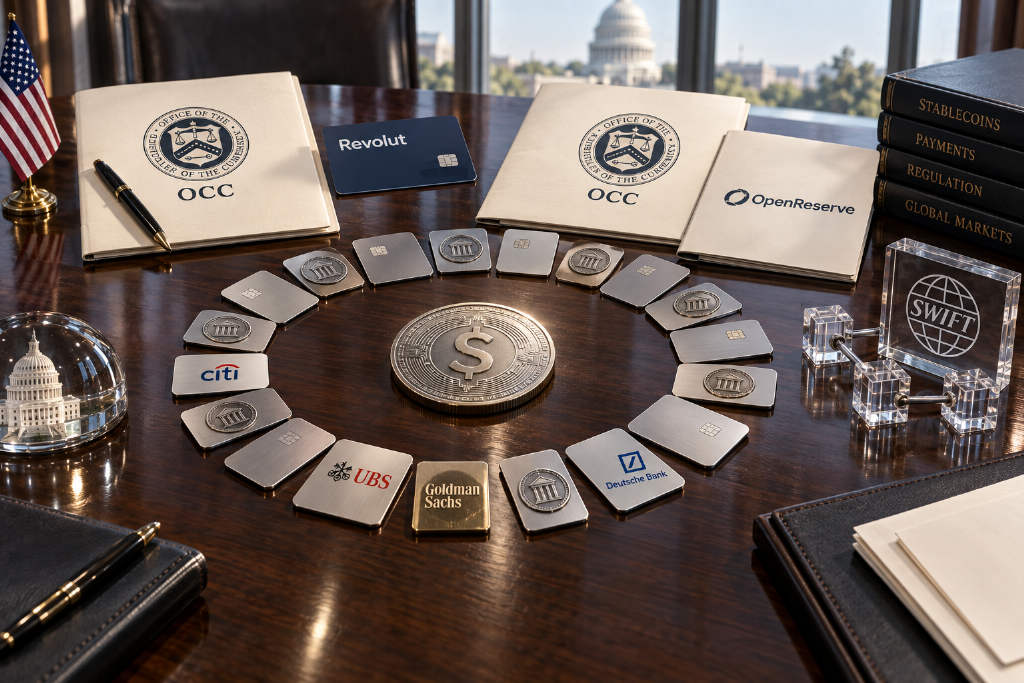
Global Payments Weekly W36: 21 Institutions Back Stablecoin Venture as OCC Issues Two Preliminary Bank Approvals

The global payments sector saw several major shifts during the week of Aug. 31 to Sept. 6, with stablecoins, bank charters, cross-border settlement rails and dealmaking all moving at once. A group of 21 financial institutions, including 17 global systemically important banks, said they would form a joint stablecoin company in the second half of 2026 and issue a U.S. dollar stablecoin in the first half of 2027, with a euro version to follow. In the U.S., the Office of the Comptroller of the Currency granted conditional preliminary approval on the same day to Revolut and Andreessen Horowitz-backed OpenReserve, and both outlined plans tied to issuing or distributing stablecoins. Bloomberg also reported that total stablecoin supply has fallen by roughly $15 billion from its mid-May peak, even as capital keeps flowing into payment and banking infrastructure. Elsewhere, Citi, FAB, OCBC and DBS completed live transactions on Swift’s blockchain-based shared ledger, including a weekend tokenized deposit payment from Singapore to New York that settled in minutes. The week’s developments pointed to a market where public-chain stablecoins, bank-led stablecoins and tokenized deposits are all competing for a larger role in payments and settlement.

3790
Global Payments Weekly W36: 21 Institutions Back Stablecoin Venture as OCC Issues Two Preliminary Bank Approvals
DBS
Sep 8, 2026

DBS and Citi’s New York office settle U.S.-Singapore dollar payment on Swift Digital Ledger

DBS and Citi’s New York office completed a U.S. dollar cross-border payment between Singapore and the United States on Sept. 5 using tokenized deposits through the Swift Digital Ledger. The transaction was carried out over the weekend and took only minutes, compared with traditional cross-border payments that can take up to two business days, reducing delays tied to time zones and weekends. Swift said this was the second confirmed real-time use case on the ledger after HSBC and Standard Chartered completed the first real-time tokenized deposit cross-border transaction in August. Swift had announced on July 9 that the ledger was available for initial use, with 17 banks preparing to pilot it. DBS is the only Asia-headquartered bank among the 12 members of the core design group. DBS COO Rachel Chew said the ledger links traditional banking infrastructure with emerging digital networks, while Citi South Asia Services Head Mridula Iyer said the weekend transaction showed that around-the-clock cross-border payments are now possible.

1780
DBS and Citi’s New York office settle U.S.-Singapore dollar payment on Swift Digital Ledger
Swift
Sep 8, 2026

DBS and Citi Complete Weekend Dollar Payment on Swift Ledger

DBS and Citigroup completed a U.S. dollar payment between Singapore and Citi’s New York office over the weekend of Sept. 5 using tokenized deposits on Swift’s blockchain-based Digital Ledger, DBS said. The transfer took minutes, extending the ledger’s live operation beyond standard banking hours. Swift says participating banks can move customer funds overnight and on weekends before final settlement runs through existing banking systems. The arrangement is aimed at giving corporate treasurers a way to shift liquidity across time zones without waiting through weekend gaps; DBS compared the test with an industry norm of up to two business days for cross-border payments. The blockchain does not replace the banks’ settlement infrastructure. It acts as a coordination layer for bank-issued tokenized deposits held on the participating banks’ own ledgers, while final settlement remains in existing systems. The transaction was the ledger’s second confirmed live use, after HSBC and Standard Chartered completed the first in August. Swift announced initial readiness on July 9, with 17 banks across six continents preparing pilots. DBS is the only Asian-headquartered bank in the ledger’s 12-bank core design group. The transaction value and broader client rollout timetable were not disclosed.

1330
DBS and Citi Complete Weekend Dollar Payment on Swift Ledger
DBS
Sep 7, 2026

DBS and Citi complete first weekend U.S. dollar cross-border payment using tokenized deposits

DBS said it completed the first weekend U.S. dollar payment between Singapore and the United States with Citibank’s New York branch on Sept. 5 through Swift’s Digital Ledger, with settlement carried out using tokenized deposits. According to DBS, the transfer was completed in minutes, while a conventional cross-border U.S. dollar payment can take as long as two business days. The test was designed to remove limits tied to banking hours, weekends and time-zone differences, allowing round-the-clock movement of funds across borders. DBS said possible use cases include cross-border e-commerce and digital services. Citi joined Swift’s 24/7 cross-border payments pilot based on tokenized deposits in July this year and plans to take part in building a U.S. tokenized deposit network. DBS, for its part, launched a blockchain-based banking system in 2024 that includes DBS Treasury Tokens for liquidity management.

1750
DBS and Citi complete first weekend U.S. dollar cross-border payment using tokenized deposits
Total 98 items
Go topage