Zcash2026-10-01 13:09:25Zcash integrates Udon into Zakura Common as it works toward 50,000 TPS private transactionsZcash developers have integrated Udon, a core component of the Project Tachyon scaling effort, into Zakura Common, a shared cryptographic library already used across the Zcash ecosystem. The move is aimed at supporting a long-term goal of handling more than 50,000 private transactions per second. Udon has been released as software, but the broader Tachyon upgrade is not live on the Zcash mainnet and is still subject to additional development and security review, making a near-term launch unlikely. According to the source report, Udon brings key Tachyon computation logic into Common early, allowing developers to build on code that has already been optimized. Earlier improvements to Common cut single private transaction creation time from more than three seconds to under 200 milliseconds. The report also says Tachyon is designed around aggregated proofs, which would let nodes validate many transactions through a single proof and reduce the amount of data they need to receive and check. That matters because, at 50,000 TPS, each Zcash node would otherwise need to handle more than 500 megabytes of data per second. On-chain figures cited from ZecStats show current private transaction activity remains far below that target, underscoring that Tachyon is being built for long-range capacity rather than short-term demand.30
Zcash2026-09-29 12:15:46Zcash developers fold Tachyon code into existing software as privacy scaling work advancesZcash developers are moving part of the proposed Tachyon scaling upgrade into software already used by the network, according to CoinDesk. The component, called Udon, was originally built as part of Project Tachyon and was released on Monday to Zakura Common, a shared cryptography library used by Zakura and other Zcash projects. Sean Bowe, who leads Project Tachyon, said the release is meant to prepare the system for a future with far more private transactions. Common handles some of the heavy mathematical work behind creating and verifying shielded payments. Zakura is being developed by Bowe’s team together with Dev Ojha’s Valar Group. CoinDesk noted that earlier improvements to Common had already reduced the time needed to create a private transaction from more than 3 seconds to under 200 milliseconds in some tests reported in August. Udon has been released as software, but the upgrade has not yet been activated on Zcash. Bowe and Ojha have set a long-term target of more than 50,000 payments per second. At that rate, they estimate current cryptography would cause each Zcash node to receive more than 500 MB of data every second.230
Instinct2026-09-29 06:57:55Instinct founder says user growth of 10% to 11% a day is pushing compute demand close to doubling weeklyInstinct founder Noah Shinn said the personal AI agent startup has been seeing user growth of roughly 10% to 11% per day in recent weeks, a pace that has pushed its compute needs close to doubling every week. He said around 40% of his time is now spent deciding how much capacity the company should buy in advance, because compute procurement cannot keep up in real time with user growth. Shinn laid out the trade-off in simple terms: buying 2x current capacity would last about a week, while 5x would be filled in less than three weeks. Buying 10x, on the other hand, would require a large upfront cost. He added that many resources must be reserved months ahead, and emergency capacity can cost 3x to 4x more. Even if daily growth slows from 10% to a range of 5% to 8%, Shinn estimated that after three to four months the company could still need to prepare compute for a user base on the scale of 100 million. He said the wait time for new capacity to come online is roughly in the same range. In his view, scaling a personal agent product is harder than scaling consumer internet apps such as Instagram or Facebook because each added user continuously consumes significant model inference.250
Instinct2026-09-29 04:55:29Instinct says 10% daily user growth is pushing compute demand close to doubling every weekInstinct founder Noah Shinn said the personal AI agent startup has been growing users by roughly 10% to 11% a day in recent weeks, a pace that is driving compute demand to nearly double every week. He said about 40% of his time now goes into deciding how much capacity to buy in advance, because compute cannot simply be added at the same speed users arrive. Shinn laid out the trade-off in blunt terms: buying 2x current capacity may last only about a week, while 5x capacity could still be filled in less than three weeks. Buying 10x capacity, on the other hand, means taking on a large cost upfront. He added that many resources must be booked months ahead, and spot purchases can cost 3x to 4x more. Even if daily growth slows from 10% to a range of 5% to 8%, Shinn estimates that after three to four months of continued expansion, Instinct may still need to provision for a user base of 100 million. That timeline, he said, overlaps with the waiting period needed for new capacity to come online. He argued the scaling problem is harder than it is for traditional consumer internet apps, because each new personal agent user continues to consume heavy model inference.250
Ethereum2026-09-22 07:14:09Vitalik outlines EIP-8288, shifting signature and proof aggregation into Ethereum’s mempoolVitalik Buterin used his ETHShanghai 2026 talk to lay out EIP-8288, a proposal he said could ease one of Ethereum’s hardest tradeoffs: scaling without giving up privacy or stronger cryptography. The design keeps large signatures and STARK proofs off-chain, then has mempool nodes aggregate them before block inclusion, so the chain only needs to verify a single proof for a batch of transactions. In Buterin’s framing, the proposal builds on EIP-8141, the native account abstraction upgrade expected in the next hard fork. Transactions would declare dependencies for signatures or proofs through compact frame structures, while the heavy cryptographic objects are absorbed and compressed in the mempool. He argued this could sharply reduce the cost of quantum-safe transactions, privacy-preserving applications, and proof publication for Layer 2 systems. Buterin also described the architecture as a form of specialized sharding for verification work, separating transaction business logic from expensive dependency checks. He said the approach could become one of Ethereum’s first practical paths for using RISC-V or a similar instruction set in proof expression, while early simulation tools, testnets, competitions, and prototype code are already under development around the proposal.440
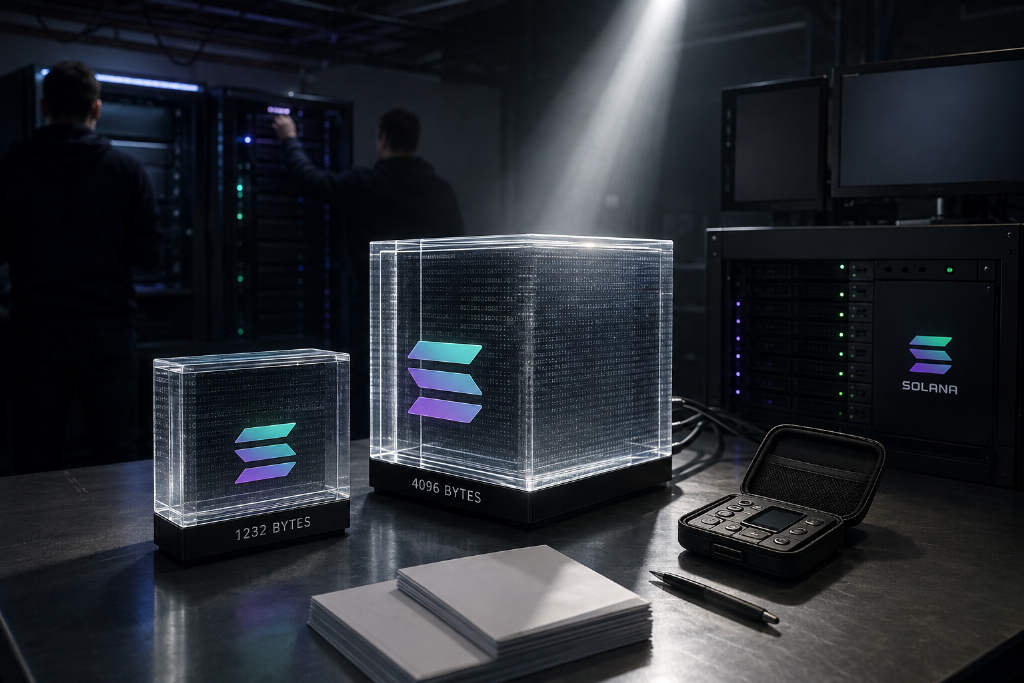
Solana2026-09-07 12:12:59Solana to Triple Transaction Byte Limit to 4,096, Closing Gap with EthereumSolana plans to increase the maximum transaction byte size from 1,232 to 4,096 bytes on Wednesday, enabling complex operations like multi-signature payments and confidential transfers to fit into a single transaction. The upgrade, running on testnet, does not require mandatory updates for wallets or apps. Services that read on-chain data must update to avoid failures. The change is defined by proposals SIMD-0296 and SIMD-0385 and is independent of recent SOL issuance adjustments.940
Long.xyz2026-09-07 01:53:30Long.xyz Co-founder: Continue RWA Pairings, Next Goal is Scaling Up to 100xIn a post on X, Long.xyz co-founder Nate declared that the platform will continue to develop assets and products centered around Robinhood Chain, maintaining a strict 'RWA pairings only' policy, which means exclusively focusing on pairing real-world assets. He argued that this model has the potential to create an entirely new asset class, effectively bridging the gap between on-chain digital assets and the physical world. Nate also highlighted the performance of tokens BONER and MEME, which experienced rapid growth immediately after their listing and have continued to develop further, with liquidity deepening over time. He believes that the RWA pairing model has been preliminarily validated, though it is still in its early stages. Looking ahead, the next phase for Long.xyz is to scale up significantly, aiming for a 100x increase.1180
stablecoin2026-09-06 15:04:26Stablecoin Scaling Requires Trusted, Regulated Infrastructure, Report SaysA new report highlights that the main bottleneck for stablecoin scaling is the lack of trusted, regulated infrastructure, and that banks and traditional financial institutions are essential to building it.660