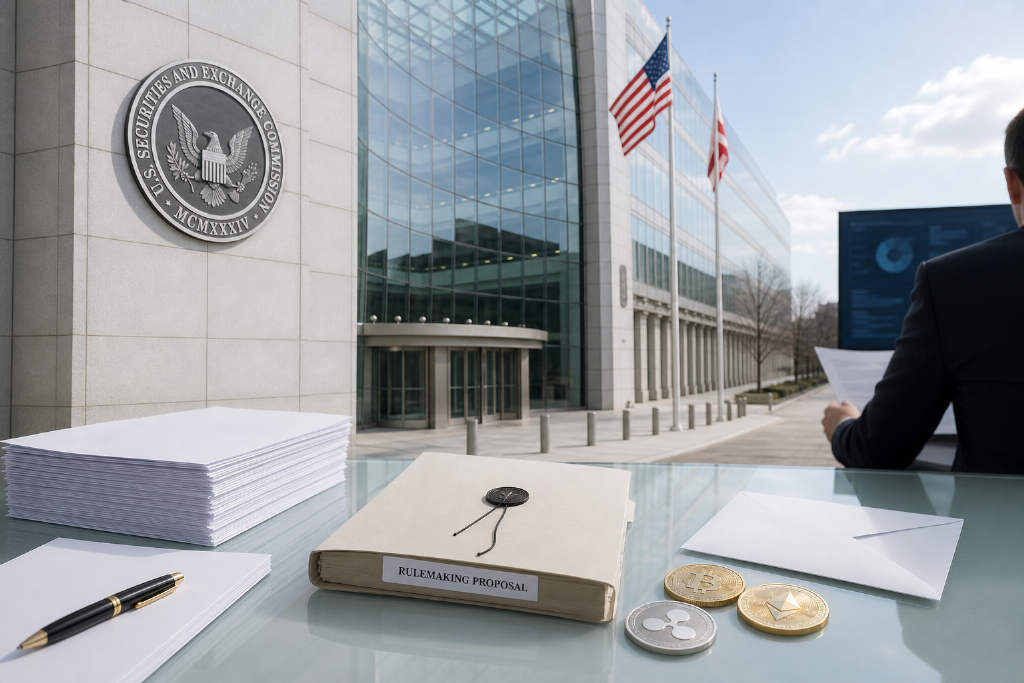
SEC2026-10-26 07:31:05SEC crypto rule closes comment period, putting a regulated ICO path in viewThe U.S. Securities and Exchange Commission’s proposed Regulation Crypto Assets has reached the end of its public comment period, closing on Oct. 20 after being introduced on Aug. 18, 2026. The proposal is designed to move token fundraising away from a system shaped largely by enforcement actions and toward a dedicated framework for public crypto offerings. Its core features include a startup exemption allowing up to $5 million over four years without an audit or licensed intermediary, two higher-tier exemptions capped at $20 million and $75 million annually, a Safe Harbor process that would let issuers file Form TR to end a token’s securities status after development commitments are completed or permanently abandoned, and partial federal preemption of state registration rules. Public feedback has been mixed but mostly reform-oriented rather than outright hostile. According to a public tracker built by BI Norwegian Business School researcher Mert Erinc, the SEC had received 171 comment letters by Oct. 20, with 165 coded. Of those, 8 were clearly supportive, 115 conditionally supportive, 14 opposed, 3 mixed, and 25 procedural or off-topic. The sharpest disputes center on four areas: fundraising caps, disclosure standards, insider resale restrictions, and the design of the Safe Harbor exit mechanism. The article argues that the rule has a relatively high chance of advancing after revisions, with the biggest implications being a legal route for token fundraising, a clearer process for exiting securities treatment, and a more unified federal-state regulatory boundary.50
Blockchain As2026-10-21 12:03:07Blockchain Association urges SEC to raise crypto startup exemption to $10 millionThe Blockchain Association has asked the U.S. Securities and Exchange Commission to expand key parts of its proposed crypto framework, backing Regulation Crypto Assets while calling for higher fundraising limits and clearer legal standards. In a comment letter cited by The Defiant, the trade group said the SEC should double both offering caps to $10 million. It also asked the agency to write Howey guidance directly into the rule, a move aimed at giving token issuers a clearer basis for assessing whether an asset falls under securities law. The letter included another request: allow third parties to file applications for tokens that are already trading. Taken together, the proposals focus on three areas in the draft regime — fundraising thresholds, legal clarity, and who can seek regulatory treatment for an existing token. The filing signals support for the broader Regulation Crypto Assets proposal, but with changes the association says would make the framework more workable for crypto startups and token markets.270
SEC2026-10-19 16:01:18Blockworks urges SEC to require token issuers to disclose market-maker deals and promoter paymentsBlockworks said it is submitting a comment letter on the U.S. Securities and Exchange Commission’s proposed Regulation Crypto Assets, asking the agency to require much more detailed disclosures from token projects raising money under the framework. As described by Blockworks in a briefing shared with Unchained before release, the requested changes would require issuers to spell out token loans and liquidity arrangements, agreements with exchanges and market makers, tokens paid to advisers or influencers, key wallet and contract addresses, and the methodology used to calculate supply. Blockworks also said it wants the SEC to recognize a new category called a Qualified Onchain Disclosure Agent, an independent provider that would pull visible onchain data, let projects complete the rest of the filing, and maintain a public searchable archive with dated versions. Two other requests cover tokens without a current filing: allowing exchanges or other third parties to prepare disclosures for projects that never filed, and allowing a third party to maintain a labeled record after a project shuts down or exits mandatory reporting. The SEC’s current draft is less specific and places the disclosure duty on the issuer. Comments on the proposal are due Oct. 20.420
Hyperliquid P2026-10-19 12:25:17HPC backs SEC crypto asset proposal and urges five changesHyperliquid Policy Center said it has submitted a comment letter to the U.S. Securities and Exchange Commission backing the agency’s proposed Regulation Crypto Assets and urging its adoption. The proposal, which the SEC put forward in August 2026, would let startup projects raise up to $5 million through token sales over four years and up to $75 million under a 12-month exempt offering framework. It would also create a new safe harbor to determine when a token is no longer tied to an investment contract. In its letter, HPC asked the SEC to make five changes before finalizing the rule. Those requests cover the treatment of airdrops, the legal status of secondary-market trading and on-chain protocol intermediaries, certification that a token was never linked to an investment contract, the handling of token buybacks, and continued federal preemption once a project satisfies safe harbor conditions. HPC said these revisions would give projects and market participants clearer rules while reducing the risk of overlapping registration requirements across more than 50 jurisdictions.270
SEC2026-08-21 14:45:05SEC proposes Reg Crypto to create legal path for some token offerings and investment contract exitsThe U.S. Securities and Exchange Commission proposed Regulation Crypto Assets, or Reg Crypto, on Aug. 18, according to a post on X by Galaxy Head of Research Alex Thorn. The proposal is designed to create a lawful route for some token issuers to sell crypto assets to the U.S. public and to establish a mechanism for ending the securities-law treatment tied to certain investment contracts. The framework applies only to crypto assets that are not securities in themselves but were previously offered or sold as part of an investment contract. Tokenized stocks and bonds, as well as structures that bundle tokens with equity or other securities, are outside the proposal’s scope. Reg Crypto sets out four stages: fundraising, disclosure, development, and exit. It includes a one-time startup exemption allowing up to $5 million to be raised over as long as four years, plus a higher-tier exemption modeled on Regulation A that would allow raises of $20 million or $75 million in a 12-month period. The SEC would review issuer eligibility, ongoing disclosures would be required, and non-accredited investors would be capped at 10% of the higher of annual income or net worth. The SEC estimates roughly 475 issuers a year would use the investment contract safe harbor, while about 130 would rely on the two new exemptions.1510
SEC2026-08-20 02:08:38SEC Crypto Assets Proposal Would Ease Registration, Not OversightThe U.S. Securities and Exchange Commission’s Aug. 18 Regulation Crypto Assets proposal has triggered a wave of excitement in crypto circles, with some reading it as a green light for token issuers to raise money in the U.S. without dealing with securities regulation. That is only partly correct. The proposal creates a tailored exemption framework for crypto asset offerings inside the existing U.S. securities regime, but it does not remove SEC oversight or anti-fraud enforcement. At the center of the draft are two fundraising exemptions, a safe harbor that could let a token stop being treated as a security once core development work is completed or permanently halted, and federal preemption over state-level registration requirements. The proposal sets a $5 million cap over four years for an early-stage exemption and a $75 million cap in a 12-month period for a larger fundraising exemption that comes with audited financials and ongoing reporting. The rule is still only a proposal. Its fate will depend on a 60-day public comment period, a procedural Senate vote on the CLARITY Act scheduled for Sept. 15, 2026, and the possibility of legal challenges from Wall Street groups such as SIFMA. For crypto projects, the draft offers a clearer path than the current case-by-case uncertainty, but it also comes with legal, audit and compliance costs that the source estimates could run from hundreds of thousands of dollars to more than $1 million.1270
SEC2026-08-18 19:46:11SEC Unveils Crypto Offering Framework as Clarity Act Vote SlipsThe U.S. Securities and Exchange Commission has proposed a new framework for crypto asset offerings, moving ahead with agency rulemaking while Congress remains stuck on broader legislation. The proposal, called Regulation Crypto Assets, is designed to give token issuers a path to raise funds in the United States without violating securities laws. It creates two exemptions under the Securities Act of 1933: a one-time exemption for up to $5 million raised over four years, and another for up to $75 million in any 12-month period, with the larger route requiring financial statements and ongoing reporting. Both exemptions would require narrative disclosures describing the business and its risks. The proposal also includes a conditional safe harbor. Under that approach, once an issuer completes — or permanently abandons — the managerial work it promised, the token would no longer be treated as subject to an investment contract and would fall outside the definition of a security. SEC Chairman Paul Atkins said the move would help bring crypto market innovation onshore and give entrepreneurs clearer fundraising routes while Congress works on a lasting framework. Meanwhile, the Clarity Act, which some pro-crypto lawmakers had hoped to pass before the August recess, has been pushed to September after Democrats objected to the latest draft.1220
IAO2026-07-23 15:55:16What Is IAO? How AI Agent Token Offerings Work and Where the Risks LieIAO is a Web3 fundraising model built for AI agents, letting users gain shared ownership through agent tokens. Its structure, participation steps, and regulatory, technical, and market risks are central to understanding the model.540