‹ BackUS bank

US bank

US Treasury
2026-09-11 04:53:26

Bessent says US will sanction a major bank on Monday as Treasury tightens Iran licensing policy

US Treasury Secretary Scott Bessent said on Sept. 10 that Washington will sanction “a major bank” next Monday, but he did not identify the institution or say where it is based. Speaking on Real America’s Voice, Bessent said, “We’re going to act on Monday, because we want to commemorate our fellow citizens lost on 9/11. Watch this space on Monday,” according to CNBC. The comment came the same day the Treasury Department’s Office of Foreign Assets Control, or OFAC, issued a new Iran-related licensing policy that shifts to a presumption of denial. OFAC said exceptions would be limited to cases required by law or involving life, personal safety, or environmental safety, and that it had already begun denying the vast majority of pending Iran-related specific license applications. Treasury’s announcement also disclosed an enforcement settlement in which one individual agreed to pay $1,427,230 to resolve potential civil liability tied to management consulting and advisory services provided to a major Iranian software company, transfers of Iran-sourced dividends into a US bank account, and the purchase of real estate in Iran. OFAC said the conduct was egregious and was not voluntarily self-disclosed. Bessent linked the broader push to “Operation Economic Outcast,” launched on Aug. 24, 2026.


710
Bessent says US will sanction a major bank on Monday as Treasury tightens Iran licensing policy
Citi
2026-09-07 10:34:47

Citi and DBS complete first weekend tokenized cross-border deposit transfer on Swift

Citi and DBS have completed their first weekend tokenized cross-border payment between Singapore and the United States, using tokenized deposits on Swift Digital Ledger to get around the limits of traditional banking hours. DBS said the transfer was settled in minutes, compared with the industry norm of as long as two business days for conventional cross-border transactions. The deal adds to a growing list of bank experiments with blockchain-based settlement rails designed to improve payment speed while keeping deposits within the banking system. Swift said in July that its blockchain-based ledger was ready for initial use and that it was preparing tokenized cross-border payment pilots with 17 major banks, including Citi, DBS, HSBC, BNP Paribas, UBS, ANZ and Standard Chartered. Citi is also part of a separate effort by major US banks to launch a tokenized deposit network in the first half of 2027 through The Clearing House. Earlier, in November 2025, DBS and JPMorgan said they planned to build a blockchain tokenization framework for onchain transfers between their deposit token ecosystems.

250
Citi and DBS complete first weekend tokenized cross-border deposit transfer on Swift
tokenized dep
2026-08-29 10:44:06

Tokenized Deposits Could Cut US Bank Lending by $580 Billion

A research paper published August 25 warns that widespread adoption of tokenized deposits could reduce US bank lending capacity by $580 billion, roughly 5% of total bank loans. Instant on-chain transfers erode deposit stability under fractional reserve banking, forcing banks to hold more liquidity and lend less. LayerZero and Keeta launched tokenized deposit products covering nine fiat currencies in July 2026, while the Bank of England and South Korea have signaled support.

810
Tokenized Deposits Could Cut US Bank Lending by $580 Billion
US banking re
2026-08-28 10:07:15

US Bank Regulators Plan to Narrow Enforcement Focus to Financial Risk

US banking regulators plan to narrow their enforcement focus to financial risk, according to the Financial Times. Techub News carried the report. The shift is described as a move to direct enforcement resources toward core financial stability issues. No implementation timetable was disclosed. No specific regulatory agency names were disclosed. The report thus says little about how the narrower focus would work, where it would be applied, or what would be downplayed. The Financial Times is the named source behind the report; Techub News summarized the item. The confirmed facts are limited to the intended direction: enforcement attention is to be narrowed to financial risk, and resources are to be concentrated on financial stability. Beyond that, the report does not supply timing or agency details. It functions as a brief supervisory-policy update rather than a detailed program announcement. The summarized version contains no added data, quotes, or market references. That leaves the scope of the change open, with the only concrete takeaway being the reported plan itself: banking regulators intend to shift enforcement priorities toward financial risk and core financial stability. The item ends without additional context or follow-up details.

730
US Bank Regulators Plan to Narrow Enforcement Focus to Financial Risk
tokenized dep
2026-08-28 07:06:28

Report says tokenized deposits could cut U.S. banks' lending capacity by $580 billion

A research report released on Aug. 25 said widespread adoption of tokenized deposits could materially reduce the long-term lending capacity of U.S. banks, with the estimated impact reaching about $580 billion. The report argues that tokenized deposits allow funds to move on a near real-time basis, which may weaken deposit stability across the banking system. That shift, in turn, could affect banks' ability to extend long-term credit. The potential effect has drawn attention from regulators and the banking industry, which are increasingly watching the risks tied to emerging financial technologies. The item was cited by Techub News and attributed to Crypto.news.

730
Report says tokenized deposits could cut U.S. banks' lending capacity by $580 billion
Policy and Re
2026-08-26 11:50:45

Dallas Fed economists say tokenized deposits could curb US banks’ capacity for long-term rate risk

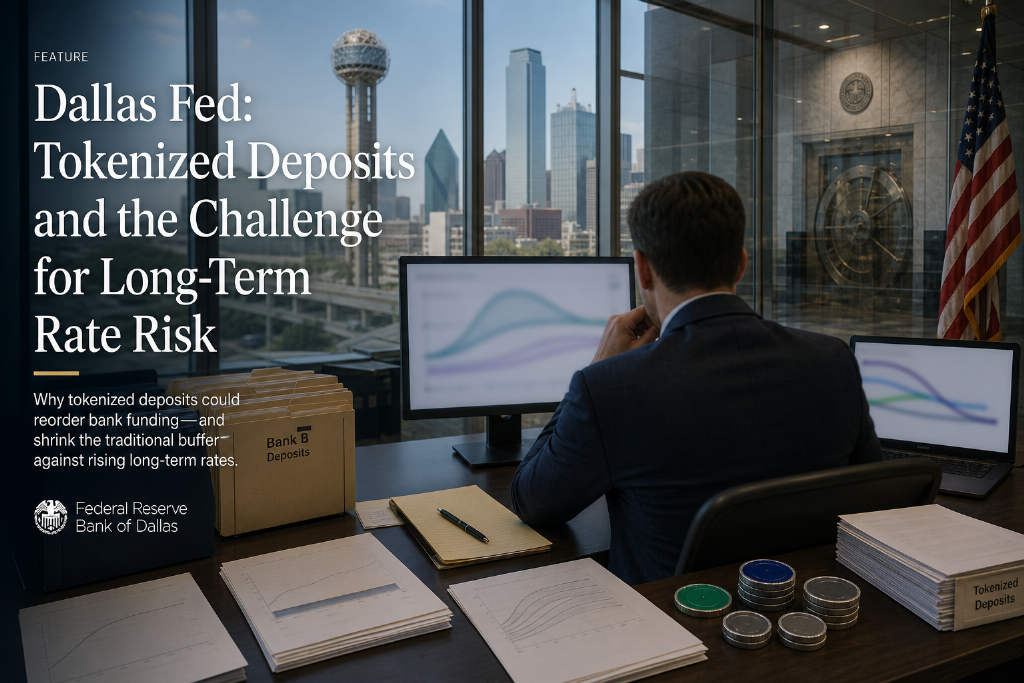
CoinDesk reported that two economists at the Federal Reserve Bank of Dallas modeled how tokenized deposits could affect US banks’ ability to absorb long-term interest-rate risk. In one scenario, if tokenized deposits make depositors 10% more sensitive to interest rates, US banks’ capacity to hold long-term rate risk could fall by about $700 billion. In a second scenario, if tokenization causes 10% of deposits to leave banks earlier, banks’ capacity to absorb interest-rate risk tied to long-term loans and securities could drop by about $580 billion. The estimates outline how changes in depositor behavior, rather than a direct balance-sheet shock alone, may alter banks’ role in carrying duration risk.

750
Dallas Fed economists say tokenized deposits could curb US banks’ capacity for long-term rate risk
tokenized dep
2026-08-26 11:53:10

Dallas Fed economists say tokenized deposits could weaken US banks’ capacity to absorb rate risk

Economists Rosie Levy and Srini Ramaswamy at the Federal Reserve Bank of Dallas estimate that tokenized deposits could materially reduce how much long-term interest rate risk US banks can bear under two stress assumptions. In their estimate, a 10% increase in depositor sensitivity to interest rates could reduce that capacity by about $700 billion. If tokenization were to trigger a 10% early outflow of deposits, banks would lose roughly $580 billion of risk absorption capacity. The analysis describes tokenized deposits as commercial bank money placed on blockchain rails, enabling programmable payments and real-time settlement. At the same time, the economists say smart contracts and AI agents could automate deposit shifts, cutting into deposit stickiness. They add that banks could respond by raising deposit rates, holding more reserves and Treasuries, or relying more on term debt, though those adjustments may increase borrowing costs for households and businesses. The piece also points to research on Brazil’s Pix instant payment network, which found that more frequent use was associated with higher bank holdings of liquid assets such as government bonds and less credit intermediation. Tokenized deposits remain at an early stage, with The Clearing House, Bank of America, Citigroup, and Wells Fargo among those developing interoperable networks for interbank clearing, automated workflows, and 24/7 settlement.

810
Dallas Fed economists say tokenized deposits could weaken US banks’ capacity to absorb rate risk
US banking
2026-08-26 05:03:37

39 U.S. state banking associations back BankChain Alliance, targeting a 2027 launch

A group of U.S. state banking associations is moving to build its own blockchain network rather than rely on outside public chains as competition from stablecoins and blockchain-based payment rails grows. According to a CoinDesk report dated Aug. 25, the initiative, called BankChain Alliance, is being formed as a nationwide blockchain network owned, governed, and operated by the banking industry itself. The effort has already drawn participation from banking associations in 39 states. It is being led by Kathy Kraninger, chief executive of the Florida Bankers Association and a former federal regulatory official. The network is intended to function within existing bank security and regulatory standards, bringing blockchain-based capabilities into the regulated banking system instead of placing assets onto external public blockchains. Its planned use cases include smart payments, tokenized deposits, stablecoins, and automated settlement. The report said the banking industry’s aim is to keep payment and deposit activity inside the banking system rather than cede that ground to externally issued stablecoins. The alliance has not yet selected a technology partner to build the network, leaving work still to be done before its 2027 target.

300
39 U.S. state banking associations back BankChain Alliance, targeting a 2027 launch