YCC

US Treasury
2026-08-21 10:00:00

Treasury buyback move revives debate over a "Bessent Put," but QE still looks far off

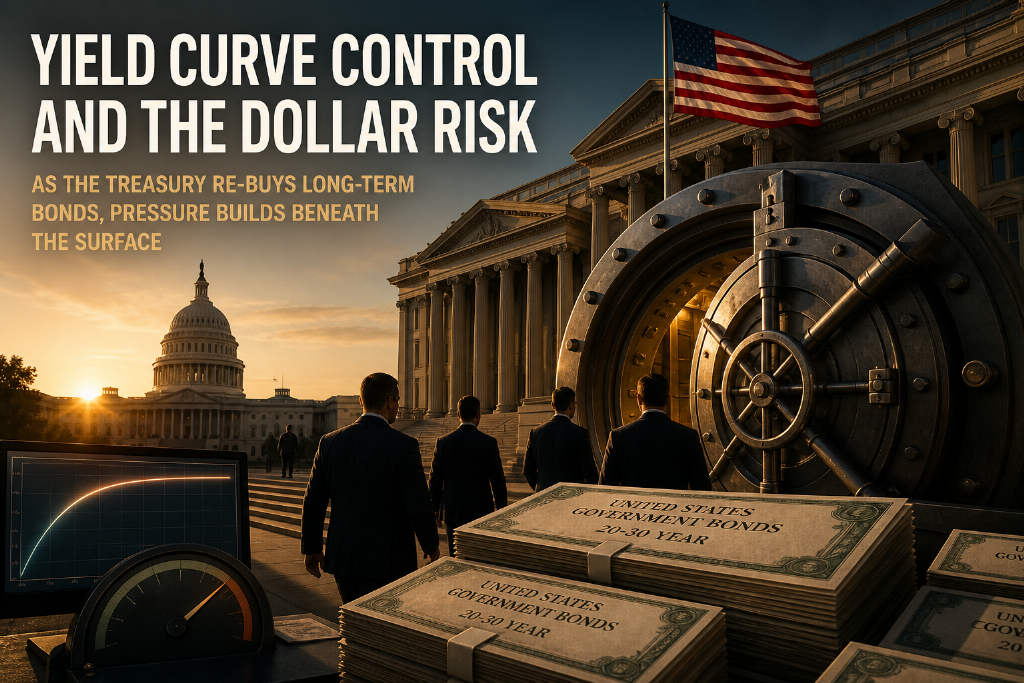
The U.S. Treasury’s decision to raise the size of its liquidity-support buybacks for longer-dated Treasuries has triggered a fresh round of debate over whether Washington is becoming less willing to tolerate sharply higher long-end yields. On Aug. 19, the Treasury said it would increase single-operation buybacks for 10-20 year and 20-30 year nominal coupon securities from a maximum of $2 billion to at least $4 billion, with the new arrangement taking effect on Sept. 9. The move came after 30-year Treasury yields briefly climbed to about 5.34%, a level not seen since 2007, before easing after the announcement. The discussion is centered less on the size of the buyback than on the timing. The change arrived roughly two weeks after the latest Quarterly Refunding Announcement rather than through the usual debt-management window, prompting investors to ask whether Treasury Secretary Bessent is signaling a lower tolerance for disorder in the long-bond market. The Heisenberg Report, citing Nomura cross-asset strategist Charlie McElligott and Rabobank strategist Michael Every, frames that idea as a market-created "Bessent Put" rather than an official policy guarantee. The article argues that buybacks are not the same as quantitative easing. Treasury operations are debt-management tools, while QE is a Federal Reserve balance-sheet expansion. It also says any move toward yield curve control or large-scale asset purchases would require much worse market and economic conditions than those seen so far.

40
Treasury buyback move revives debate over a "Bessent Put," but QE still looks far off
Bitcoin
2026-08-21 09:17:15

Treasury’s Latest Move Isn’t QE or YCC, but Bitcoin Is Still Surging

CoinDesk says the latest rally in hard assets is not necessarily about what the U.S. Treasury is doing. The bigger driver, the piece argues, is the signal that move sends to markets. The article does not spell out the Treasury measure itself, and it does not provide price details beyond saying bitcoin is skyrocketing. It also frames the move as something other than quantitative easing or yield curve control. In short, the market is reacting to the message, not just the policy action.

40
Treasury’s Latest Move Isn’t QE or YCC, but Bitcoin Is Still Surging
TS Lombard
2026-08-20 13:10:52

TS Lombard says U.S. long-bond buybacks resemble yield curve control and could pressure the dollar

TS Lombard said the U.S. Treasury’s move to buy back ultra-long government bonds "sounds a lot like" yield curve control, arguing that efforts to hold yields down by intervention could weaken the U.S. dollar. In a report, chief economist Freya Beamish said the United States is running procyclical fiscal policy and, in her view, interest rates should be rising, a setup that would normally support the dollar. She said long-term bond investors want compensation, while the Treasury is intervening to suppress yields and further shorten debt duration even though the average maturity of debt is already relatively short. Beamish said the main question is how markets ultimately push back: by keeping pressure on long-end yields and forcing the Federal Reserve to act sooner than currently expected, or by selling the dollar instead. She added that the Fed will eventually raise rates.

50
TS Lombard says U.S. long-bond buybacks resemble yield curve control and could pressure the dollar
Arthur Hayes
2026-08-12 06:38:45

Arthur Hayes ties yen stress, Fed FIMA facility and Bitcoin upside, with an unexpected nod to Taiwan

BitMEX co-founder Arthur Hayes used his latest essay, "Yen-quake," published on Aug. 11, to argue that the long era of cheap yen may be nearing an end and that any U.S.-Japan effort to support the currency through the Federal Reserve’s FIMA Repo Facility could amount to a fresh channel for dollar liquidity. In his view, that matters well beyond foreign exchange: if Japan can obtain dollars by posting U.S. Treasuries to the Fed instead of selling those bonds outright, the result could support the yen without forcing heavy liquidation of U.S. assets, while also expanding the Fed’s balance sheet in practice. Hayes says that kind of liquidity backdrop has historically favored scarce assets such as Bitcoin and gold. The essay also opened with an unexpected Taiwan reference. Recalling the 2011 earthquake in Japan, Hayes wrote that one question on his mind at the time was whether he could physically handle another run of Taiwan’s Spring Scream festival in Kenting, later adding in a footnote: "This is the most underrated music festival in Asia, I fucking love Taiwan." He said he is currently adding exposure to Bitcoin, physical gold, gold miners and ETH, while describing Ethena’s ENA as a higher-risk, higher-upside trade tied to the liquidity thesis.

610
Arthur Hayes ties yen stress, Fed FIMA facility and Bitcoin upside, with an unexpected nod to Taiwan
JPY
2026-07-23 14:50:16

Japanese Yen Hits 2-Month High as Intervention Talk Rattles Currency Markets

The yen surged to a two-month high against the U.S. dollar amid rising expectations of coordinated FX intervention by U.S. and Japanese authorities. The New York Fed conducted a yen rate check, widely seen as a precursor to action, while the BOJ held rates at 0.75% with dovish guidance.

220
Japanese Yen Hits 2-Month High as Intervention Talk Rattles Currency Markets