QNT
Sep 28, 2026

QNT jumps about 158% in a week as bank tokenized deposit narrative fuels attention

QNT has become a closely watched token after market discussions linked its rally to Quant’s reported role in a tokenized bank deposit network. According to the cited discussion, The Clearing House selected Quant to provide technical support for the network, with Quant serving as the interoperability and orchestration layer. The same discussion said the network has backing from 25 large U.S. banks, while seven banks in the U.K., including HSBC, Barclays and Standard Chartered, were said to have already completed real tokenized deposit transactions through Quant. The market read those developments as a sign that demand for putting traditional financial assets on-chain is moving from narrative to implementation. QNT was said to have risen about 158% over the past week, with the price at one point moving from around $70 to near $370. Some observers argued Quant’s value proposition is tied less to public-chain traffic and more to middleware and interoperability for bank-to-bank asset tokenization. Others said the move was amplified by an institutional narrative and a liquidity vacuum, while warning that the sharp pullback has made chasing the rally notably riskier.


1390
QNT jumps about 158% in a week as bank tokenized deposit narrative fuels attention
Policy and Regulation
Sep 27, 2026

Taiwan banks’ first-half offshore profit hits NT$85.754 billion, a record for the period

Taiwan’s domestic banks posted NT$85.754 billion in combined after-tax profit from Offshore Banking Units and overseas branches in the first half of the year, according to the central bank’s latest statistics cited by ABMedia. That marked a 14.8% increase from a year earlier, the first time the total has moved above NT$80 billion, and a record for the same period. Second-quarter after-tax profit came in at about NT$44.3 billion, keeping the figure above NT$40 billion for a second straight quarter. ABMedia said that trend was supported by supply-chain realignment, faster overseas expansion by Taiwanese businesses, and stronger demand for cross-border capital and financial services under the government’s push to build an Asian asset management center. Among individual lenders, the top five profit contributors were all banks under private financial holding groups: CTBC Bank, Taipei Fubon Bank, E.SUN Bank, SinoPac Bank, and Cathay United Bank. Their combined after-tax profit reached NT$47.74 billion, accounting for 55.7% of the total. CTBC Bank led with NT$19.885 billion, followed by Taipei Fubon Bank with NT$10.05 billion. They were the only two banks whose first-half offshore profit topped NT$10 billion.

1030
Taiwan banks’ first-half offshore profit hits NT$85.754 billion, a record for the period
Germany
Sep 26, 2026

German bank union seeks AI relief days in private banking labor talks

Germany’s bank employees’ union DBV plans to push for "AI relief days" in upcoming labor talks with private-sector bank employers, arguing that artificial intelligence and automation have intensified work in some departments rather than eased it. Under the proposal, staff in units where workloads are formally found to have increased because of AI-related changes could receive 1 to 3 extra days off per quarter, or as many as 12 days a year. The first round of talks is scheduled for Oct. 8 in Berlin and covers roughly 150,000 workers in the private banking sector. Employer group AGV Banken has rejected the idea, saying it would raise labor costs at a time when automation is already eliminating some jobs. The union is also seeking a 9.5% pay increase from Oct. 1 under a 24-month contract, along with higher apprentice pay, the option to buy extra vacation days, and a transition model for older employees with reduced working hours and a monthly knowledge-transfer bonus.

1400
German bank union seeks AI relief days in private banking labor talks
Federal Reserve
Sep 25, 2026

Sources say Federal Reserve plans to raise asset thresholds for tougher bank oversight

The Federal Reserve is preparing a plan to raise the asset thresholds that trigger tougher oversight for large banks, according to four people familiar with the matter cited by BlockBeats. The move would ease costly additional compliance burdens for some lenders and could also encourage consolidation across the banking sector. Sources said the Fed is expected to soon propose recalibrating the thresholds tied to balance-sheet stress tests, liquidity, capital and other stricter regulatory requirements, with the changes intended to reflect inflation and economic growth. Three of the four sources said the proposal is expected later this year. Under current rules, regulatory requirements become more stringent once a bank reaches $100 billion in assets, and tighten again at $250 billion and $700 billion. Lenders have argued that those thresholds, set in 2019, have not kept pace with economic expansion and have subjected banks to increasingly strict requirements beyond the risks they actually pose.

870
Sources say Federal Reserve plans to raise asset thresholds for tougher bank oversight
Federal Reserve
Sep 25, 2026

Fed Proposes Stablecoin Capital Rules and Treats Some Yield Arrangements as Presumptively Prohibited

The Federal Reserve Board on Thursday released two proposals tied to the GENIUS Act, laying out reserve, capital and risk-management standards for stablecoin issuers under its supervision and a separate application process for state member banks seeking to issue stablecoins through subsidiaries. Under the proposal, issuers would have to maintain reserves equal to at least the par value of outstanding tokens at all times, using a limited set of eligible assets that includes cash, Federal Reserve balances, demand deposits, short-dated Treasuries, certain overnight repo and reverse repo positions, funds invested only in those assets, and some tokenized versions of them. Redemptions would generally need to be completed within two business days unless a safe harbor applies. The proposal also sets tiered operational-risk capital charges, adds a second capital requirement tied to non-reserve revenue, and imposes a separate 2% requirement on reserves held as uninsured deposits or undercollateralized reverse repos. In a separate section, the Fed said it would presume an issuer is paying prohibited yield if it pays an affiliate or related third party that then passes yield on to stablecoin holders, though issuers could challenge that presumption in writing. Governor Michael Barr backed the proposal but raised concerns about how one anti-money-laundering provision is framed in the statute.

800
Fed Proposes Stablecoin Capital Rules and Treats Some Yield Arrangements as Presumptively Prohibited
Tether
Sep 25, 2026

Tether says assets held at EQIBank made up less than 0.034% of group total

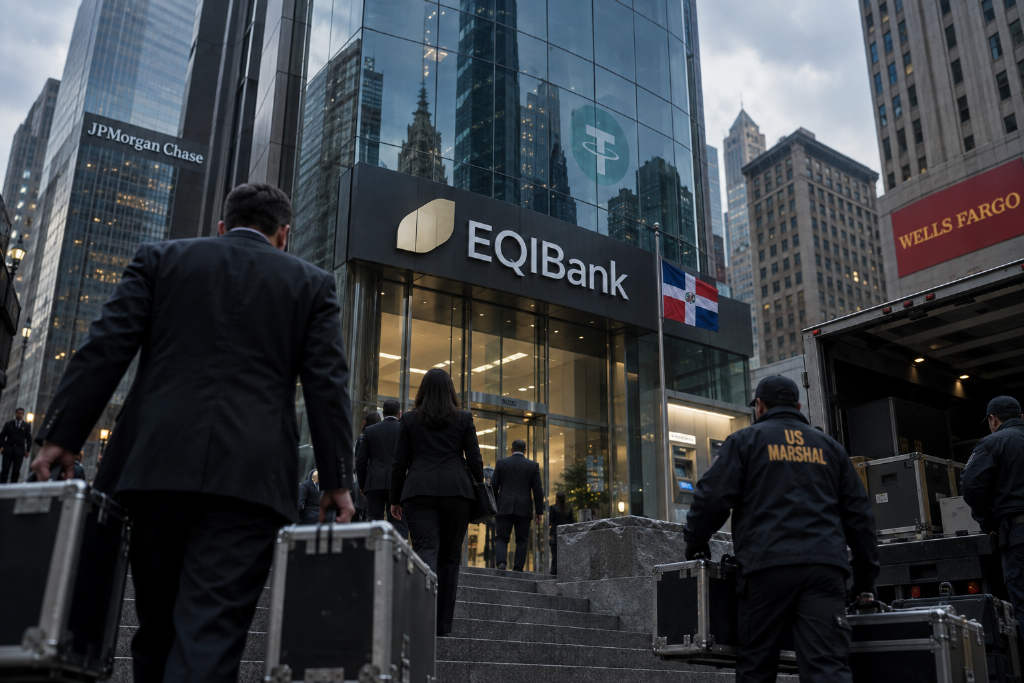
Tether said assets it held at Dominica-licensed digital bank EQIBank accounted for less than 0.034% of the group’s total assets, according to a CoinDesk report. Based on Tether’s June disclosure of $187.75 billion in total group assets, the company’s exposure would be capped at roughly $64 million, though it did not disclose the exact amount. The report said EQIBank used U.S. payments processor Capstone to handle client funds, with transfers moving through accounts at Wells Fargo and JPMorgan Chase. U.S. prosecutors have seized funds tied to those Capstone accounts and filed a civil forfeiture case, alleging the processor misrepresented its business to banks. EQIBank said about $89 million had been seized, equal to around 80% of its monetary assets, a situation that could leave the bank facing liquidation risk. EQIBank previously provided banking services to Tether, including wire transfers tied to USDT purchases and redemptions. Tether said it was not aware of the Capstone-related conduct described by the U.S. Department of Justice.

860
Tether says assets held at EQIBank made up less than 0.034% of group total
Societe Generale
Sep 21, 2026

Societe Generale targets hundreds of millions of euros in savings with AI by 2029

Societe Generale has outlined a broad plan running through 2029 that aims to cut operating costs by hundreds of millions of euros through artificial intelligence. The bank said the AI-led cost reduction effort is intended to reshape efficiency across its operations, putting automation and process changes at the center of the program. At the same time, it flagged two constraints that will shape execution: how much of the savings should be reinvested, and how well employees can adapt to the shift. The update was cited by Techub News, which referenced Crypto Briefing. No further financial breakdown, implementation timeline within the plan, or business-line details were disclosed in the brief.

680
Societe Generale targets hundreds of millions of euros in savings with AI by 2029
Citigroup
Sep 20, 2026

Citigroup CEO Jane Fraser warns AI is raising cybersecurity risks in banking

Citigroup Chief Executive Officer Jane Fraser warned that artificial intelligence is acting as both a tool and a threat in the banking sector, increasing cybersecurity risks for financial institutions. Fraser said the rise of AI is also speeding up regulatory scrutiny, putting more pressure on banks to reassess how they handle risk. According to the brief item cited by Techub and sourced to Crypto Briefing, Fraser’s remarks frame AI as a force reshaping two core areas at once: risk management and investment strategy. Her comments point to a banking environment in which firms are not only adopting AI-driven tools, but also facing a broader set of security and compliance challenges tied to that adoption. The report did not provide additional details on where Fraser made the remarks or which specific regulatory measures or investment changes she was referring to.

970
Citigroup CEO Jane Fraser warns AI is raising cybersecurity risks in banking
Total 146 items
Go topage