GEODNET2026-10-02 15:05:16GEODNET says it is building a positioning layer for physical AI, with Q3 revenue estimated at $2.8 millionDecentralized physical infrastructure network GEODNET is building what it describes as a positioning layer for physical AI, according to Techub News. The network’s correction data delivers centimeter-level accuracy for drones, agricultural machinery, and surveying equipment, drawing on roughly 22,000 base stations deployed by operators across 174 countries. As of August, GEODNET had more than 150 enterprise customers, while its hardware and software partners continued to expand service coverage. The company said positioning remains an ongoing need for these customers, with most spending recurring in nature. GEODNET estimated third-quarter revenue at $2.8 million, more than double the $1.2 million recorded in the same period last year. Delphi Digital said the growth of physical AI is expected to put more robots, agricultural equipment, and drones to work outdoors, where precise positioning is critical to their operation.20
Deutsche Bank2026-09-28 06:45:25Deutsche Bank says tech rotation still has room as positioning remains below June peakDeutsche Bank said in a Sept. 25 investor positioning and flow report that the tech rotation still has room to run, even after a 14% gain since late July and a fresh record high. Over the same period, the rest of the S&P 500 fell 3%, underscoring a sharp split inside the broader market. The bank’s main argument rests on positioning. Tech exposure is elevated at 0.8 standard deviations, or the 80th percentile, but still well below the early-June peak near 2 standard deviations and the 99th percentile. Chief strategist Binky Chadha said aggregate large-cap positioning sits at the 79th percentile, systematic strategies have climbed to the 91st percentile, while discretionary investors remain at the 64th percentile despite strong earnings growth. Deutsche Bank identified rate volatility as the key variable for further buying. It said discretionary positioning has a negative 89% correlation with the MOVE Index, and argued that falling rate volatility would be the condition for renewed additions. The report also showed a split in fund flows through the week ended Sept. 23, with $10.2 billion leaving equity funds, $17.3 billion entering bond funds, and $11.6 billion flowing into money market funds. Deutsche Bank kept its 2026 S&P 500 target at 8,000, with EPS forecasts of $358 for 2026 and $420 for 2027.200
Bitcoin2026-09-26 13:57:08Benson Sun says Bitcoin may climb in a slow bull cycle, with institutional divergence as a key warning signCrypto KOL and former FTX community partner Benson Sun said he expects Bitcoin to post a slower, step-by-step bull run in this cycle rather than a sharp blow-off top like those seen in 2013 and 2017. In his view, the market may show several local topping signals before a true cycle peak arrives. Sun argued that since 2021, the main source of BTC demand has been shifting away from retail investors toward institutions such as public companies, spot ETF buyers, and corporate treasuries. Because these players mainly buy spot, while some capital also runs delta-neutral arbitrage strategies, traditional cycle-top indicators such as funding rates and the MVRV Z-Score may not return to past extremes. He said a more likely topping pattern in the current market would be fading institutional follow-through rather than fully overheated retail sentiment. To track that, he uses an Institutional Liquidity Index, or ILI, which references overall U.S. dollar liquidity, Strategy’s mNAV, and net Bitcoin ETF flows. A yellow divergence appears when BTC makes a rolling 30-day high without a corresponding rise in ILI. A red divergence appears when BTC breaks an all-time high while ILI diverges and stays below 50. Sun said he uses repeated yellow divergences to reduce altcoin exposure and leverage, then raise BTC allocation over time. If a red divergence appears, he said he would stop participating.260
Jiang Zhuoer2026-09-12 16:25:03Jiang Zhuoer lays out BTC path toward $76K liquidation zone, keeps neutral positionJiang Zhuoer, founder of mining pool B.TOP, said Bitcoin’s most likely near-term path is a move higher to sweep the $76,000 upper liquidation zone, with Ether testing liquidation around $2,665 at the same time. He outlined two scenarios after that level is cleared. In the first, BTC finds support before falling below $75,000, rebounds, and is then more likely to retake $80,000 and possibly test the heavy resistance area at $83,000 to $84,000 before a larger pullback begins. In the second, a confirmed break below $75,000 would trigger a pullback corresponding to the earlier rise from $64,000, with a projected move to $70,000-$72,000 before the next phase of the bull market. Jiang added that next week’s bill vote and Federal Reserve news could act as key catalysts. Based on that view, he said he is maintaining a neutral position made up of a full BTC short and a full ETH spot holding.730
whale2026-08-27 01:48:44Whale flips from short to long on BTC with a $43.72 million leveraged positionOn Aug. 27, BlockBeats reported that on-chain analyst Ai Yi (@ai_9684xtpa) tracked a whale address, 0x604…0b21d, that has reversed its Bitcoin trading direction. The address had previously opened a $45.17 million BTC short between Aug. 24 and Aug. 25, then exited the trade with a loss of $831,000. Earlier on Aug. 27, the same address switched to a long position. The whale opened a 12x leveraged long for 554.71 BTC, with the position valued at about $43.72 million. According to the monitoring data cited by BlockBeats, that makes it the eighth-largest BTC position on Hyperliquid at the time of reporting. The reported entry price for the long was $80,140.6. The position was already under water when the update was posted, showing an unrealized loss of about $748,000. No additional information was provided on whether the trader had adjusted margin, added collateral, or changed leverage after opening the position.920
Citi2026-08-11 06:58:04Citi: Investors Turn Bullish as S&P 500 Shorts Face Squeeze RiskCiti strategists said positioning across U.S. and European markets has been repaired over the past week, with short sellers taking the brunt — especially in the S&P 500. Both markets saw investors put fresh money to work rather than simply closing bearish positions. In the U.S., the latest rally has piled up losses for shorts, and a steady grind higher could force heavy S&P 500 short positions to cover.1600
SNDK2026-08-06 03:03:08Whale positioning in SNDK flipped ahead of earnings, with one trader buying back lower after the dropBlockBeats said whale positioning in SNDK had already turned defensive before earnings, based on Pro data and a TradingBeats review. On Aug. 4, while SNDK rose 8.4%, four early longs cut a combined $11.111 million in exposure. At the same time, the ratio of million-dollar addresses on the long side fell to 0.75:1 by count and 0.72:1 by value, while the largest short kept adding and the 24-hour cumulative funding rate swung sharply negative. Address activity pointed the same way before the report. One address, 0x0ad, took profit and was only willing to buy back 12.2% below the then-current price. Another, 0x0c4, closed longs and flipped short for $4.79 million. In the 24 hours before earnings, million-dollar long positions fell by a net $3.945 million, while shorts increased by a net $21.923 million. BlockBeats also tracked a trader described as a “perfect storage winner,” who had taken profit before earnings and waited for a lower re-entry. After selling 3,890.8 SNDK at an average of about $1,390 for roughly $401,000 in profit, the address later bought back in four tranches. As of publication, it held a 1x full long of 4,588.3 SNDK worth about $5.733 million, with an average entry of $1,309.2 and an unrealized loss of about $274,000.2160
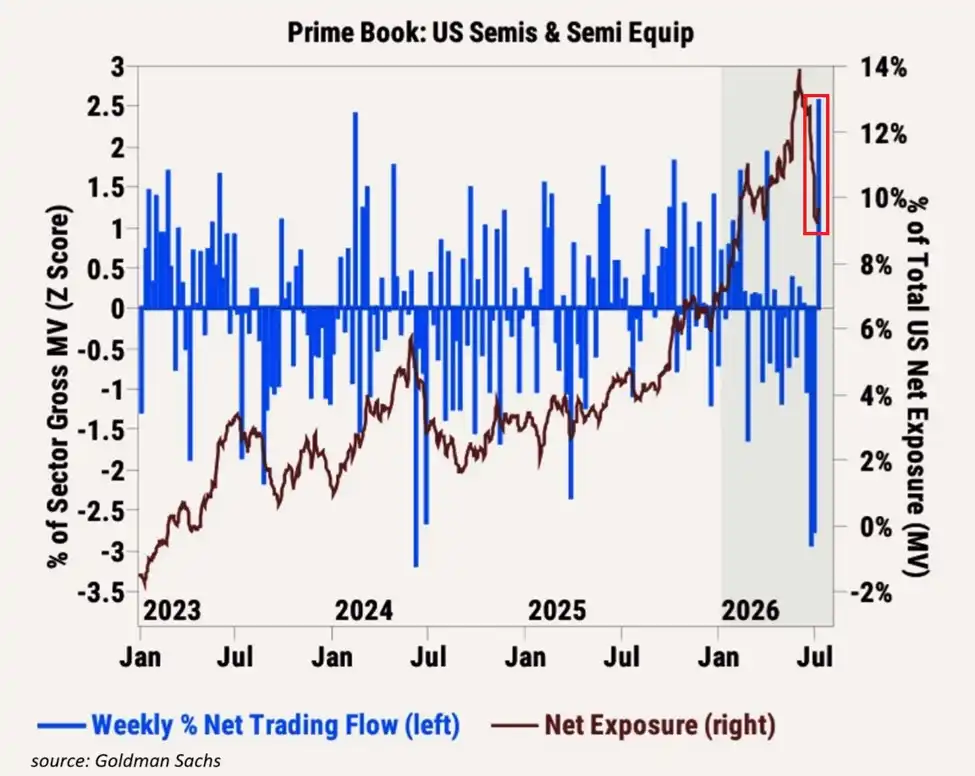
Hedge Funds2026-07-14 01:06:35Hedge funds sharply increase buying of U.S. semiconductor stocks, Goldman data showsHedge funds stepped up purchases of U.S. semiconductor stocks last week, according to Goldman Sachs data cited by BlockBeats. The buying marked the largest accumulation in nearly three and a half years and came after two straight weeks of the biggest selling in the sector since June 2024. Semiconductor stocks now make up 10% of hedge funds’ total exposure, double the level seen a year earlier. That figure, however, remains below the 14% peak recorded in May. The move suggests hedge funds are betting that the recent sell-off in semiconductor shares has run its course.1920