Nvidia
Nov 7, 2026

Nvidia’s AI Growth Faces a New Question: Who Will Pay for the Next Data Centers?

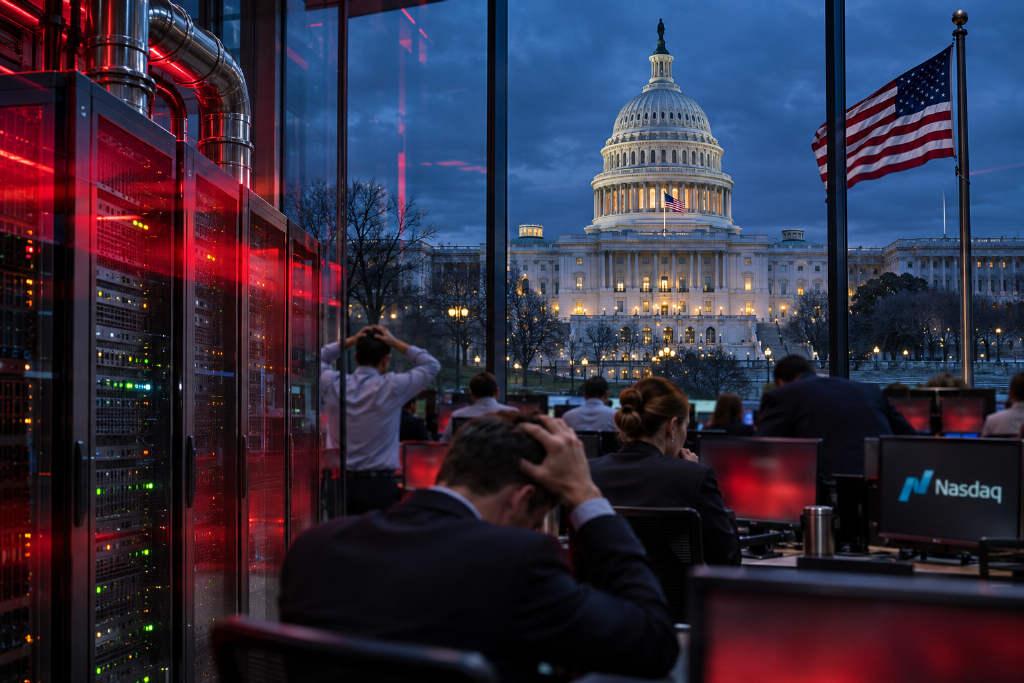
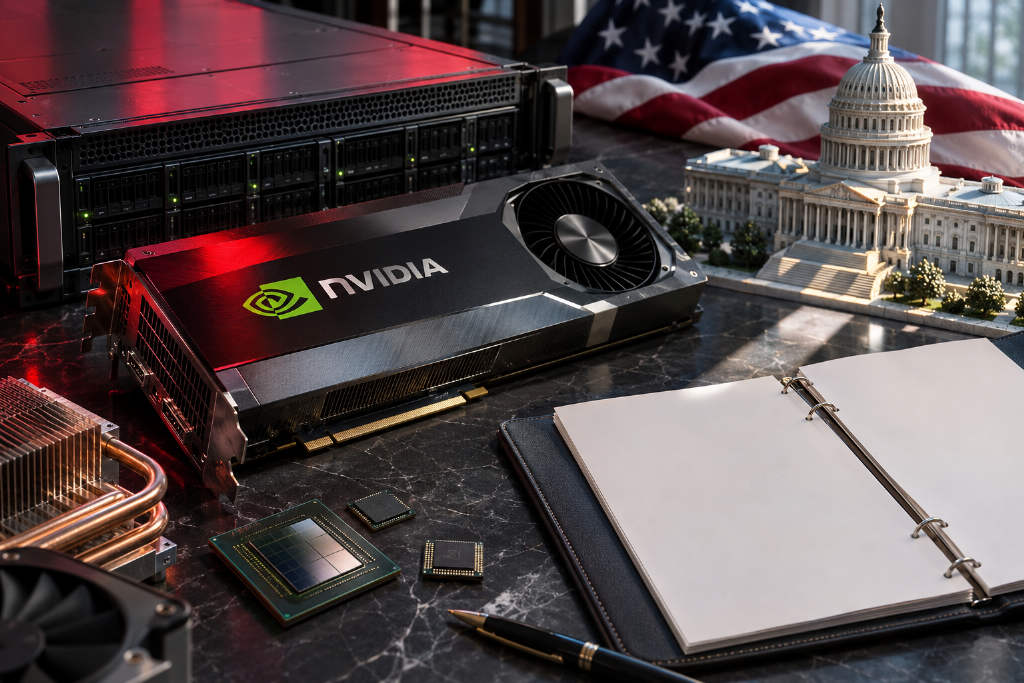
The US midterm election has pushed AI regulation, data-center approvals and funding back to the center of the market debate. On Nov. 5, the so-called Magnificent Seven lost about $1.04 trillion in combined market value. Nvidia fell 9.26%, wiping out more than $440 billion, while Apple slipped 1.53% and Tesla dropped 10.77%. Nvidia’s decline was two to four times deeper than that of major chip buyers including Microsoft, Alphabet and Amazon. The move came even as most large technology companies retained solid operating results. Nvidia’s revenue doubled year on year, Apple reached a record for the period, and cloud or advertising businesses at Microsoft, Alphabet, Amazon and Meta continued to grow. The concern is the cost and timing of AI infrastructure. Four major buyers increased capital spending in the third quarter, but their combined operating cash flow, once $61.7 billion above fixed-asset spending, became a deficit of about $26.4 billion. Google raised long-term debt from roughly $20 billion to $125 billion in a year, while Amazon’s free cash flow turned from a $14.8 billion inflow to a $42.4 billion outflow. Local restrictions could affect data-center plans aimed at 2028 and beyond, particularly in Texas. Financing costs, permitting delays and the funding needs of private AI companies could determine how quickly Nvidia’s customers keep building.

360
Nvidia’s AI Growth Faces a New Question: Who Will Pay for the Next Data Centers?
Binance
Nov 7, 2026

About 70% of Binance Altcoins Fall Below 200-Day Average as Market Weakens

Crypto analyst Darkfost said the altcoin market has returned to a weak state, with roughly 70% of altcoins on Binance now trading below their 200-day moving averages. From mid-August through the end of September, the total altcoin market capitalization rose by about $320 billion. A subsequent pullback erased roughly $200 billion, or close to two-thirds of that earlier gain. Data cited by Darkfost shows that the share of Binance-listed altcoins below their 200-day moving averages fell from 82% in mid-August to about 10% in early October. That ratio has since climbed back to around 70%, close to the level seen before the market move began in August. Darkfost attributed the renewed weakness to macro policy, geopolitical tensions, uncertainty linked to the U.S. midterm elections and declines in U.S. equities, particularly technology stocks. He also said that similarly extreme market conditions have sometimes preceded a change in trend historically.

1230
About 70% of Binance Altcoins Fall Below 200-Day Average as Market Weakens
Strategy
Nov 7, 2026

Strategy’s Stretch Raises $2.521 Billion and Buys 21,021 Bitcoin

Strategy’s Stretch completed its initial issuance in July 2025, raising about $2.521 billion, according to information reported by Odaily. Strategy said the net proceeds, after expenses, were used to purchase 21,021 bitcoin. Stretch is a perpetual preferred stock traded on Nasdaq, with a monthly dividend-rate policy set by the company’s board. Michael Saylor also wrote on X that digital credit combines financial infrastructure built up over hundreds of years, including corporate equity, preferred stock, trading markets, tax law and securities regulation. The report did not provide additional details on the issuance beyond the amount raised, the bitcoin purchase and the security’s dividend policy. The bitcoin purchase figure refers to the net proceeds after expenses, as described by Strategy. Stretch’s monthly dividend rate is determined by the board, according to the same information. The issuance and purchase were both attributed to Strategy’s statement, while Saylor’s comments concerned the broader financial infrastructure associated with digital credit.

650
Strategy’s Stretch Raises $2.521 Billion and Buys 21,021 Bitcoin
Polymarket
Nov 7, 2026

Polymarket Trader Made Over $77,000 After Nearly $200,000 Bet Before Poll

A Polymarket user placed nearly $200,000 on Pete Ricketts winning re-election as a U.S. senator from Nebraska shortly before a key poll showed him in the lead, according to researchers at Vanderbilt University. The user made the bet on Oct. 31 and, about an hour later, The New York Times and Siena College released a joint poll showing Ricketts ahead. The trade ultimately generated more than $77,000 in profit. The New York Times reported that the same user also made similar large trades on Kalshi and other prediction markets. It remains unclear whether the user had access to inside information before the poll was published. Brett Goldstein of the Vanderbilt University National Security Institute said the series of trades was difficult to regard as random and warranted further investigation. Polymarket said it had identified the trades and was investigating them. Kalshi declined to comment.

540
Polymarket Trader Made Over $77,000 After Nearly $200,000 Bet Before Poll
Donald Trump
Nov 7, 2026

Trump Names Stephen Miller as Chief of Staff, Signaling No Policy Shift

After Republicans lost control of both chambers of Congress in the midterm elections, President Donald Trump appointed longtime aide Stephen Miller as White House chief of staff. Miller, currently the deputy chief of staff, will replace Susie Wiles, with the appointment taking effect Monday. A White House official said Trump would not change direction, while The Wall Street Journal described the move as the clearest signal yet that Trump intends to hold to his core positions during the final two years of his administration rather than seek compromise with Democrats. Miller, 41, has been closely associated with the administration’s aggressive immigration enforcement agenda, including a daily arrest target of 3,000 and the deployment of masked immigration officers in communities across the United States. An Ipsos poll completed this week found that 36% supported the policy and 54% opposed it. Miller has also backed military strikes on suspected drug-smuggling boats in the Caribbean and Pacific, defended US and Israeli strikes on Iran, and supported blockades and sanctions against Tehran. His promotion follows Wiles’ resignation and could narrow the White House’s communication channel with business leaders. Democrats have announced major congressional investigations and signaled plans to scrutinize Miller’s immigration policy.

410
Trump Names Stephen Miller as Chief of Staff, Signaling No Policy Shift
OpenAI
Nov 7, 2026

OpenAI CFO Says 2027 IPO Plan Unaffected by U.S. Midterm Election

OpenAI Chief Financial Officer Sarah Friar said the company’s plan to pursue an initial public offering next year has not been affected by the 2026 U.S. midterm election, despite the election changing the political balance in Congress. Friar made the comments in an interview on the 6th, local time, according to CNBC. She said OpenAI’s team is focused on handling different scenarios and that she did not believe anything had materially affected the company. Friar reiterated the goal of seeking a public listing next year. She also said OpenAI will continue investing in large data centers and is attempting to redefine those facilities as “compute campuses” to meet customer demand and continue raising financing. Friar described the company’s current operating condition as strong, citing 70% revenue growth in the third quarter and a doubling of enterprise-business sales. She said she looks forward to OpenAI going public, arguing that a listing would fit the company’s mission of making artificial intelligence available to everyone. “Why should institutions be the only ones to have access to these benefits?” she said.

620
OpenAI CFO Says 2027 IPO Plan Unaffected by U.S. Midterm Election
U.S. Midterm Elections
Nov 7, 2026

$5.7 Trillion Wiped Out as Election Win Triggers AI Stock Rout

A Democratic sweep in the U.S. midterm elections was initially welcomed as a removal of political uncertainty. Within a day, that view reversed. The Nasdaq 100 posted its sharpest one-day decline since March 2020, while U.S. equities lost $2.3 trillion in market value on Thursday and $5.7 trillion from the Oct. 6 peak. The VIX rose from 16.6 to nearly 28. Retail investors led the selling, followed by hedge funds, long-only managers and systematic strategies. Quantitative positioning then amplified the move through options hedging, volatility-control funds, leveraged ETF rebalancing and CTA futures selling. AI-linked groups suffered the most, with storage chips, optical networking, data centers and AI semiconductors falling 12% to 15%. The selloff came as investors reassessed Democratic opposition to large-scale data-center expansion in Texas, Ohio and Georgia, adding a political risk to existing concerns about rising capital spending, shrinking cash reserves and debt at data-center operators. Some investors had already rotated toward defensive sectors, while Jeff Muhlenkamp avoided much of the damage after almost eliminating his AI holdings. Chip stocks rebounded Friday, but the S&P 500 still fell 2.68% for the week. Investors remain divided over whether the episode marks a violent correction within the AI bull market or the start of a deeper cycle shift.

390
$5.7 Trillion Wiped Out as Election Win Triggers AI Stock Rout
Total 2192 items
Go topage