Zest Protocol2026-09-25 13:33:45Zest Protocol launches mainnet demo for native BTC-backed USDC borrowing on EthereumZest Protocol has rolled out a mainnet demo that lets users post native Bitcoin as collateral and borrow USDC on Ethereum without wrapping or bridging their BTC. The setup uses a self-custodied Taproot vault on Bitcoin, while smart contracts on Ethereum handle the lending flow. Zest said the bitcoin deposited into the system remains native BTC rather than being turned into another token representation on Ethereum. For now, the release is limited to a demonstration environment rather than an unrestricted production launch, with collateral capped at 0.001 BTC per wallet. The project also said its architecture is designed around BitVM-based verification, which it says could eventually allow lending events on Ethereum to be verified on Bitcoin. The update was cited by Techub, referencing Bitcoinist.390
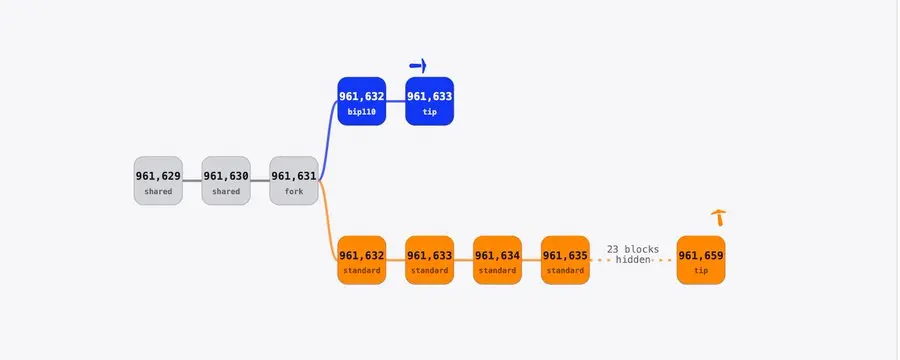
Bitcoin2026-08-11 03:21:18Bitcoin splits at block 961632 as BIP-110 enforces rules despite 2.53% supportBitcoin split into two incompatible chains on Aug. 8 after BIP-110 nodes began rejecting blocks that did not signal bit 4 at block height 961632, even though the proposal had received support from just 51 blocks in the prior 2,016-block window, or 2.53%. The higher-work chain continued under the existing rules, while the BIP-110 branch fell behind, reaching block 961633 by 9:00 a.m. Beijing time on Aug. 9, 21 blocks behind the main chain at 961654. The proposal was put forward by pseudonymous developer Dathon Ohm, with Luke Dashjr involved in the early draft and technical suggestions. Its reference implementation is based on Bitcoin Knots rather than Bitcoin Core, and it did not secure majority miner support. Supporters are trying a user-activated soft fork, arguing that nodes, exchanges, wallets and payment services can define valid blocks even without strong miner signaling. For now, BIP-110 has not activated its data limits on Bitcoin mainnet. What exists is a low-hashrate execution chain. The main chain still follows the original rules, and the 21 million BTC cap, existing balances and everyday payments remain unchanged. Risks are concentrated among nodes, wallets and services using BIP-110 infrastructure because the split came without dedicated replay protection.1940
BIP-1102026-08-07 03:43:59BIP-110 Forced Signaling to Begin in About 48 Hours, Miners Told to Prepare or Risk Invalid BlocksAccording to ChainCatcher, BIP-110 supporter Dathon Ohm has said that forced signaling for BIP-110 is expected to begin in roughly 290 blocks, or about 48 hours from now. At that point, miners must include a signal in their blocks to indicate they are prepared for BIP-110. Blocks that fail to do so could be considered invalid and subsequently dropped from the chain. Ohm also recommended that miners and users upgrade to Bitcoin Knots, adding that continuing to run Bitcoin Core after forced signaling begins would pose a security risk. BIP-110 is a Bitcoin Improvement Proposal aimed at restricting, at the consensus level, the size and manner in which arbitrary data can be embedded in Bitcoin transactions. The proposal’s main targets include Ordinals inscriptions, BRC-20 tokens, Runes, large OP_RETURN payloads, and certain Taproot constructions used for data storage. The goal is to ease the burden that blockchain “junk data” places on node storage and bandwidth.1840
BIP-1102026-08-07 03:34:29BIP-110 Mandatory Signaling Set to Begin in About 48 HoursBIP-110 supporter Dathon Ohm said on X that mandatory signaling for BIP-110 will begin after about 290 blocks, or roughly 48 hours, at block height 961632. Miners will need to start signaling readiness or their blocks will be treated as invalid and discarded. Ohm also urged miners and users to upgrade to Bitcoin Knots nodes and said he does not recommend continuing to run Bitcoin Core, arguing that Core will become unsafe once mandatory signaling begins. Foresight News noted that BIP-110 is a Bitcoin improvement proposal aimed at limiting the size and method of arbitrary data embedded in Bitcoin transactions at the consensus layer, including Ordinals inscriptions, BRC-20 tokens, Runes, large OP_RETURN payloads, and some Taproot constructions used for data storage.1830
Bitcoin2026-08-03 10:10:19Craig Wright Reopens Bitcoin Governance Debate With Call for a Fixed ProtocolBitcoin governance is back in focus after Craig Wright renewed his criticism of the network’s current development path, arguing that the protocol should remain permanently fixed rather than evolve through upgrades backed by a small group of developers. His comments revived a long-running argument at the center of Bitcoin: whether a system built on predictable monetary rules should resist change, or retain enough flexibility to respond to security risks, shifting user needs, and technical limits. The debate goes well beyond Wright’s personal controversy. In March 2024, the UK High Court ruled that Wright was not Bitcoin creator Satoshi Nakamoto and said some of the evidence he presented had been forged. Even so, the governance question he continues to raise remains central to Bitcoin’s future. Supporters of a fixed protocol say Bitcoin’s value depends on certainty, transparent issuance, and rules that cannot be rewritten at will. Others argue that a real-world technical system cannot stop changing entirely, pointing to past upgrades such as SegWit in 2017 and Taproot in 2021. The article revisits those milestones, the 2017 split that led to Bitcoin Cash, and the broader tension between stability and adaptability. At stake is not only whether Bitcoin should change, but who has the authority to change it and how decentralized consent is formed.1800
Bitcoin2026-07-24 08:45:19Google Quantum Computing Projections Reignite Bitcoin Security DebateGoogle-related quantum computing projections have revived concerns over Bitcoin security. The report says a sufficiently powerful quantum machine could derive private keys from public keys before transaction confirmation, though the threat remains theoretical at current hardware levels.220
Bitcoin2026-07-24 03:40:15Quantum Risk Puts 6.9 Million BTC at Exposure, Including Satoshi's HoldingsThe report says quantum computing threatens Bitcoin wallet ownership rather than mining. About 6.9 million BTC are already in addresses with exposed public keys, including roughly 1 million BTC linked to Satoshi Nakamoto.170
Bitcoin2026-07-23 22:15:16Quantum Threat to Bitcoin Remains Theoretical as Markets Show Little ConcernA new report says quantum computers are still years, if not decades, away from threatening Bitcoin’s ECDSA. Older addresses are more exposed, developers are studying post-quantum options, and markets are still treating the issue as a distant risk.590