
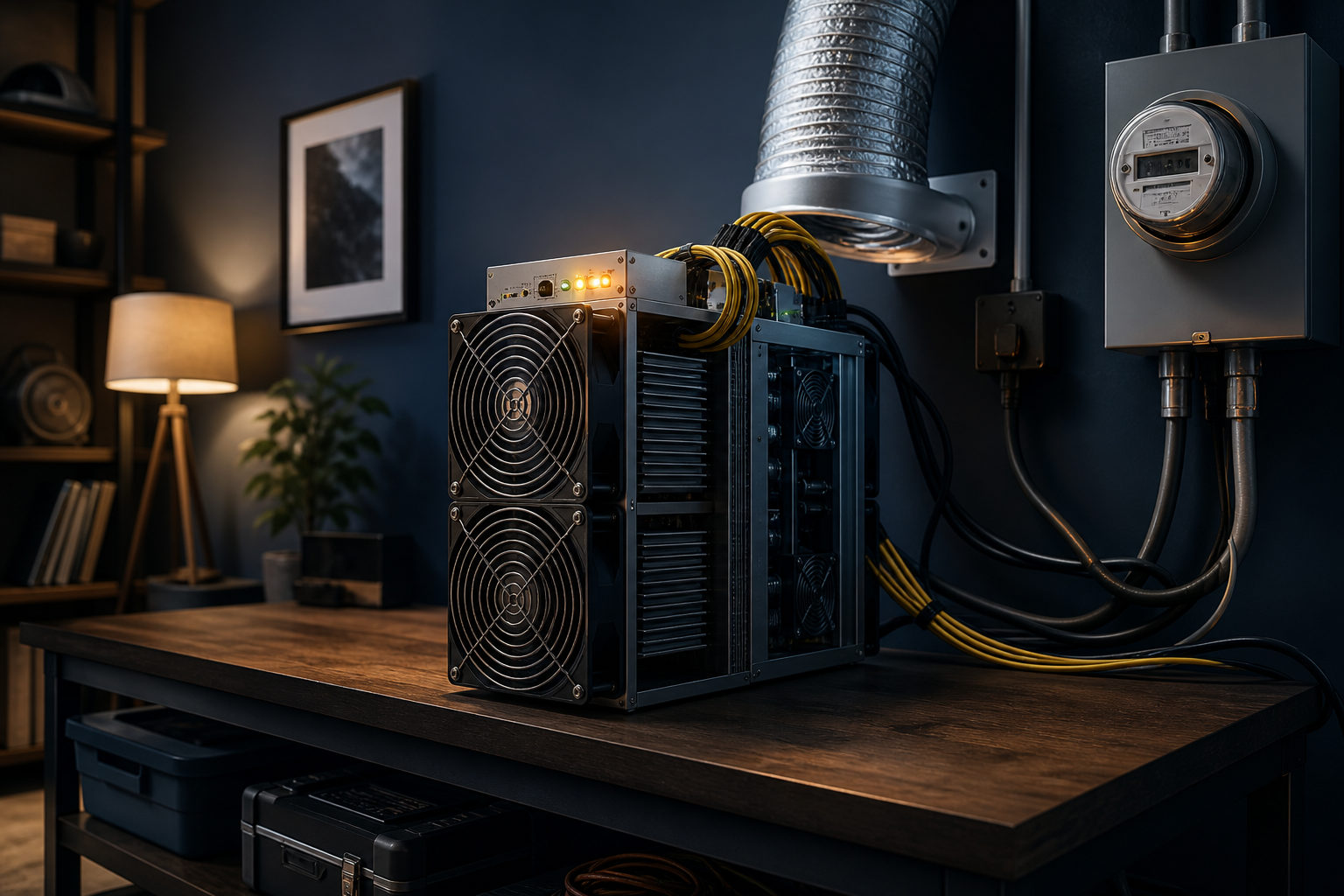
Yes, you can mine bitcoin at home in 2026, but for most people it is a demanding hardware and electricity project, not a simple way to earn bitcoin with a regular computer.
What home bitcoin mining actually means
A useful way to think about bitcoin mining is a bookkeeping race. The Bitcoin network produces a new block about every 10 minutes, and miners compete to be the one that finds a valid result first and adds a batch of transactions to that block.
So mining does not mean digging coins out of a system. You are supplying computing work, specialized machines, electricity, and constant uptime. In return, the network follows its own rules to decide which miner gets to add the next block. Bitcoin has used this model since its genesis block in January 2009, and it remains a core part of how the network stays secure.
When people ask whether you can mine bitcoin at home in 2026, they are usually asking two different questions at once. One is technical: can a person physically run mining equipment at home? The other is practical: does it make sense once you deal with noise, heat, power use, and maintenance? The technical answer is yes. The practical answer depends heavily on your setup.
Why a normal home computer is usually not enough
Many beginners still imagine bitcoin mining as something a desktop PC can do in the background. That picture is outdated. Bitcoin mining is dominated by ASICs, which are machines built for this specific task. They are designed to perform the exact type of computation that matters in Bitcoin's proof-of-work system.
A standard laptop or gaming PC may be useful for learning, wallet management, or running software that helps you understand the process. It is generally not the right tool for serious bitcoin mining. In this race, efficiency matters more than flexibility. Specialized equipment is built for that race, while general-purpose computers are not.
This is where many first-time readers get tripped up. They assume that if a home PC can mine a little, then it might still be worth trying. The problem is that Bitcoin does not reward effort in a smooth, casual way. Miners compete for block production under fixed rules. If your machine is far weaker than the equipment used by serious operators, you are not just slower. You may be so uncompetitive that the setup never feels meaningful at all.
That is why many individual miners who do participate choose to connect their machine to a mining pool. A pool combines the work of many miners and splits results according to its rules. It does not remove costs, but it makes participation less random than trying to mine alone.
The real obstacles to mining bitcoin at home in 2026
Electricity is the first filter
The biggest reality check is power cost. A mining machine runs for long periods, and electricity is not a one-time purchase. It is an ongoing operating expense that shows up every day the machine is on. Even without using any profitability numbers, it is easy to see why home mining becomes harder when household power is expensive.
People often focus on the machine price because it feels concrete. In practice, the recurring cost matters just as much. Your residential power rate, how stable your home's electrical system is, and whether your household can handle sustained heavy usage all affect whether the setup is even tolerable.
Heat and noise are not side issues
Mining hardware is not quiet consumer tech. It generates clear fan noise and a steady stream of heat while running. In a bedroom, office, or shared living space, that can become the main issue very quickly. What sounds manageable for a day can feel very different after weeks of continuous operation.
Heat matters just as much. A machine that runs hard needs airflow. In warmer conditions, cooling becomes tougher, and poor ventilation can create a chain of problems that affects comfort, machine stability, and hardware life. So the question is not only whether the miner fits in your home. It is whether your home can support the miner for long periods without turning daily life into a nuisance.
Your home's electrical setup matters
Running a dedicated machine at high load over long periods is different from charging a phone or using a normal appliance on and off. The state of your outlets, wiring, extension cords, dust exposure, ventilation, and power recovery plan all matter. Older electrical systems deserve extra caution.
For that reason, it makes more sense to treat home bitcoin mining as a small equipment operation rather than a casual gadget project. If you are guessing about load handling or placing a machine wherever there is an empty corner, you are already approaching it the wrong way.
Maintenance is part of the deal
Home mining is not a one-click activity. Machines can go offline. Pool settings can break. Dust can build up. Cooling can become less effective. A fan problem or a network interruption can stop your machine from contributing at all. If you are not checking the setup, downtime can stretch longer than you think.
That means the real barrier is often not software knowledge. It is whether you are willing to live with a machine that needs attention, monitoring, cleaning, and occasional troubleshooting. A lot of people like the idea of mining bitcoin at home more than they like the reality of maintaining a miner at home.
Common ways to participate if you still want to try
Buy an ASIC and run it at home
This is the most direct version of home mining. You buy the machine, set up power, connect to the internet, configure your pool or solo settings, and deal with airflow and monitoring yourself. The upside is control. The downside is that every practical issue lands in your home as well.
This route makes the most sense for people who have a dedicated space, can tolerate constant machine noise, and are comfortable treating the setup like working equipment instead of a hobby toy. If your interest is mostly curiosity, the home environment itself may become the reason you stop.
Join a mining pool
For individual miners, a pool is usually the realistic path. Solo mining with a small setup can feel extremely uneven because block discovery is competitive by design. Pools smooth out participation by combining many miners and using a payout structure based on the pool's rules.
Still, joining a pool does not make bitcoin mining easy. You still need to understand account settings, machine status, pool configuration, and what to do if your hardware drops offline. Choosing a pool also takes some care. Clear rules, stable service, and transparent information matter more than flashy marketing language.
Start with education before equipment
For many readers, the smartest first step is not buying a miner. It is learning the mechanics well enough to judge whether mining fits your goals. That means understanding blocks, proof of work, mining pools, difficulty adjustment, and the effect of halvings on miner behavior.
Bitcoin's supply is capped at 21 million coins, and halvings happen about every 4 years, or every 210,000 blocks. Known halving years include 2012, 2016, 2020, and 2024. Those events change the block subsidy structure, which is one reason miners pay close attention to machine efficiency, uptime, and power costs rather than just asking whether mining is possible in theory.
There is also a basic distinction that new users often miss: mining bitcoin and owning bitcoin are not the same activity. Mining is equipment-heavy and operations-heavy. Buying and holding bitcoin is a different decision with a different risk profile. Confusing the two leads to poor choices.
How to judge whether home mining makes sense for you in 2026
Start with your environment, not with dreams of output. Do you have a place where a machine can run for long periods without disrupting sleep or work? Can your home handle the heat and sound? Is your internet stable enough for continuous operation? Are you willing to monitor equipment and respond to downtime?
Then look at your goal. If your goal is to understand how Bitcoin secures its ledger through proof of work, building familiarity with mining hardware and pool setups can be educational. If your goal is to turn a normal living space into an easy, low-effort bitcoin machine, expectations usually need to come down.
It also helps to think in terms of trade-offs instead of yes-or-no answers. Home bitcoin mining in 2026 is possible, but it asks for compromises. You may be trading quiet space for machine noise, comfort for heat, convenience for maintenance, and simplicity for constant monitoring. Some people accept those trade-offs. Many do not.
FAQ
Can a regular person mine bitcoin at home in 2026?
Yes, a regular person can do it if they use suitable specialized hardware and have a home setup that can support the electrical load, heat, and noise. The harder question is not permission or access. It is whether the home environment is practical for long-term operation.
For most people, the answer depends more on living conditions than on technical curiosity. A machine may run at home, but that does not mean the experience will be comfortable or sustainable.
Do I need an ASIC to mine bitcoin at home?
If you want to participate in actual Bitcoin mining, an ASIC is generally the relevant type of hardware. A normal PC can help you learn concepts, but it is usually not a realistic device for serious mining on the Bitcoin network.
That distinction matters. Learning with ordinary hardware is one thing. Competing in Bitcoin's proof-of-work system is another.
Is joining a mining pool basically the easy version of home mining?
No. A pool can make participation less uneven because it combines many miners, but it does not remove the core burdens of home mining. You still need to deal with power, heat, machine monitoring, and setup errors.
Think of a pool as a participation method, not as a shortcut that turns mining into a passive household activity.
What costs do beginners most often underestimate?
Many people focus on buying the machine and underestimate the daily impact of electricity, heat, fan noise, cleaning, and downtime management. Those factors shape the real experience of living with mining hardware.
There is also the cost of attention. A miner that needs checking and occasional troubleshooting can become more demanding than expected.
If I only want to know the bitcoin price, where should I look?
If your question is about the live market price, check a major market data platform or a trading service that shows real-time bitcoin pricing. Compare sources carefully and pay attention to timing and quote conventions.
But if you are deciding whether to mine bitcoin at home, price is only one part of the picture. Hardware efficiency, power conditions, cooling, and uptime matter just as much in practice.
Before you buy anything, make a simple home checklist: space, ventilation, wiring, internet stability, noise tolerance, and how you will monitor the machine if it goes offline. If those answers are still vague, you are not ready to judge home bitcoin mining yet.
Disclaimer: This article is for informational and educational purposes only and is not investment, financial, or legal advice. Crypto assets are highly volatile and you could lose your entire investment. Do your own research and decide carefully.