


The question usually comes from a moment of doubt
A player sits at a machine, watches the reels settle, and wonders whether the machine itself is watching back. The short answer is that the camera the player should think about is not inside the cabinet. The camera is above it, on the ceiling, operated by the casino's surveillance department and pointed at the whole bank of machines, not at one person's face through the glass.
What sits inside a slot machine is a set of sensors and logging systems. Those are not cameras. They record mechanical and electronic events, not pictures. The distinction matters because the two systems answer different questions: one asks what the machine did, the other asks what the person at the machine did.
What the machine monitors
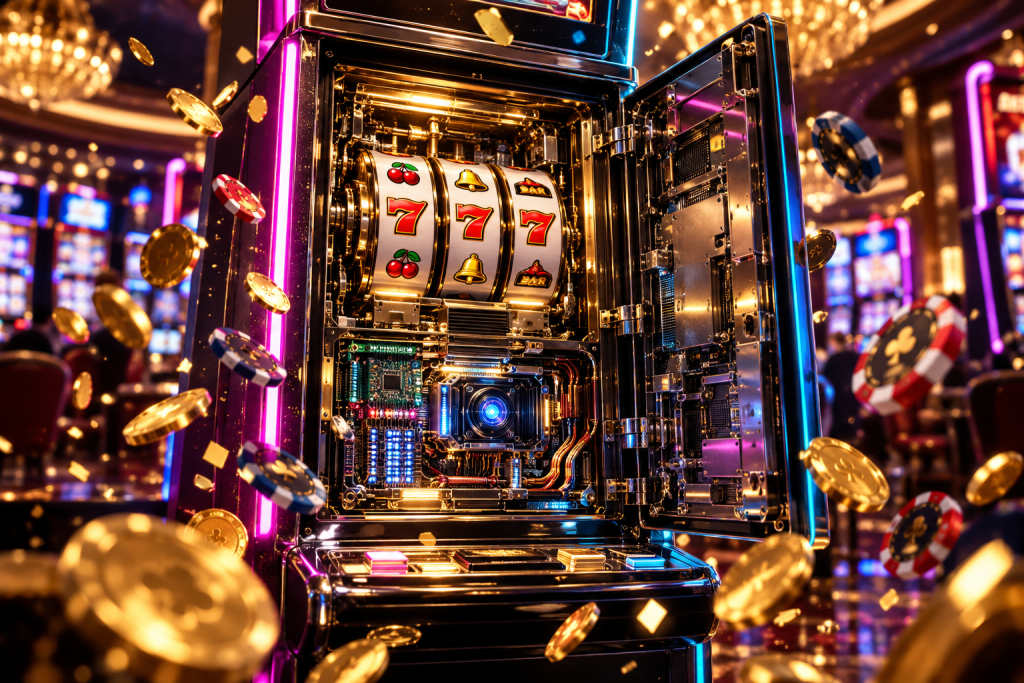
A modern slot machine is a specialised computer inside a locked cabinet. Its internal monitoring is built around protecting the integrity of the game and the money path, not around photographing players. The hardware that does this work includes door sensors, bill validator optics, coin comparators where coin handling still exists, and tilt or motion detectors.
Each of those components produces a log entry when it is triggered. A door-open event, a bill insertion, a hand-pay request, a reel-stop irregularity, a communication failure with the central server: all of these are written to the machine's event log with a timestamp. The log is a record of state changes. It contains no image data.
Where image capture happens
Image capture in a casino is handled by the property's overhead surveillance system. That system is separate from the slot machines. It uses cameras mounted on ceilings, walls and poles, positioned to cover entrances, cashier cages, table games and slot banks. The footage is stored on servers in a surveillance room, not on the machine.
When a dispute occurs, the casino does not open the machine to look for a picture. It pulls two things together: the machine's event log and the overhead video. The log says what the machine recorded; the video says what the surveillance system recorded. Neither one is stored inside the slot cabinet.
Why a camera inside the machine would make little sense
A camera inside a slot machine would point at the player through the glass, which is not where the machine's own security problems live. The machine's security problems are internal: someone opening the door, tampering with the bill validator, inserting a foreign object, or trying to manipulate the game program. Those events are better detected by contact switches, optical sensors and software integrity checks than by a camera.
There is also a practical limit. A camera inside the cabinet would need to store or transmit its footage. That adds cost, heat, wiring and a point of failure to a device whose whole design goal is to run for years with minimal human contact. The economics of the machine do not support it, and the surveillance need is already met by the ceiling.
| System | What it records | Where it sits | What it protects |
|---|---|---|---|
| Machine event log | Door opens, bill inserts, tilt events, hand-pay requests, errors | Inside the slot cabinet | Game and money-path integrity |
| Bill validator optics | Note denomination and acceptance/rejection events | Inside the cash path | Payment accuracy and counterfeit rejection |
| Overhead surveillance cameras | Video of people and activity | Ceiling, walls, poles above the floor | Patron and staff conduct, dispute resolution |
| Door and tilt sensors | Physical access and machine movement events | Cabinet frame and interior | Tamper detection |
What the player-facing parts do and do not do
The parts of the machine a player touches or looks at have no camera function. The button panel registers presses. The display shows game graphics. The card reader, where one is fitted, reads a loyalty card's identifier. None of these components captures an image of the player.
Some machines have a player-tracking display that shows messages or promotional content. That screen is an output device. It is not pointed at the player as a sensor. The only input devices on the machine are the buttons, the touchscreen, the bill acceptor, the coin slot where present, and the card reader.
How a dispute is investigated
When a player says the machine did not pay correctly, the casino does not rely on the player's memory or the machine's word alone. A slot supervisor or surveillance operator reviews the machine's event log to see what the game program recorded. In parallel, the surveillance department reviews the overhead footage covering that machine at that timestamp.
The two records are compared. If the log shows a hand-pay was triggered and the video shows the attendant arriving, the sequence is confirmed. If the log shows no win and the video shows the reels stopping on a non-winning combination, that is also confirmed. The machine's internal record is the authoritative game state; the overhead video is the authoritative visual record.
What the law and the regulator require
Gaming regulators in most jurisdictions require that slot machines keep detailed event logs and that casinos maintain surveillance coverage of gaming areas. The exact requirements differ by jurisdiction, and this article does not describe any specific regulator's rules. The general structure is consistent: the machine must be able to prove what it did, and the property must be able to prove what happened around it.
A player who wants to know the specific surveillance and logging requirements for a particular casino should ask the property's gaming regulator in that jurisdiction. The regulator publishes the technical standards that machines must meet before they may operate. Those standards describe logging requirements in detail; they do not describe cameras inside the machine, because that is not part of the standard architecture.
The privacy question behind the question
The underlying concern is usually not about hardware. It is about whether the casino is watching the player in a way the player cannot see. The honest answer is that the casino is watching, but through the ceiling cameras, not through the machine. The player's image is recorded whenever they are on the gaming floor, and that recording is retained according to the property's policy and any applicable legal requirements.
A player who wants to know what a specific property records and how long it keeps the footage should ask the property's surveillance or compliance department. The answer will be specific to that property and may be limited by security policy. What is not in question is the location of the cameras: they are overhead, not inside the cabinet.
What to confirm before you go
If the question matters because of a specific incident, the player should act while the footage and logs still exist. Retention periods for surveillance video and machine logs are finite and differ by property and jurisdiction. A delay of weeks can mean the record is gone.
- Ask the casino how long it retains surveillance footage and machine event logs, and whether a specific timestamp can still be reviewed.
- Ask the jurisdiction's gaming regulator what technical standards apply to machine logging and what surveillance coverage is required.
- If the concern is about personal privacy, ask the property for its surveillance and data retention policy in writing.
FAQ
Do slot machines have cameras inside them?
No. A slot machine contains sensors and event-logging systems that record mechanical and electronic events such as door opens and bill insertions, but it does not contain a camera. Image capture is handled by the casino's overhead surveillance system, which is separate from the machine and records the whole gaming floor.
Can a slot machine see my face?
The machine cannot. Its input devices are buttons, a touchscreen, a bill acceptor, a coin slot where present, and a card reader. The overhead surveillance cameras can record your face while you are on the gaming floor, but those cameras are mounted on ceilings and walls, not inside the machine cabinet.
What happens if I dispute a slot machine result?
The casino reviews two records: the machine's internal event log, which shows what the game program recorded, and the overhead surveillance video, which shows what happened around the machine. The two are compared by a supervisor or surveillance operator. Neither record is stored inside the slot cabinet.
Play responsibly
Gambling should be treated as paid entertainment, never as a way to earn income or recover losses. 1-800-MY-RESET (1-800-697-3738)
18+ or 21+ depending on where you are; follow the minimum age that applies to you.
This article is general information about how these mechanics work. It is not legal advice and not a recommendation to gamble or to use any particular operator. Availability and legality differ by jurisdiction — check the rules that apply where you are.