


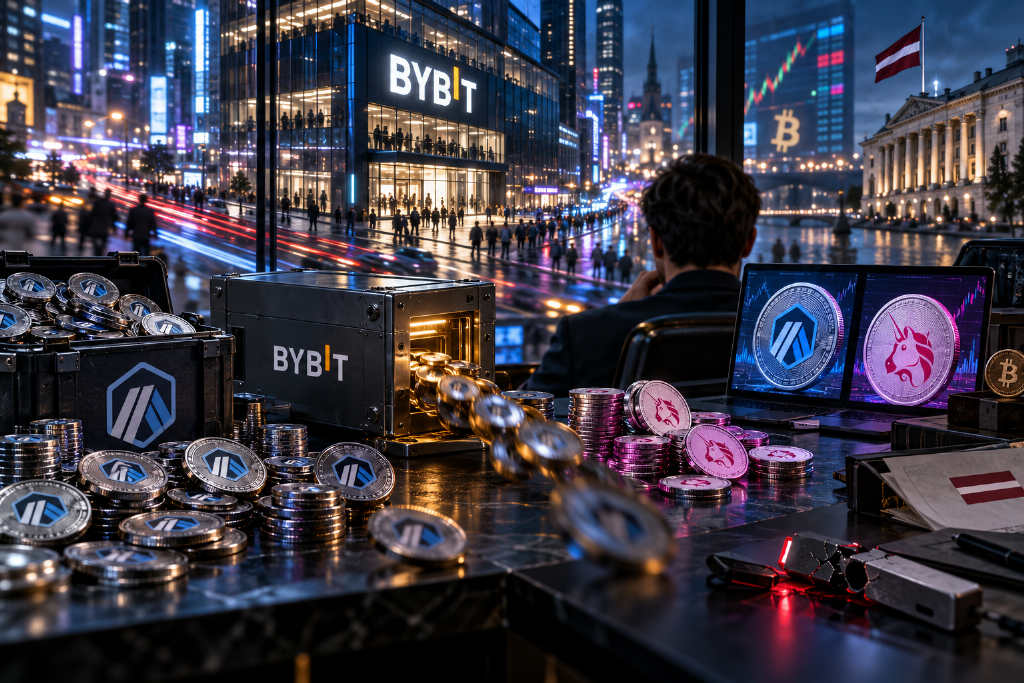
Whale pulls $2.34 million in ARB and UNI as unlock pressure persists
On-chain tracking showed whale address 0x204 withdrawing about $2.34 million worth of Arbitrum (ARB) and Uniswap (UNI) tokens from Bybit around two hours earlier.
The move came after Arbitrum unlocked more than 90 million ARB this week. The source said ARB has still posted a sharp rise recently and stayed at elevated levels over the past month despite ongoing token unlock pressure.
Hyperliquid pushes for U.S. rules focused on the application layer
According to Bloomberg, Hyperliquid Labs co-founder Jeff Yan is seeking U.S. rules that protect blockchains. He argued that regulatory responsibility for Hyperliquid should sit with financial institutions operating markets on top of the blockchain, meaning the application layer, rather than with the blockchain network itself.
He said that split would allow Hyperliquid to move into Wall Street without taking on the full compliance burden carried by traditional exchanges.
Yan also said Hyperliquid is not open to U.S. customers at this stage. He described the project as infrastructure for traditional financial institutions rather than a replacement for existing market participants, comparing its role to Amazon Web Services as computing infrastructure for enterprises.
Microsoft exits Nscale data center project as IPO plans face more uncertainty
Microsoft (MSFT.O) has withdrawn from a data center partnership with British cloud startup Nscale in Loughton, Essex, in the U.K. The development landed at a key point in Nscale’s IPO preparations.
The report said Microsoft did not explain why it ended the partnership, though the project had already faced a series of delays. Local authorities told Nscale that power for the facility is not expected until the 2030s.
Nscale’s flagship project in Norway is also running about six months behind schedule. Of its planned 30 megawatts of capacity, only 6.4 megawatts are currently in operation.
IPO filings show about 85% of Nscale’s contracts depend on Microsoft and Anthropic. Microsoft had been expected to serve as the anchor tenant for Nscale’s first U.K. data center in Essex. The company is seeking to raise as much as $3 billion through an IPO and could list as early as this month.
Market calls diverge on altcoins, growth pricing and Bitcoin
One market view said small- and mid-cap crypto assets have unusually moved ahead of BTC, though the risk of a trend reversal remains high.
Another analysis said the long-end pricing anchor has clearly shifted toward a growth and AI cycle, while the market’s inflation-pricing power in the U.S. is fading quickly.
Trader Killa said he remains bullish on Bitcoin and will not close his position before BTC reaches $126,000. He wrote that Bitcoin does not always rise because the move looks logical, and at times it rises precisely because the market behaves in ways that do not fit a neat explanation. He added that he is still holding a BTC long.
Large token unlocks scheduled for next week
Data from Token Unlocks showed several tokens are set for sizable unlocks next week:
- LayerZero (ZRO): about 23.28 million tokens at 7:00 p.m. Beijing time on Oct. 20, equal to about 3.83% of circulating supply and worth about $43.3 million.
- Plasma (XPL): about 227 million tokens at 8:00 p.m. Beijing time on Oct. 25, equal to about 5.02% of circulating supply and worth about $17.9 million.
- Humanity (H): about 266 million tokens at 8:00 a.m. Beijing time on Oct. 25, equal to about 6.84% of circulating supply and worth about $15 million.
- SoSoValue (SOSO): about 23.46 million tokens at 5:00 p.m. Beijing time on Oct. 24, equal to about 5.63% of circulating supply and worth about $6.9 million.
- SOON (SOON): about 20.24 million tokens at 4:30 p.m. Beijing time on Oct. 23, equal to about 3.50% of circulating supply and worth about $6.3 million.
- Kaito (KAITO): about 17.6 million tokens at 8:00 p.m. Beijing time on Oct. 20, equal to about 3.69% of circulating supply and worth about $5 million.
- ChainOpera AI (COAI): about 19.55 million tokens at 3:00 p.m. Beijing time on Oct. 25, equal to about 6.36% of circulating supply and worth about $5 million.
DeepSeek sets pricing for web search and fetch APIs
DeepSeek said its API now supports web search and fetch functions, priced by request volume at 5 yuan per 1,000 successful requests.
The company said users accessing DeepSeek API through DeepSeek Harness, Claude Code and Codex already reach the Search and Fetch interfaces through server-side tool calls. Those calls are not being billed for now, but usage-based charges will begin at 00:00 Beijing time on Nov. 1, 2026.
Strive and Strategy hint at fresh Bitcoin holding updates
Strive CEO Matt Cole posted the company’s Bitcoin holdings chart again on X and wrote that it is now using “double horsepower” to stack sats, a message the source said may hint at a BTC accumulation update next week. The move was described as potentially echoing Strategy founder Michael Saylor.
Saylor, Strategy’s founder and executive chairman, also posted another Bitcoin Tracker update. Based on prior patterns, Strategy often discloses changes in its Bitcoin holdings the day after Saylor posts such messages.
Institutions split on Bitcoin’s year-end path
Institutional views on Bitcoin into year-end remain divided, with bullish forecasts pointing to $100,000 and more cautious takes centered on inflation pressure.
Bitwise head of research Ryan Rasmussen said Bitcoin could break above $100,000 by the end of 2026, citing continued buying through ETFs and by corporations, concerns over inflation and government debt, and a clearer regulatory backdrop.
LO:TECH head of research Adam Morgan McCarthy said Bitcoin is more likely to trade in an $85,000 to $95,000 range before year-end. He said inflation pressure and Federal Reserve policy remain headwinds, and that a return above $100,000 may require lower market expectations for a December Fed rate hike. Falling oil prices and easing inflation could help drive that shift.
CoinShares head of research James Butterfill said the tension between persistent inflation and a weakening labor market will shape the Fed’s room to act. Cooling inflation could create space to respond to softer employment, while renewed inflation could keep policy restrictive.
Hacken says Q3 crypto losses rose 55% quarter on quarter
Blockchain security firm Hacken said the crypto sector recorded 107 security incidents in the third quarter of 2026, with total losses reaching $1.18 billion, up 55% from the previous quarter.
About $906.8 million of those losses were tied to compromised vendors or development tools, known vulnerabilities that were not patched in time, and components that were not included in the latest audit scope.
The report also said some derivatives platforms and prediction markets rely on key-management arrangements that are not sufficient for asset security, though no actively exploited vulnerabilities have been found on those platforms. The analysis said audits cannot replace ongoing vulnerability management and that teams still need to patch known issues quickly and make sure audits cover the components that actually affect fund security.
Hyperliquid burns HYPE and reports 30-day revenue
Hyperliquid bought back and burned about 11,340 HYPE over the past 24 hours at an average price of $78.55, for a total value of about $890,900. Estimated platform fee revenue over the same period was about $764,900.
Total HYPE burned has now reached about 49.63 million tokens, valued at about $3.9 billion at current prices, or 4.96% of the token’s 1 billion maximum supply. Hyperliquid’s revenue over the past 30 days was about $69.94 million.
Justin Sun trades PEPE again after two years
The source said Justin Sun’s address, 0x176…0a132, received 7.2 trillion PEPE worth $28.44 million from a Poloniex multisig address 22 hours earlier, marking his first PEPE trade in two years.
CZ responds cautiously to proposal for a BNB phone
BNB ecosystem member Spigg proposed a dedicated BNB phone with a native wallet, instant payment and transfer functions, and a unified platform for all DApps in the BNB ecosystem so users could manage assets, make payments and interact on-chain from one device.
Binance founder CZ replied that he rarely disagrees with Spigg, but is not sure carrying a crypto phone around is a good idea. He did not explain his concerns in detail and did not explicitly oppose the idea.
Roger Ver reaches deferred prosecution deal over U.S. tax case
Early Bitcoin investor Roger Ver, often called “Bitcoin Jesus,” has reached a deferred prosecution agreement with the U.S. Department of Justice to resolve criminal allegations tied to mail fraud and tax evasion.
Under the agreement, the indictment against Ver will be dismissed in one month if he complies with the terms. The Internal Revenue Service may recover as much as $49.9 million from him, covering taxes, civil penalties and interest.
The DOJ had previously alleged that after Ver renounced his U.S. citizenship in 2014 and obtained citizenship in Saint Kitts and Nevis, he failed to pay at least $48 million in taxes. Ver was arrested in Spain in April 2024. Earlier this year, he publicly called on Trump to help end the legal action against him, but he did not receive a presidential pardon and instead resolved the case through an agreement with the Trump administration. Ver said he was grateful the matter had been resolved and thanked the administration for its leadership and professional handling.
Qubic says 1,404 wallets were compromised
Qubic said in a security update that between 23:42 on Oct. 17 and 01:26 on Oct. 18 UTC, attackers exploited insufficient randomness in the seed generation of some wallets and accessed assets in 1,404 Qubic wallets, moving about 2.94 trillion QU.
Qubic said the issue was in wallet seed generation rather than in the Qubic protocol itself.
Nine U.S. public companies oppose tokenized trading of their shares on OKXICE
OKXICE, the tokenized stock trading platform jointly launched by OKX and Intercontinental Exchange, the parent company of the New York Stock Exchange, said in an Oct. 15 notice that nine U.S.-listed companies have objected to having their shares traded on the platform.
The companies are Broadcom, Verizon, UnitedHealth, AppLovin, Applied Digital, Rocket Lab, CoreWeave, Applied Optoelectronics and Cerebras Systems, which had already opted out earlier. The notice did not give reasons for the objections.
Nasdaq also said it would choose not to have its own stock tokenized under the framework. OKXICE had previously notified the SEC that it planned to rely on the SEC’s five-year “innovation exemption” launched on Sept. 17 to list tokenized shares of 63 U.S. public companies in the first batch.
Anthropic creates public benefit fund with initial 5% share commitment
Anthropic said it is creating the Anthropic Public Benefit Fund and will place part of its equity into the new vehicle. Subject to shareholder approval, the company is initially committing 5% of its shares. After that, each 50% increase in company valuation above a set baseline could allow the board to add another 2% at its discretion.
The fund is being set up as a wholly owned LLC rather than a charitable structure such as a 501(c)(3). The equity held by the fund will not be used for lobbying or political donations in any country.
Anthropic said the fund will support large grants to traditional nonprofits and direct distributions to specific groups. One stated priority is addressing labor-market disruption caused by AI, an area where the company said it has already committed $200 million.
Combined with the founders’ pledge to donate 80% of their holdings and an employee equity matching plan, about 20% of Anthropic’s shares are expected to be directed to public benefit, with room to rise if valuation milestones are met.
Latvia moves toward crypto tax payments and overhauls tax rules
Dizis Dejus, strategic planning adviser to Latvia’s prime minister, said at the UN:BLOCK fintech conference in Riga that the country plans to let residents pay personal income tax with cryptocurrency as early as next year. The finance ministry has agreed, though technical integration with payment service providers is still pending.
The plan builds on a crypto tax payment and asset tokenization initiative announced in May 2025.
On Oct. 15, Latvia’s parliament passed legislation that shifts taxation to withdrawals from crypto investment accounts above the initial deposit amount, replacing the previous approach of taxing each transaction. It also introduced a one-time declaration mechanism: holders can settle historical tax liabilities by paying 10% of the declared market value of assets by the end of 2026. The declaration window runs from April 1 to May 31, 2027, and the payment deadline is July 23. Dejus did not disclose the payment service providers involved or which cryptocurrencies would qualify.
South Korean and Japanese equities fall in early trading
South Korea’s KOSPI fell below 5,600 at the open and was down 3.17% on the day. SK Hynix fell 4% and Samsung Electronics dropped 3%.
Later, the Nikkei 225 extended its intraday decline to 2.2% and slipped below 64,000, while the KOSPI narrowed its loss to 1.00% after having fallen more than 3% earlier.
Whale closes $110 million BTC long, then opens $45.8 million U.S. equity long
A whale holding a 1,360 BTC long position worth about $110 million had placed a market stop at $80,500, but it was never triggered. At 4:00 a.m., BTC briefly fell to $80,684, just $184 above that stop level, before stabilizing.
At 5:00 a.m., the trader closed the BTC long at $80,949, taking a loss of about $3.26 million. The whale then rotated into a $45.8 million long position in U.S. equities, including TSLA, DRAM and SOXL. The source also said the long had a liquidation price at $80,034.
Musk comments on Anthropic fund structure
After Anthropic announced that its new Anthropic Public Benefit Fund would start with 5% of company shares and could rise by another 2% each time valuation increases 50% from a baseline until it reaches about 20%, Elon Musk replied that the company should “distribute the shares directly to the public.” He later added, “That is exactly what I am going to do.”
World launches World ID suite for banks
World, the identity project co-founded by Sam Altman and previously known as Worldcoin, launched a World ID suite for banks and financial institutions, its first product aimed at a specific industry.
Co-founder Alex Blania introduced the suite at the Money20/20 conference. It combines the World ID app, World ID for Zoom and World ID for Agents, also called AgentKit, to help defend against deepfake fraud and AI impersonation.
The Zoom deepfake detection feature has now fully launched after being in testing since April. World said OpenExchange, Bain Capital, VanEck Funds and Outtake served as design partners, but it did not disclose the names of banks using the product or its pricing. More than 18 million people currently hold Proof of Human, according to the company.
CZ says Japanese edition of his memoir is out, proceeds go to charity
Binance founder CZ, Zhao Changpeng, said the Japanese edition of his memoir, Freedom of Money, was released that day. The English edition, Chinese edition and Audible audiobook had already gone live, and more language versions are on the way.
CZ said all proceeds from the book will be donated to charity. He also posted a 4-minute and 31-second video about his personal story and said most of the video and voiceover were generated by AI.
Additional AI updates in the roundup
PANews AI coverage also highlighted Anthropic’s public benefit fund and DeepSeek’s Search and Fetch tool APIs, which are powered by its in-house search engine, return structured search results or webpage Markdown body text, use the existing Bearer authentication method and run on the base URL api.deepseek.com.
Separately, a filing showed that the “vast majority” of Character.AI employees who received offers have accepted positions with Disney. The transaction was described as a stalking horse bid, meaning other companies can still submit higher offers.