


Tencent is internally testing an AI interactive content product called Dongleya for children and teenagers, according to Dujia, as cited by ChainCatcher. The product includes both a web version and a WeChat Mini Program.
Dongleya is currently in limited testing for parent-child users and teachers. Its main format is an interactive content unit called Qimiaoka, which allows parents, teachers and knowledge creators to use AI to turn knowledge, experience and ideas into interactive works that can be dragged, simulated and operated.
Content formats and use cases
The product includes a built-in content community with existing Qimiaoka materials covering in-class and extracurricular topics across everyday knowledge, arts, humanities and natural sciences. Formats include 3D models, games, picture books and animated courseware.
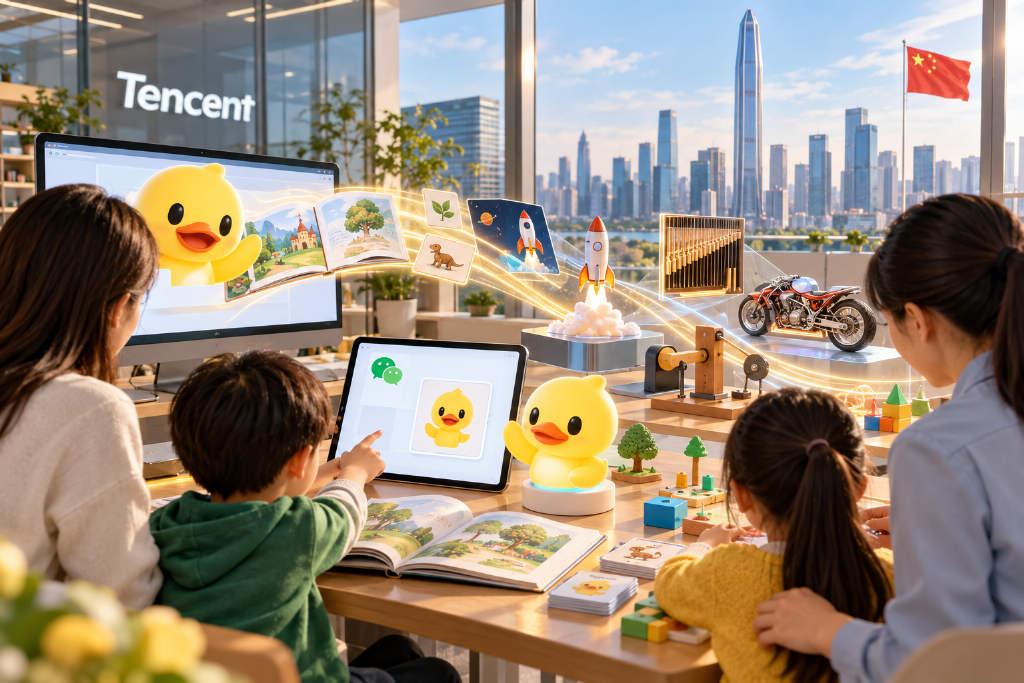
- For parent-child use, available examples include bedtime interactive picture books, rocket launch procedures, electronic piano strings and motorcycle structure simulations.
- For classroom use, the product can visualize physics concepts such as friction and levers, and also includes word-matching and level-based mini-games.
- For extracurricular learning, examples include light-and-shadow simulations for miniature museum courtyards, hydrological observation station switches between dry and wet seasons, previews of pottery shapes and glaze colors, and models for electric fields, pulley systems and the Pythagorean theorem.
Creation and sharing tools
Parents, teachers and knowledge creators can enter ideas and use the built-in Agent to make picture books, games, animated courseware, 3D content and memory cards. The platform also includes an inspiration wall and supports adapting works already published in the community.
Dujia said that after a user enters a prompt in the chat box to generate a Gomoku game, the AI creates the mini-game in a panel on the right. Users can then download it, publish it to the community or share it with WeChat and QQ contacts. The product also supports uploaded recordings and direct conversational input, allowing existing materials to be converted into interactive knowledge content.