
Andreessen Horowitz’s New Media team used its latest Charts of the Week to frame the AI infrastructure trade around a harder question: strong demand is visible, but can compute providers turn that demand into lasting profitability and free cash flow?
Written by Moses Sternstein, the piece centers on neocloud companies including CoreWeave, Nebius, and Applied Digital. From there, it expands into horizontal SaaS, model routing, token spending efficiency, and hiring competition among frontier AI labs.
Neoclouds and the repricing of older infrastructure
Sternstein starts with a historical pattern: old physical networks sometimes become the backbone of a new technology cycle. He points to the Southern Pacific Railroad, which controlled wide rights-of-way beyond its tracks in the early 20th century. Those corridors later supported a communications network called the Southern Pacific Railroad Internal Networking Telephony system. By the 1970s, the company had commercialized that network, and as long-distance telecom monopoly structures broke down and fiber became commercially viable, the same corridor was rebuilt into fiber infrastructure. The resulting network later became known as Sprint.
He gives two more examples. In the 1980s, Williams Company repurposed unused natural gas pipelines into fiber conduit and formed WilTel, which was later sold and eventually renamed WorldCom. In the 1990s, the one-way coaxial cable originally laid for cable television went through a large and expensive upgrade cycle and became the infrastructure Comcast and Charter used to deliver broadband internet to consumers.
That history sets up Sternstein’s point about neoclouds. These companies already control physical assets that are being modified and repriced for a new wave of demand. Many of them previously operated in energy-intensive and compute-intensive crypto mining. Once the AI boom arrived, access to power, data centers, cooling systems, and experience managing dense computing loads suddenly became scarce strategic assets. In CoreWeave’s case, Sternstein adds, that also included a large GPU footprint.
The argument is straightforward: AI infrastructure competition is not beginning from zero. Early advantage often comes from recombining legacy assets, energy access, and engineering experience.
Growth is real, but neoclouds are still much smaller than hyperscalers
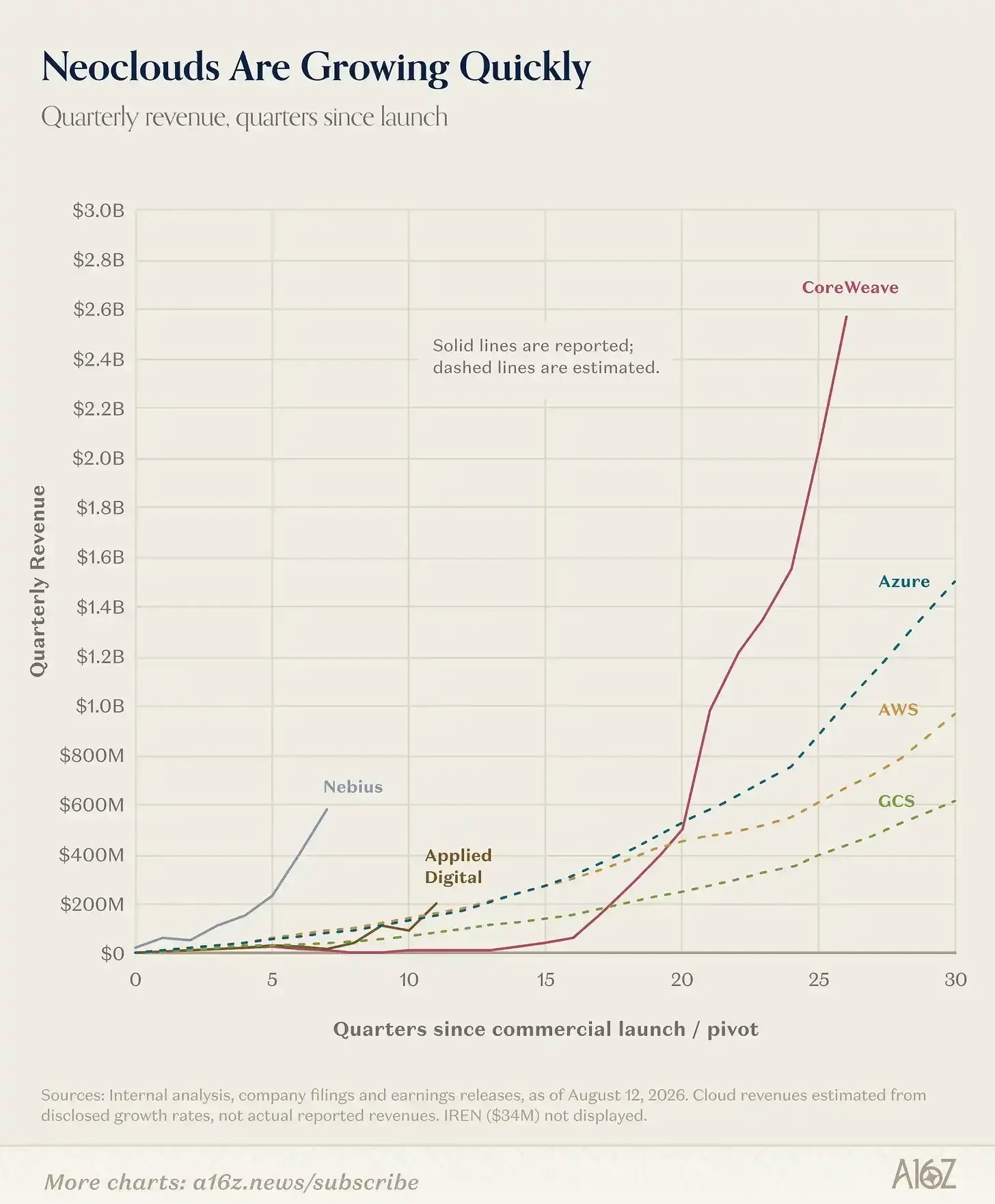
The article says the three largest public neocloud companies have posted striking revenue growth. Early cloud revenue at hyperscalers can only be estimated, Sternstein notes, but the broad pattern is clear enough: neoclouds are growing exceptionally fast, and faster than the three major cloud providers did in their early stages.
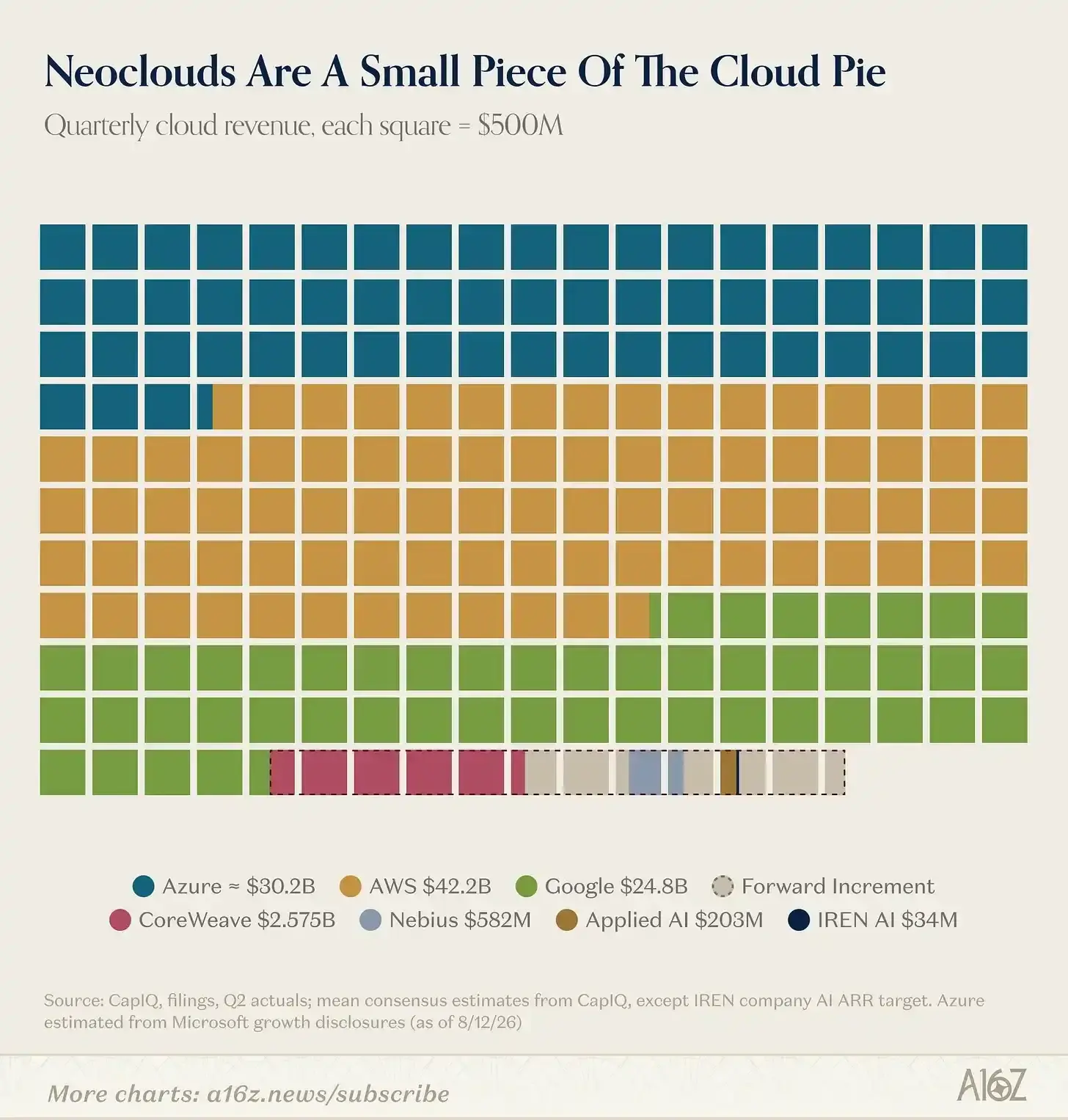
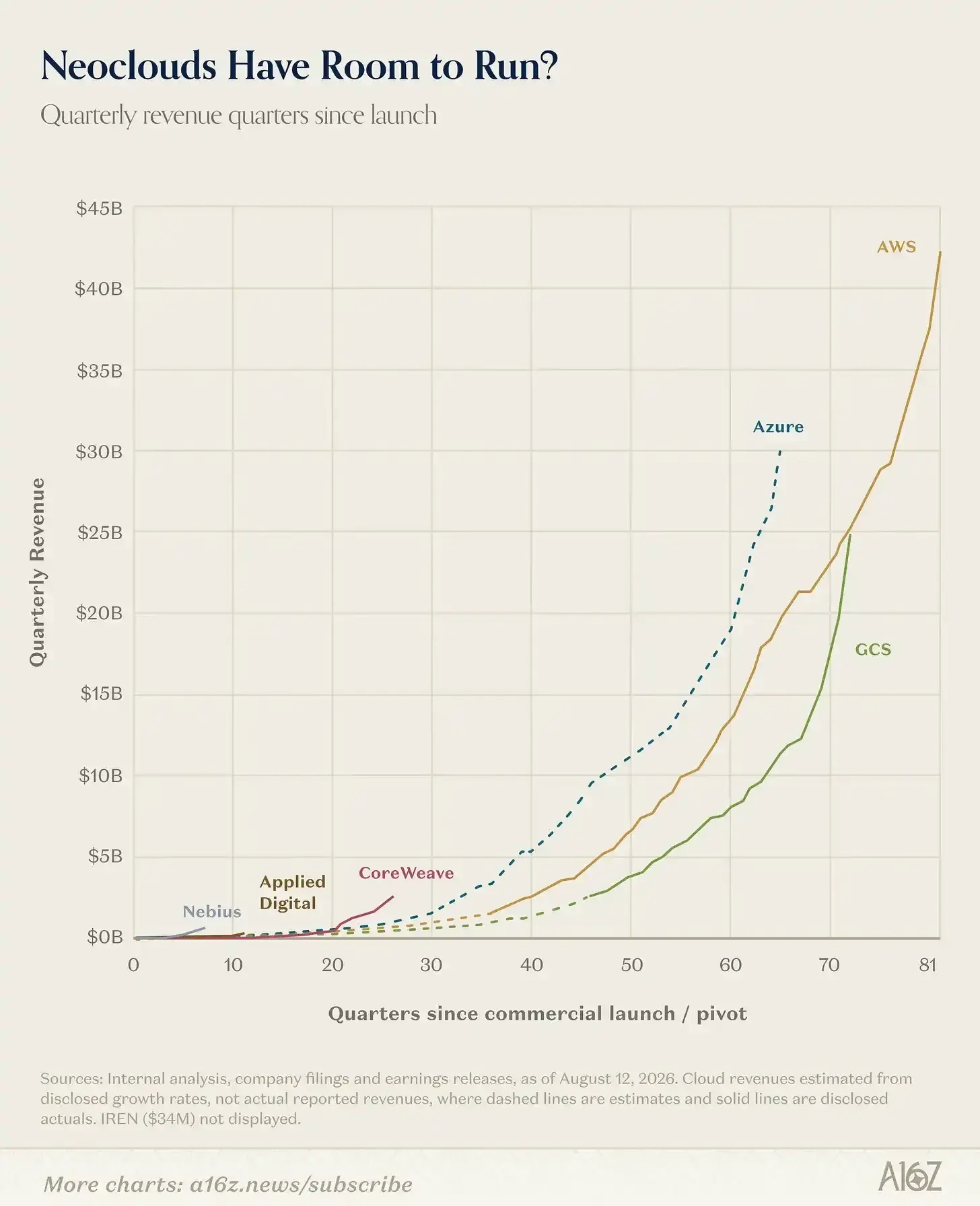
He also says these companies remain relatively small players in the wider compute sales market. They are still far from the scale of hyperscalers, whose quarterly revenue runs several orders of magnitude above that of neoclouds.
One comparison in the piece stands out. CoreWeave took about 25 quarters to reach $2.6 billion in revenue, while AWS reached that same level in its 40th quarter after launch. Sternstein uses that gap to show how quickly these newer AI-focused infrastructure providers have been expanding.
That kind of top-line growth, combined with the AI tailwind, might normally be expected to produce broad investor enthusiasm. The piece says the market response has been more complicated.
Revenue is climbing, but the market is focused on long-term profitability
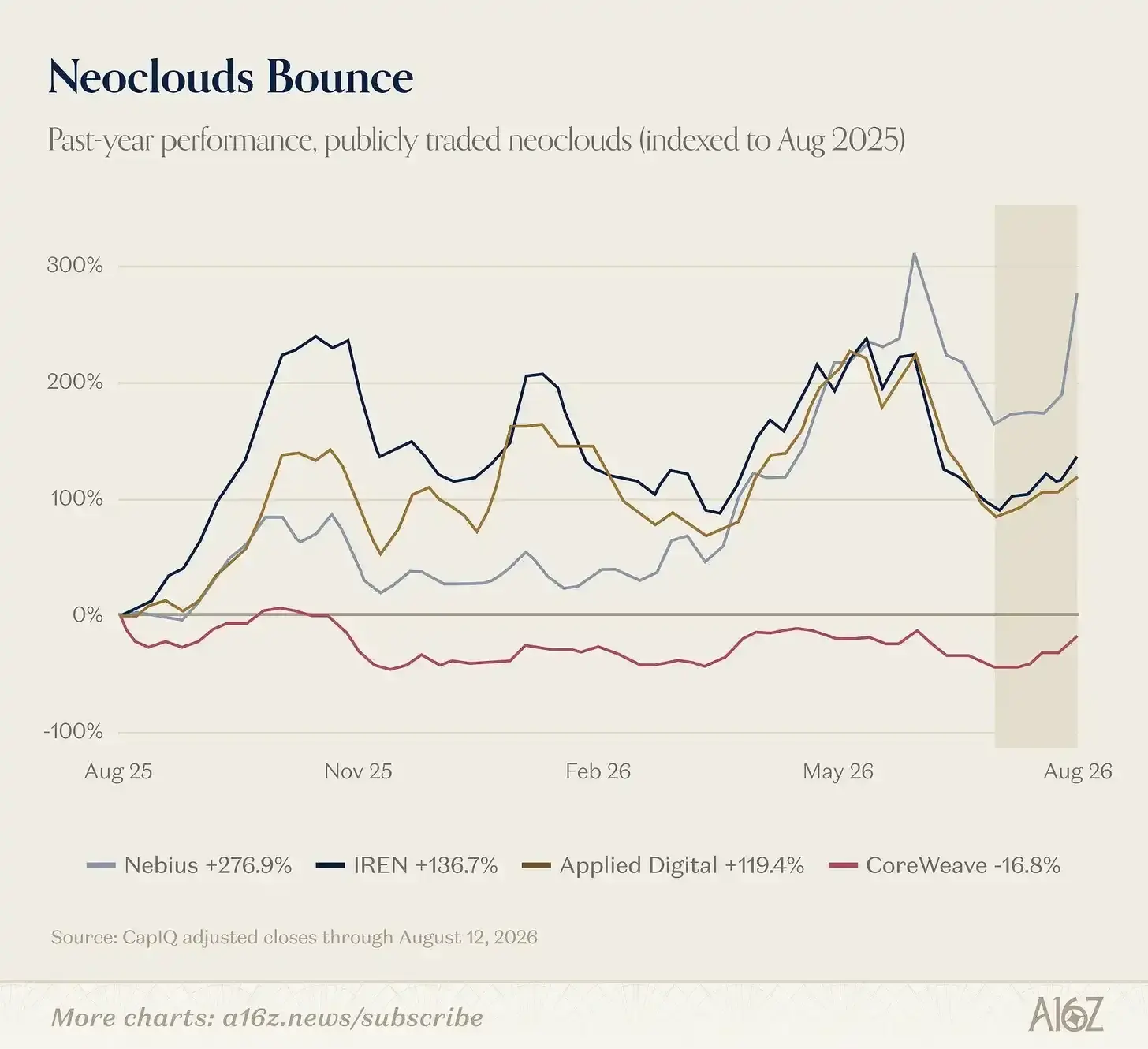
Even with generally solid recent earnings reports, neocloud stocks have not moved in lockstep with revenue. Sternstein writes that CoreWeave shares were down about 16% over the past year, while Nebius stayed closer to earlier highs. His conclusion is not that the neocloud story has broken, but that investors are treating the largest name in the group with more caution.
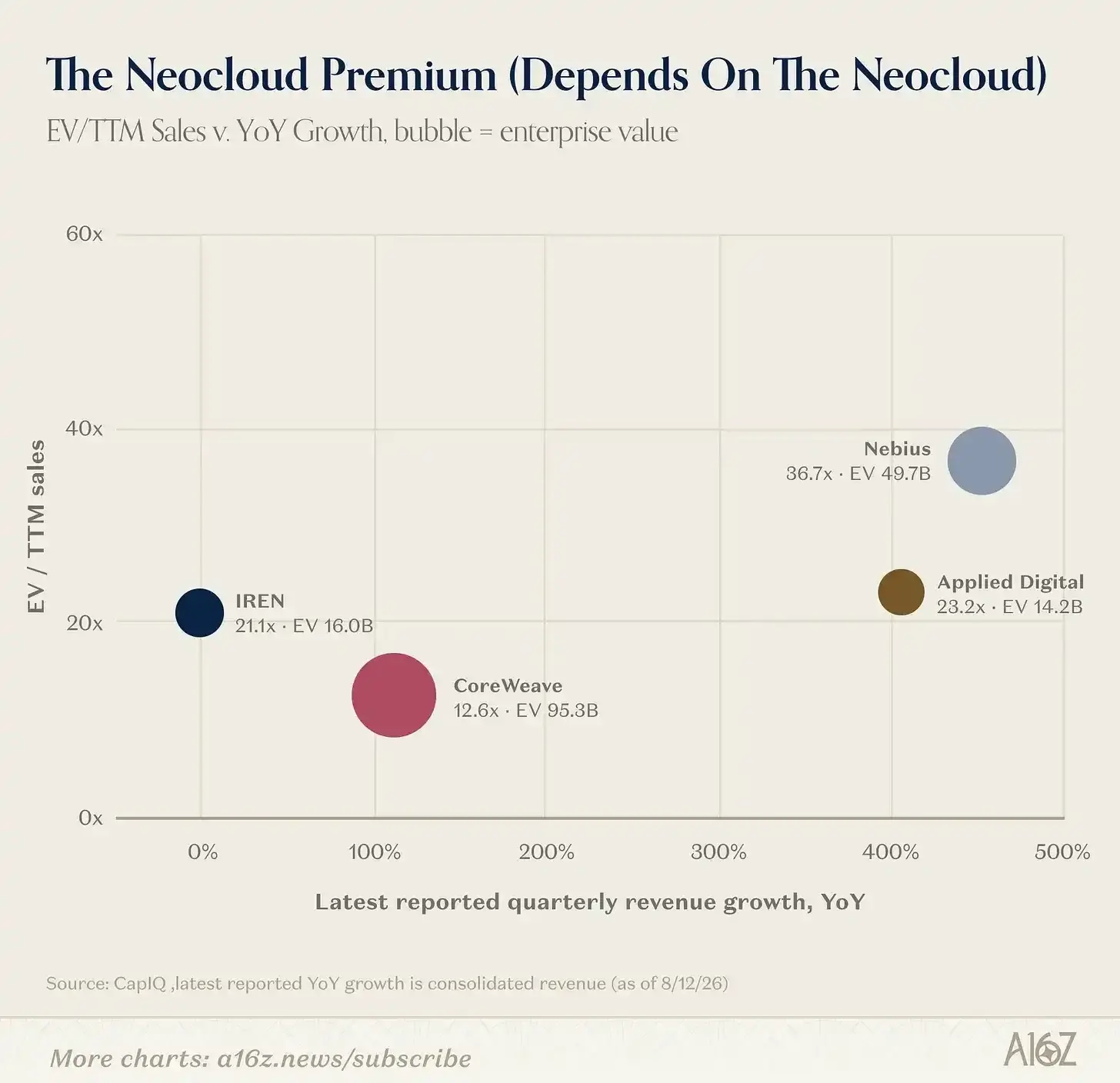
Part of the reason, he says, is that a lot of the growth narrative may already be reflected in valuation. Price-to-sales is not the best metric for a capital-intensive business, but it still illustrates the point. Smaller and faster-growing companies such as Nebius and Applied Digital trade at much richer premiums than the much larger CoreWeave. CoreWeave is still doubling revenue, yet that lags the 400% to 450% growth rates of the fastest names.
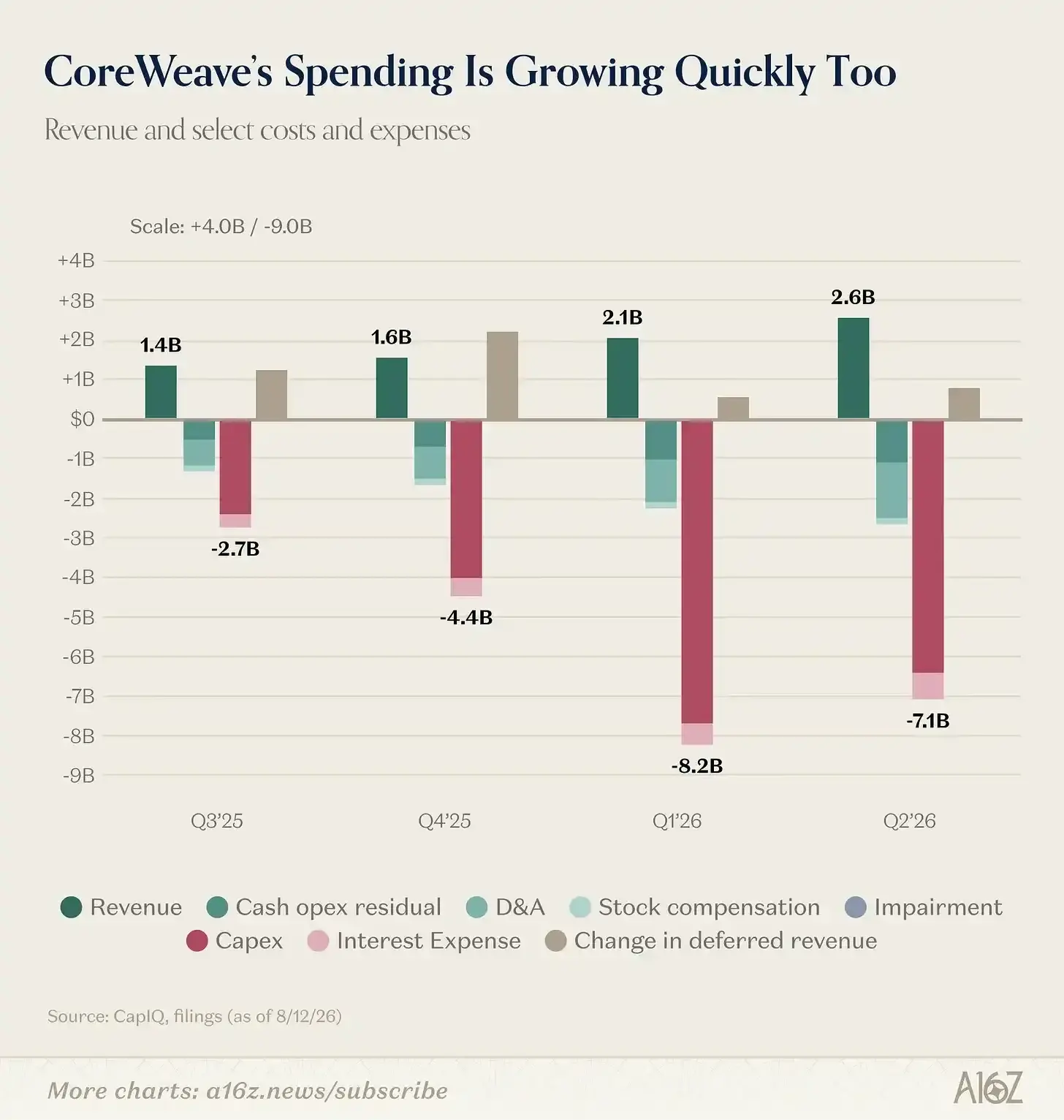
Sternstein argues that the real issue with neoclouds is not growth. It is long-term profitability. These companies have to keep spending on chips, power, and physical infrastructure to scale, and those costs are substantial.
CoreWeave is his main example. Revenue growth is strong, but capital expenditure is even more striking. Other major costs include chip depreciation, which the article says has already climbed above half of revenue, and rising interest expense from debt taken on to build costly infrastructure ahead of demand.
That leads to the article’s core tension. Rapid revenue expansion proves that AI compute demand is strong. It does not, by itself, prove that the business can deliver high returns on capital. What the market wants to see is whether bookings and revenue can eventually become sustainable free cash flow.
AI is not hitting SaaS evenly, and Atlassian is one example
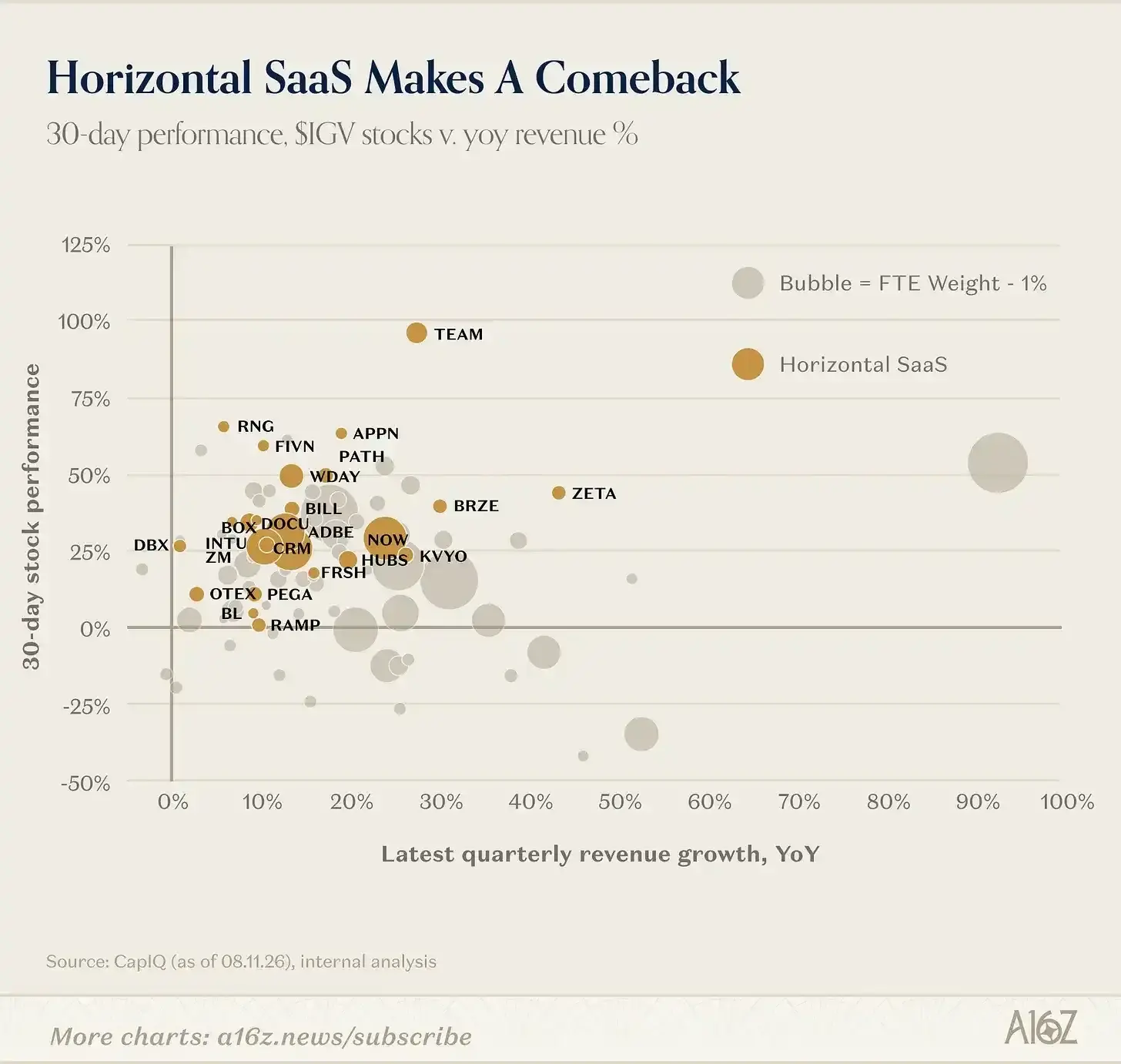
Sternstein then turns to software and revisits the shifting “SaaS doom” narrative. He writes that one of the hardest-hit software names from the earlier selloff has had a strong month. Over the past 30 trading days, horizontal software companies ranked near the top of performance inside the IGV software ETF, though some of those gains had already faded from the date the data was captured.
Fundamentals, in his telling, still look sound across much of the group. Atlassian is the clearest example that AI is not automatically eroding every horizontal SaaS business. The company delivered a beat on both results and guidance. Its cloud revenue rose 31% year over year, and deferred revenue backlog grew even faster.
The more important signal may be how AI is affecting product usage and customer spend. Atlassian said its AI assistant, Rovo, has seen broad adoption. Customers using Rovo were growing their spend at nearly twice the rate of customers not using it. Sternstein frames that as good news for Atlassian, for Rovo, and for horizontal SaaS more broadly.
He does not argue that the debate is settled. Horizontal SaaS still trades at slightly lower valuations than other software categories. With a few exceptions, including Atlassian, expected price-to-sales multiples for horizontal SaaS companies remain below the level implied by their growth-to-multiple trend line. In other words, one solid month is not enough to convince the market that the “SaaS doom” narrative has disappeared.
Cybersecurity and observability software look different. The article says cybersecurity continues to outperform other categories in the IGV software ETF. There, AI is being treated as a tailwind because it raises perceived cyber risk, and enterprise customers are unlikely to piece together their own security stack through what the article calls “vibe coding.”
Token spending is shifting from brute force to efficiency
The next section looks at model usage, token consumption, and token spending management. Databricks is the main example.
Instead of treating model choice as a winner-take-all problem or simply giving engineers a budget to experiment with, Databricks asked a different question: what happens if tasks are automatically sent to the model best suited for them? The company built what it calls a Smart Router.
Sternstein notes that Databricks is not alone in pursuing this approach, but says the company has been pleased with the results. According to the piece, the router can call stronger and more expensive models when needed, while shifting to weaker and cheaper models when the task allows. Databricks says that setup has “consistently reduced average task cost by more than 30%.”
He argues that pushing toward a token spending efficiency frontier is hard to view as negative. Demand is still growing, and use cases are spreading beyond the absolute frontier of model quality into lower-cost model tiers that earlier bearish narratives assumed would be quickly displaced.
The article ties this to a Jevons-paradox-like dynamic. Better efficiency can widen demand rather than shrink it. Sternstein cites Silicon Data’s token price intensity index, which shows overall price intensity declining, especially as lower-priced open models take a larger share of an expanding market.
He also pauses to clarify a point he says is often misunderstood: these indexes track the cost intensity of token spending, not the absolute dollar amount. They depend on both token volumes and blended token cost. That means total token consumption and total spending can still rise even if the price per token falls.
Ramp and BCG data both point to a sharply tiered spending landscape
Sternstein says “AI demand” or “AI adoption” should not be treated as a single, uniform category. Heavy users and other users remain far apart. That matters because always using the best available model may make sense for some companies, but not for all of them. The market is quickly producing more alternatives.
He cites data from Ramp showing that companies across the board are increasing AI spending, but the gaps are enormous between the median company and the top 10%, and again between the top 10% and the top 1%. The article notes that Ramp’s customer base tends to lean toward technology companies, which should be kept in mind when reading the figures.
Even with that caveat, one number is difficult to ignore: companies in the top 10% by AI spending are spending about 50 times more per employee than the median company.
Sternstein suggests that this pattern is probably not random. Companies extracting more value from AI are likely to be among the heaviest spenders, even if that does not hold in every single case.
He then points to Boston Consulting Group’s analysis of 107 public companies. In that dataset, companies in the top two quintiles of token usage posted materially faster revenue growth than the rest.
The broader claim is that token demand and token efficiency are reinforcing each other. As companies find more value, they consume more tokens. That process still involves trade-offs between investment and return, and research always carries upfront cost. But for most companies, simply throwing more tokens at the problem was never an effective strategy. A future in which they need to do less of that is, in Sternstein’s view, a positive development.
OpenAI and Anthropic draw from overlapping but distinct talent pools
The article closes with hiring patterns at frontier AI labs. Sternstein notes that New Media recently saw two team members join OpenAI, then uses a few charts to look at where these labs are recruiting from.
He first references recent comments from Dario Amodei, who said he worries employees may be putting money ahead of mission. Based on Levels.fyi data, Sternstein says that concern may not be entirely misplaced. Taken at face value, Anthropic appears to be paying engineers very well, and well above engineers of similar seniority at companies such as Google and Tesla.
Another dataset, sourced from Live Data Technologies and presented by Truist Securities, shows both overlap and divergence in the talent pipelines of OpenAI and Anthropic.
Both companies recruit heavily from mega-cap technology firms. But only OpenAI has hired from Nvidia and Tesla, and both of those hires occurred in 2026, according to the article. Databricks, Snowflake, Palantir, and DeepMind also appear as shared sources of talent, and both labs have recruited a meaningful number of employees from Salesforce and Stripe.
The overlap seems to stop there. Anthropic draws a noticeable amount of talent from SaaS companies, while OpenAI barely does. OpenAI, by contrast, hires heavily from consumer internet, platform marketplace, and ad-tech companies, areas where Anthropic hires much less, with Airbnb, Netflix, and Uber listed as exceptions.
Fast growth is no longer the only question
The piece does not try to decide whether neocloud companies will ultimately win or whether their current share prices are correct. Its point is narrower and more structural. Neoclouds capture the push and pull inside the broader AI trade: they are serving a vertical market that has grown far beyond prior expectations, yet building these businesses requires massive fixed investment that continues to depreciate.
Sternstein’s compressed conclusion is that AI infrastructure has already shown it can produce very fast growth. The next stage will depend on whether companies can convert that growth into better capital efficiency. In that sense, the debate is no longer just about whether the CoreWeaves of the world can become the next cloud giants. It is also about whether the AI industry can move from raw compute expansion to sustainable commercial returns.