
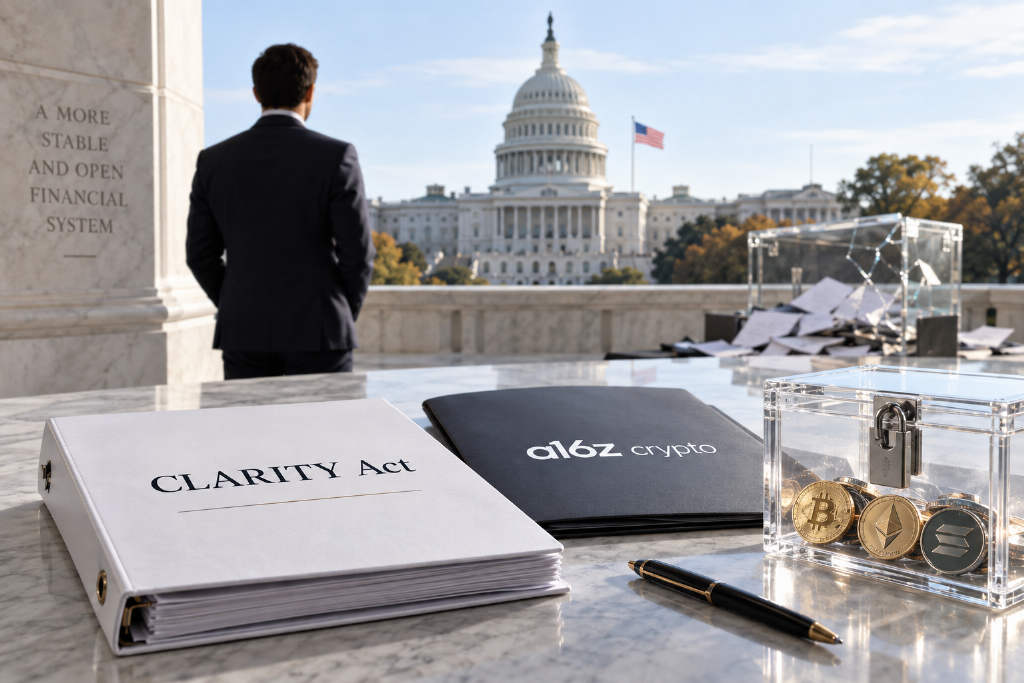
Nearly four years have passed since FTX, run by Sam Bankman-Fried and based in the Bahamas, filed for bankruptcy. In an article, a16z Crypto head of policy and general counsel Miles Jennings wrote that Congress has held hearings, the Department of Justice has secured a guilty verdict over the misuse of customer funds, and creditors have recovered nearly $10 billion. What Congress still has not done, he said, is put in place the legal safeguards that could have stopped or contained that kind of fraud earlier.
Jennings noted that the House has passed market structure legislation twice. The latest vote came in July 2025, when the bill passed with bipartisan support, 294 to 134. Earlier this year, the Senate Banking Committee and the Senate Agriculture Committee also advanced their own versions of the Digital Asset Market Clarity Act. According to the article, the Senate is set to vote on Sept. 15 on whether to open debate on the bill. If it is ultimately passed and signed into law, exchanges serving U.S. consumers would have to implement the safeguards FTX lacked. If it fails, those gaps remain.
FTX exposed missing safeguards, not an unusually complex fraud
Jennings argued that FTX was not a case where regulators failed to untangle an especially complicated scheme. In his telling, the exchange took advantage of a regulatory vacuum: there were no requirements for independent custody, segregation of customer assets, or meaningful disclosure, and no regulator was charged with checking whether those protections were actually in place.
Only after the fraud came to light and customers tried to withdraw funds did an $8 billion shortfall become visible, followed by FTX’s collapse.
What the CLARITY Act would add
The article frames these protections as old, not novel. Jennings pointed to the Commodity Exchange Act of 1936, which required futures commission merchants to segregate customer property. Broker-dealers in securities markets that hold customer assets must comply with custody, reserve, capital, disclosure, and examination requirements, including the U.S. Securities and Exchange Commission’s Customer Protection Rule. He also cited the Securities Investor Protection Act of 1970, which added another layer of protection when broker-dealers fail.
Those are standard features of regulated financial markets, he wrote. The question in Washington is no longer whether digital asset markets will exist, but what rules will govern them.
Under Jennings’ description, the CLARITY Act would bring digital commodity brokers, dealers, and exchanges into a regulated framework and import familiar guardrails from traditional finance, including:
- segregation of customer property;
- qualified custody;
- limits on affiliated-party conflicts of interest;
- mandatory disclosures;
- listing standards;
- restrictions on insider sales;
- and a designated compliance officer responsible for whether the firm follows the law.
The bill would also clarify the line between the SEC and the Commodity Futures Trading Commission, or CFTC. Jennings said the current framework leaves too much room for broad interpretation, and potentially for interpretation to be used as an enforcement weapon.
On asset classification, he wrote that the bill would no longer accept a project’s unilateral claim that it is “sufficiently decentralized.” Instead, it would apply a statutory test centered on control. Issuers would also face disclosure obligations, lock-up periods, and insider trading restrictions that he said are broadly similar to rules already applied to listed stocks.
His bottom line was simple: digital asset markets and their intermediaries should operate under rules closer to those used in traditional markets.
Three objections Jennings says should not stop the bill
Jennings said three arguments have repeatedly blocked the CLARITY Act from reaching the Senate floor: claims that it would loosen crypto regulation, concerns that public officials who hold crypto could benefit from the law, and fears that stablecoin rewards could drain deposits from banks. Each concern deserves debate, he wrote, but none justifies preserving current conditions.
1. The claim that the bill would weaken oversight
He said that argument starts from a false assumption: that all crypto assets are already covered by securities laws. Courts have repeatedly said otherwise, according to the article. For many digital assets, including Bitcoin and Ether, the view that they are not securities is not seriously disputed.
Jennings said the CLARITY Act tries to avoid two positions that both fail on the facts: that everything onchain is a security, or that nothing onchain is a security. Neither has matched reality, and consumers have borne the cost of leaving the issue unresolved. The “Wild West” critics warn about, he wrote, is the present situation.
He also argued that unclear rules helped FTX present itself as a legitimate business. An offshore exchange with no meaningful disclosure obligations could compete directly against U.S. firms, while domestic companies faced fragmented state rules, uncertainty over asset classification, and shifting enforcement theories.
2. The concern that officials holding crypto could benefit
Jennings acknowledged that this concern has merit. Public officials should not profit from the industries they regulate. But he drew a line between an ethics issue and a market structure issue. Whether officials can own assets is a government ethics question, he wrote. Whether a multi-trillion-dollar market should be subject to federal rules is a financial regulation question.
Combining the two does not solve conflicts of interest, he argued, and leaves millions of market participants without stronger protections. He added that the issue is not unique to crypto. Officials can trade stocks, own real estate, and hold interests in private companies. Writing ethics rules one asset class at a time would amount to a game of whack-a-mole, because anyone determined to benefit could just move to another path.
If Congress believes current ethics rules are too weak, Jennings said, it should strengthen them across all assets rather than let a market structure bill be tied up by a clause aimed at only one category. Under the current proposal, he wrote, the CLARITY Act would actually impose restrictions not seen before in this market. Rejecting the bill would not limit anyone’s holdings. It would leave those holdings in a market with no such federal structure.
He highlighted that the bill would require token issuers to comply with disclosure obligations, lock-up periods, and insider sale restrictions similar to those long applied to public-company shares. Right now, he said, none of those constraints exists.
3. The argument that stablecoin rewards would drain bank deposits
The third objection centers on stablecoin rewards. Banks argue that paying returns on stablecoin balances that resemble interest would create unregulated savings accounts and pull funding away from lending to households and small businesses.
Jennings wrote that there is no evidence supporting that claim. Even if it were valid, he said, the bill already addresses it. After months of negotiations, the text expressly bans passive yield, including any return that is economically or functionally equivalent to deposit interest, while still allowing rewards tied to genuine activity. The latest draft would also let the Treasury Department add more restrictions if evidence of deposit outflows actually appears.
He said the real dispute is not about deposits. The White House Council of Economic Advisers estimated that even a full ban on those returns would affect bank lending by about $2.1 billion, roughly 0.02% of total bank loans. Jennings described the argument as an anti-competitive case wrapped in the language of financial stability.
Jennings says the market has grown too large for regulation to keep lagging
Any version of the CLARITY Act that reaches the president’s desk will be a compromise, Jennings wrote, because legislation is built through compromise. Still, he said, the crypto industry should accept being brought inside the U.S. regulatory perimeter in exchange for a clearer legal foundation. In his view, that is plainly better than the current setup.
He also argued that regulators cannot solve the problem by themselves. Rules written by an agency can be reversed when a new leadership team takes over. If a party has standing to sue, the rule can also be tied up in litigation for years. The industry has already seen how a change in administration can alter its legal position.
Companies that hold customer money should not be building compliance systems on a framework that may not survive the next election, he wrote. Under those conditions, institutions are also unlikely to invest in critical infrastructure. The certainty the market needs can only come from statute.
Jennings warned that if Congress keeps delaying, the next failure will be larger. When FTX collapsed, crypto was still largely retail-driven and more peripheral to the broader financial system. He argued that this is no longer the case.
He pointed to the GENIUS Act, passed by Congress in July 2025, which created a federal framework for dollar-denominated stablecoins. Since then, stablecoin supply has exceeded $300 billion, trading volume has climbed sharply, and stablecoin issuers have become one of the largest holders of U.S. Treasuries.
But the GENIUS Act covers onchain dollars, not the blockchain infrastructure that moves them, Jennings wrote. Other onchain markets are growing as well. Tokenized assets have surpassed $30 billion in market value, with use expanding beyond crypto-native products into a wider set of traditional assets.
The article also said that the depository subsidiary of the Depository Trust & Clearing Corporation, or DTCC, holds more than $114 trillion in securities. DTCC completed its first live tokenized asset transactions in July and plans to launch a full asset tokenization service next month. BlackRock, Fidelity, Franklin Templeton, and Goldman Sachs are already operating digital asset businesses and have publicly backed the bill.
Jennings ended by saying bipartisan negotiators have already done the hardest work, and the Senate should finish the job. Every additional week without rules, he wrote, still allows exchanges to hold Americans’ assets without adopting protections that have long been standard in other regulated markets.