Mega-Fund Seed Surge: Data and Trends
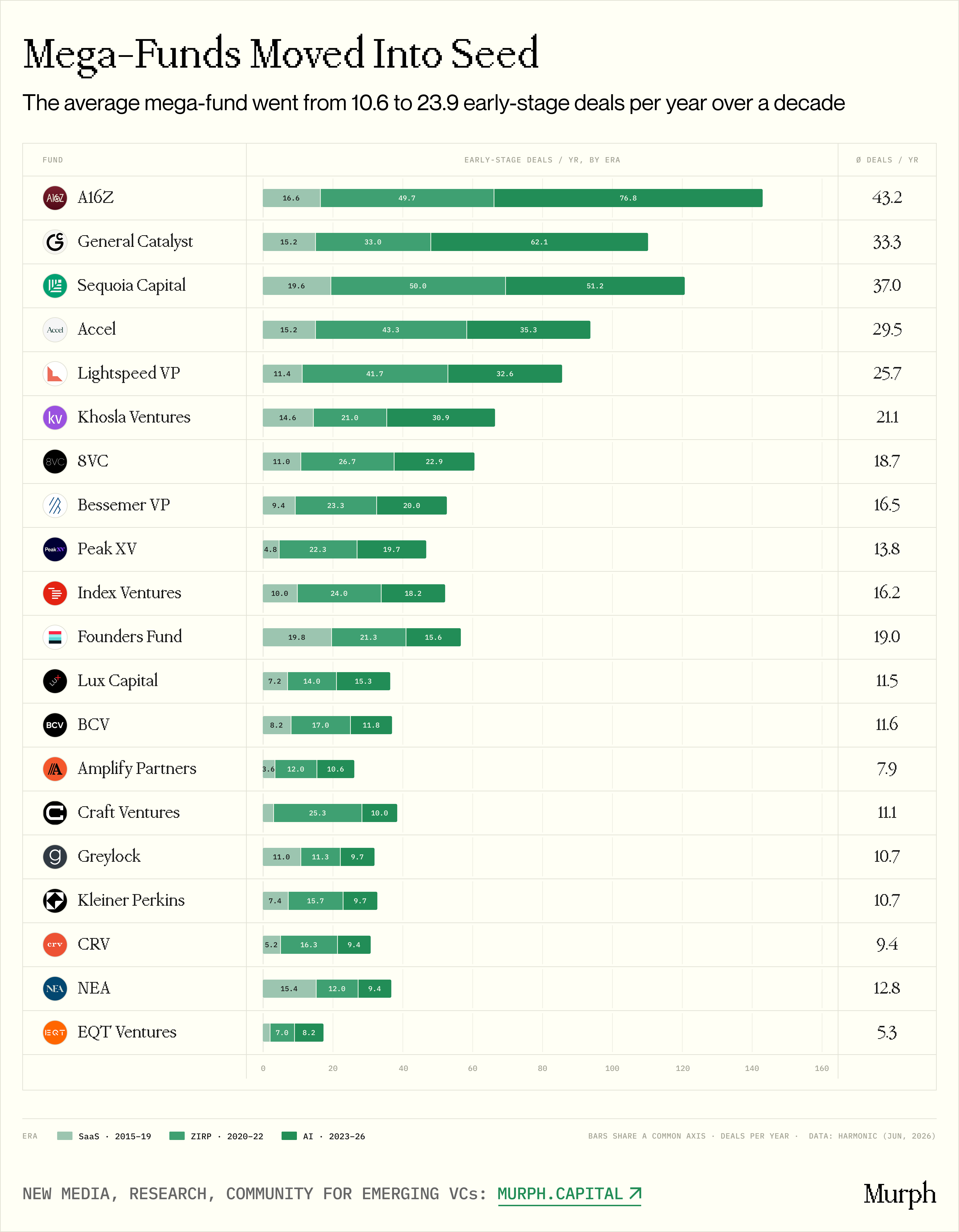
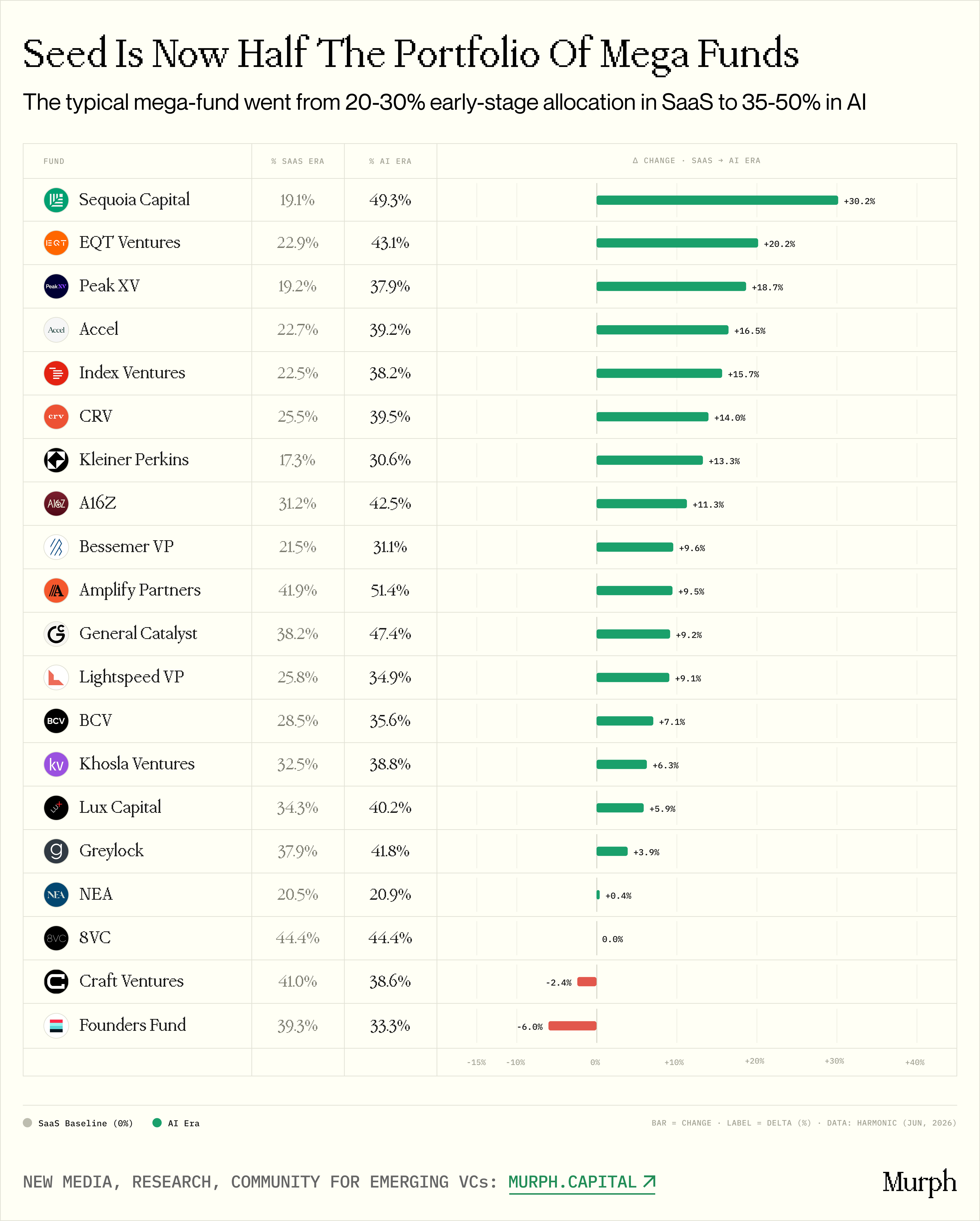
Mega-funds managing over $10 billion in assets are pouring into seed rounds at unprecedented rates. Murph Capital used Harmonic data to analyze 20 top mega-funds across three cycles: SaaS era (2015-2019), Zero Interest era (2020-2022), and AI era (2023-present). In the SaaS era, a typical mega-fund completed 10.6 early-stage deals per year; by the AI era, that jumped to 23.9 deals, a 2.37x increase. Crucially, the growth did not reverse after the end of zero interest rates: the AI-era average annual deal count (23.9) is nearly identical to the Zero Interest era (24.3), with only 3 funds reducing early-stage activity. This confirms the shift is structural.
Three Drivers: AI Costs, Founder Pricing Power, and Fund Size Mathematics
Three core factors drive mega-funds' continued expansion into seed. First, AI-native companies are inherently more capital-intensive: GPU infrastructure and research scientists earning $300,000-$500,000 annually raise baseline costs from $500,000 (SaaS: two engineers + AWS) to $2-5 million. Second, competition for top founders shifts pricing power: the best AI founders can choose between a16z, Sequoia, and Lightspeed at seed stage, forcing mega-funds to accept higher valuations. Third, fund size mathematics: the combined AUM of the top 5 funds grew from ~$34 billion to ~$249 billion over a decade (7x), while seed deal counts only grew 2-4x. A $6 million seed check represents just 0.01% of a $90 billion AUM fund; there is no incentive to haggle over every million in valuation.
Behavioral Divergence: Scalers, Steadies, and Contrarians
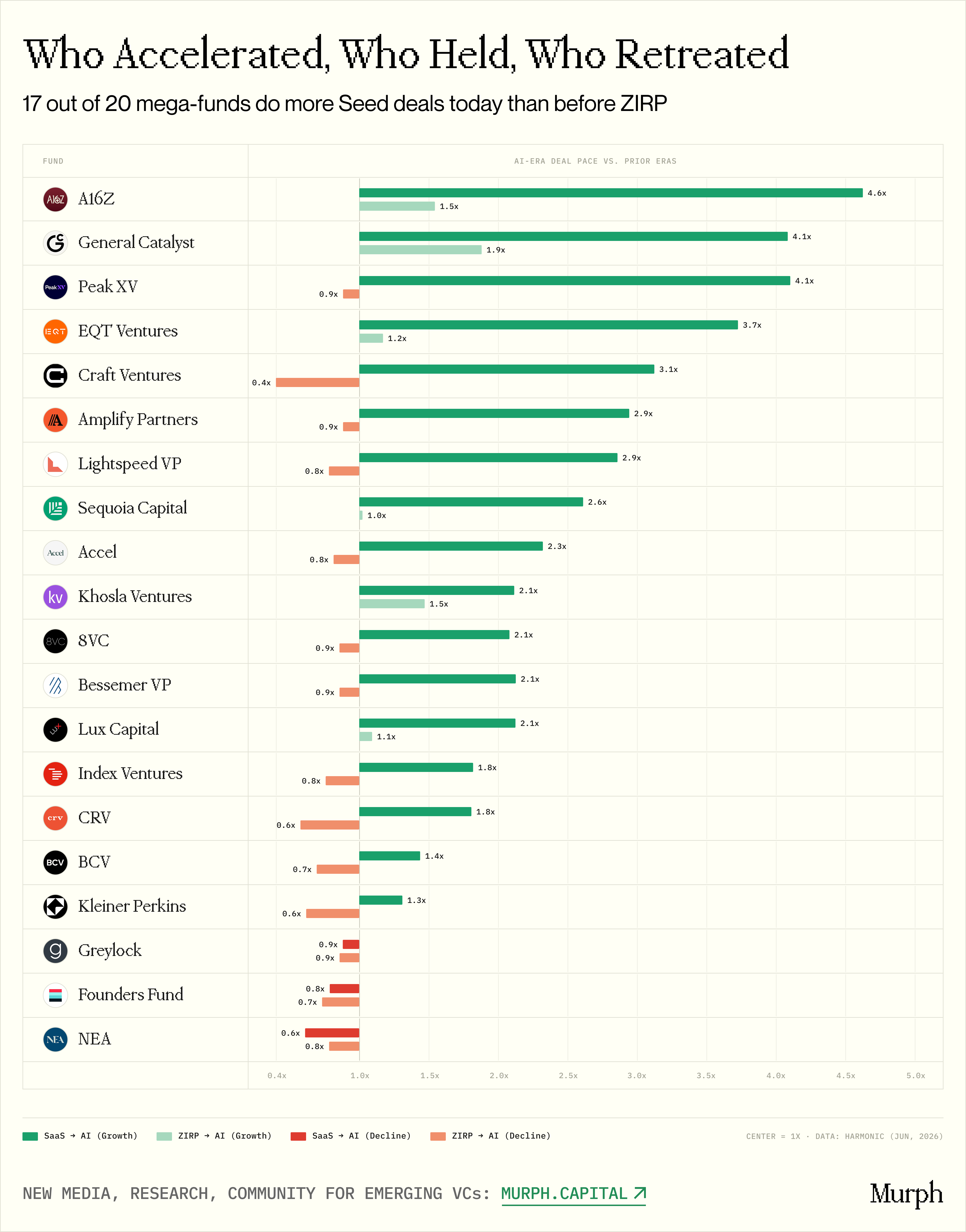
Macro divergence splits the 20 funds into three paths. Scalers (e.g., a16z with 75.3 deals/year, General Catalyst 61.5, Khosla 31.5) increased deal volume even beyond Zero Interest peaks. Steadies (Bessemer 9.4→20.9, Lux 7.2→14.7, Index 10.0→17.6) have a permanently elevated baseline at 2-3x historical levels. Contrarians (Founders Fund, NEA, Greylock) reduced or flatlined early-stage activity. Founders Fund, influenced by Peter Thiel's mimetic theory, actively avoids crowded consensus, pivoting to large late-stage bets (OpenAI, Databricks, Anduril). Greylock maintains high conviction with low volume, while NEA's multi-stage mandate makes seed activity harder to isolate.
Market Stratification: Super Seed vs. Classic Seed
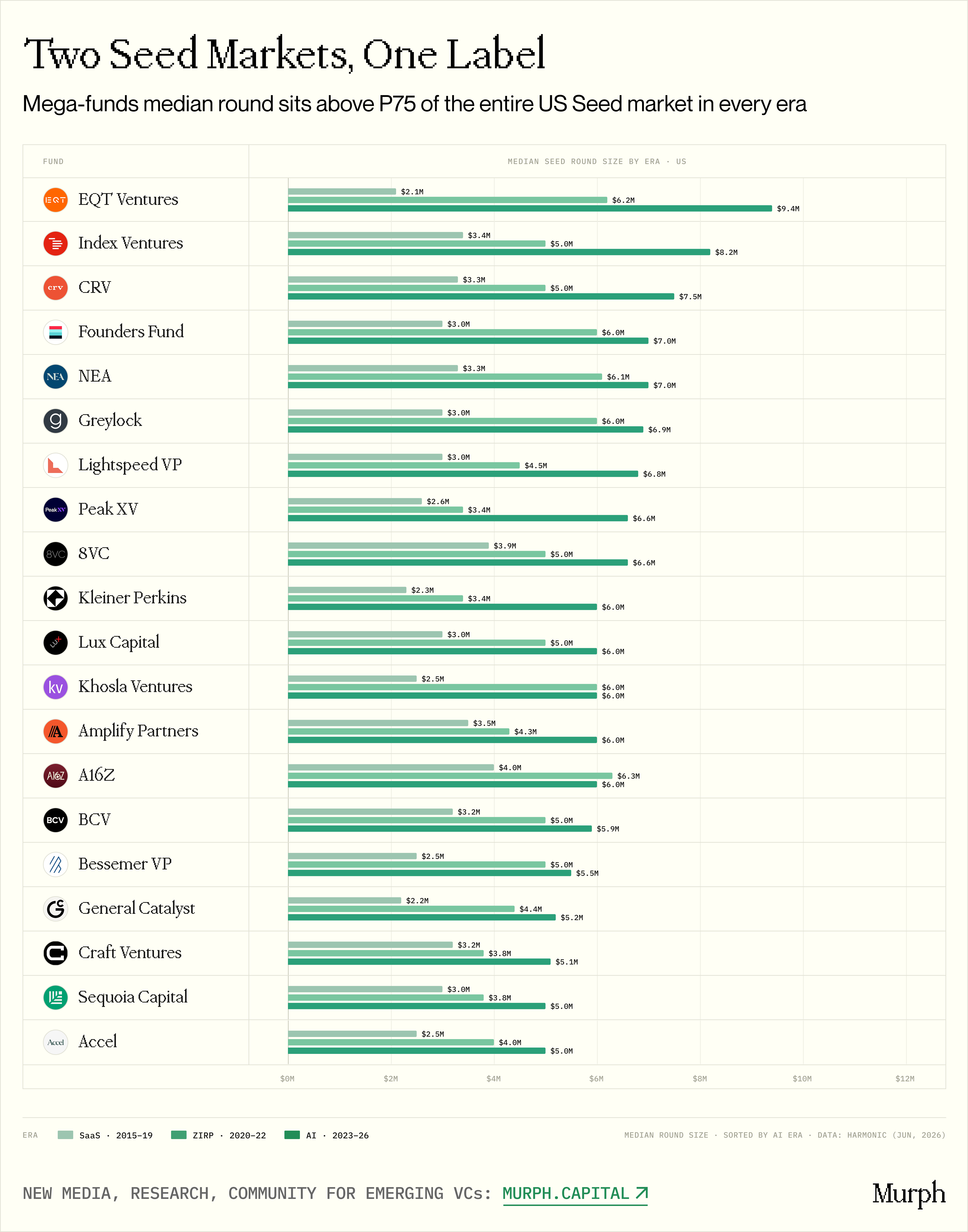
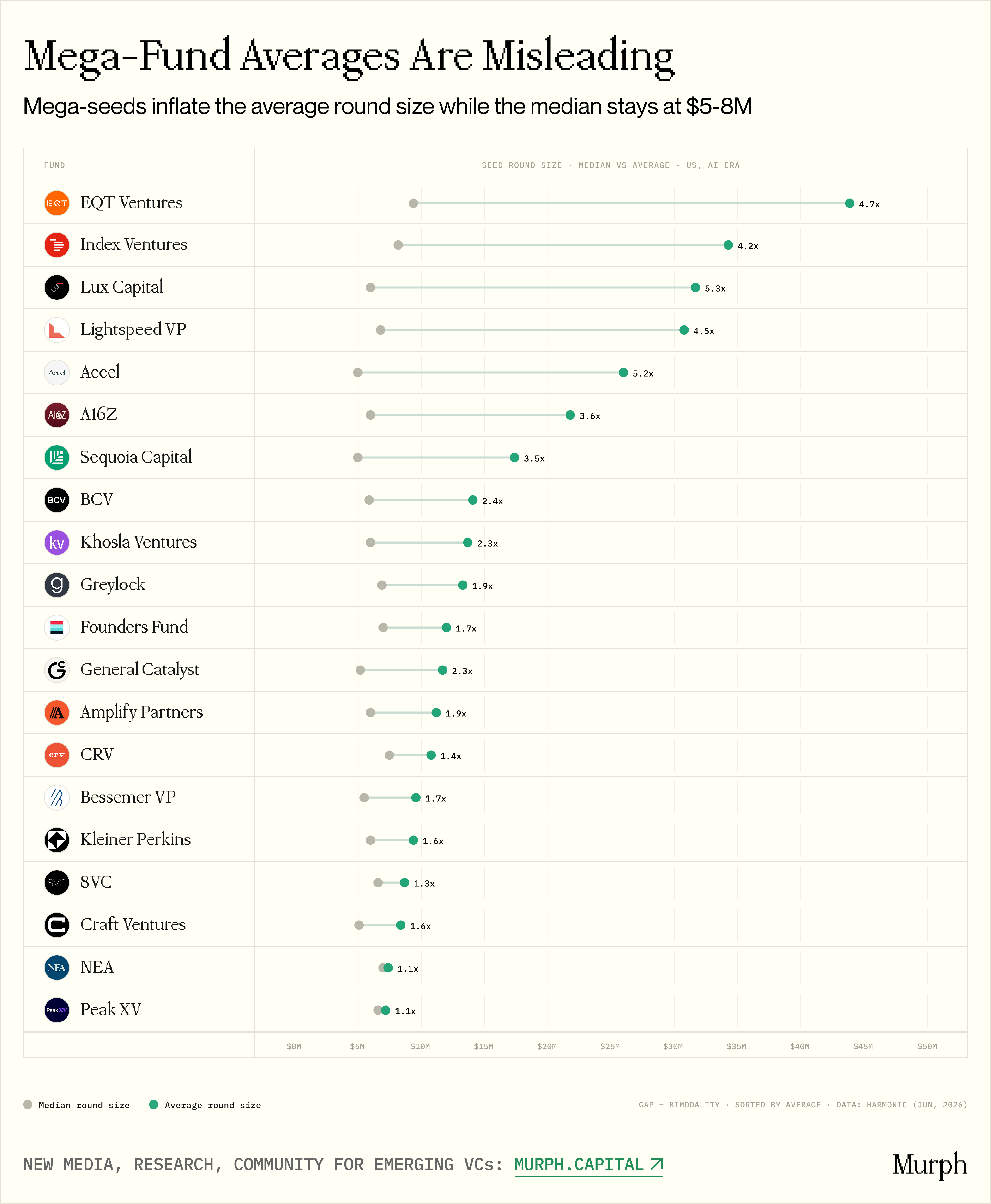
Mega-funds' median seed round size is ~$6.2 million, or 4.3x the overall U.S. seed median ($1.45 million), systematically operating in the top quartile. The gap between median and average reveals a "dual-track strategy": funds like Index (median $8.2M vs average $34.3M, 4.2x spread), Lux (5.3x), Lightspeed (4.5x) simultaneously play classic seed ($5-8M) and super seed ($50M-$500M+); while "homogeneous" funds like GC, Khosla, and Bessemer concentrate in the $5-8M range. For emerging managers (EMs), the real competitive pressure comes from homogeneous funds, not dual-track ones (which operate in super seed where EMs rarely compete).
Lead Strategies and Sector Focus: Enterprise AI and Cybersecurity Dominate
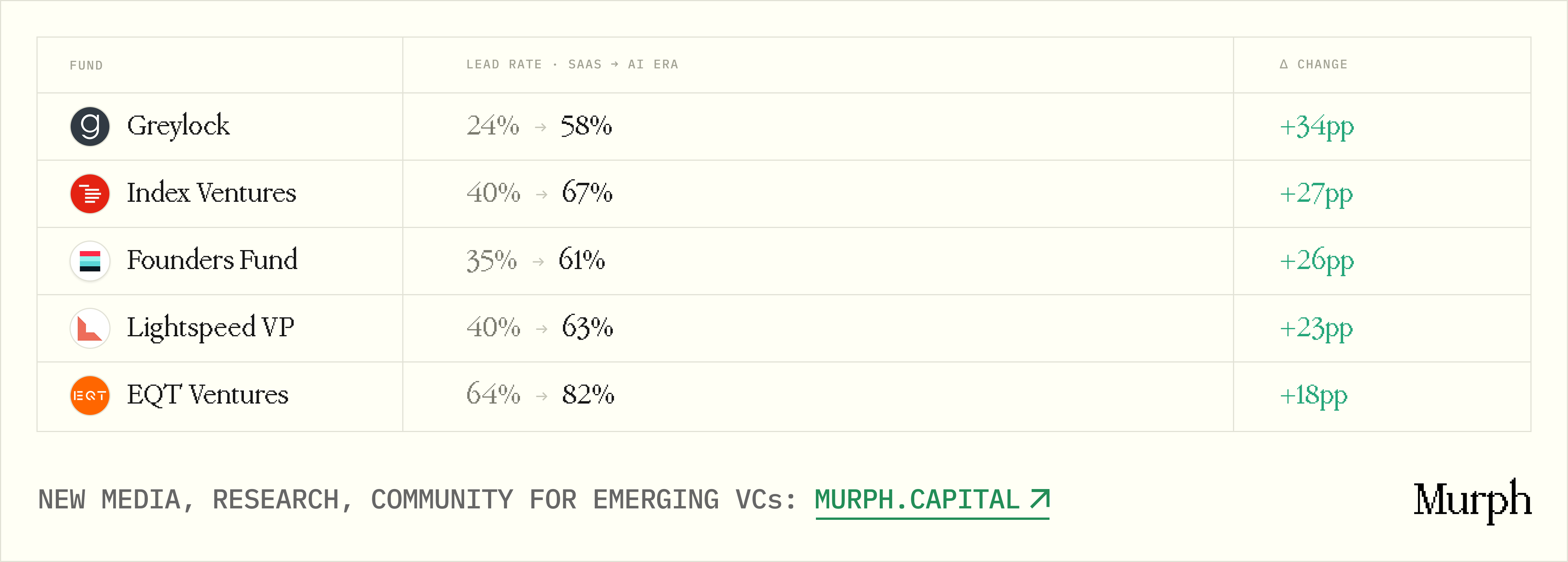
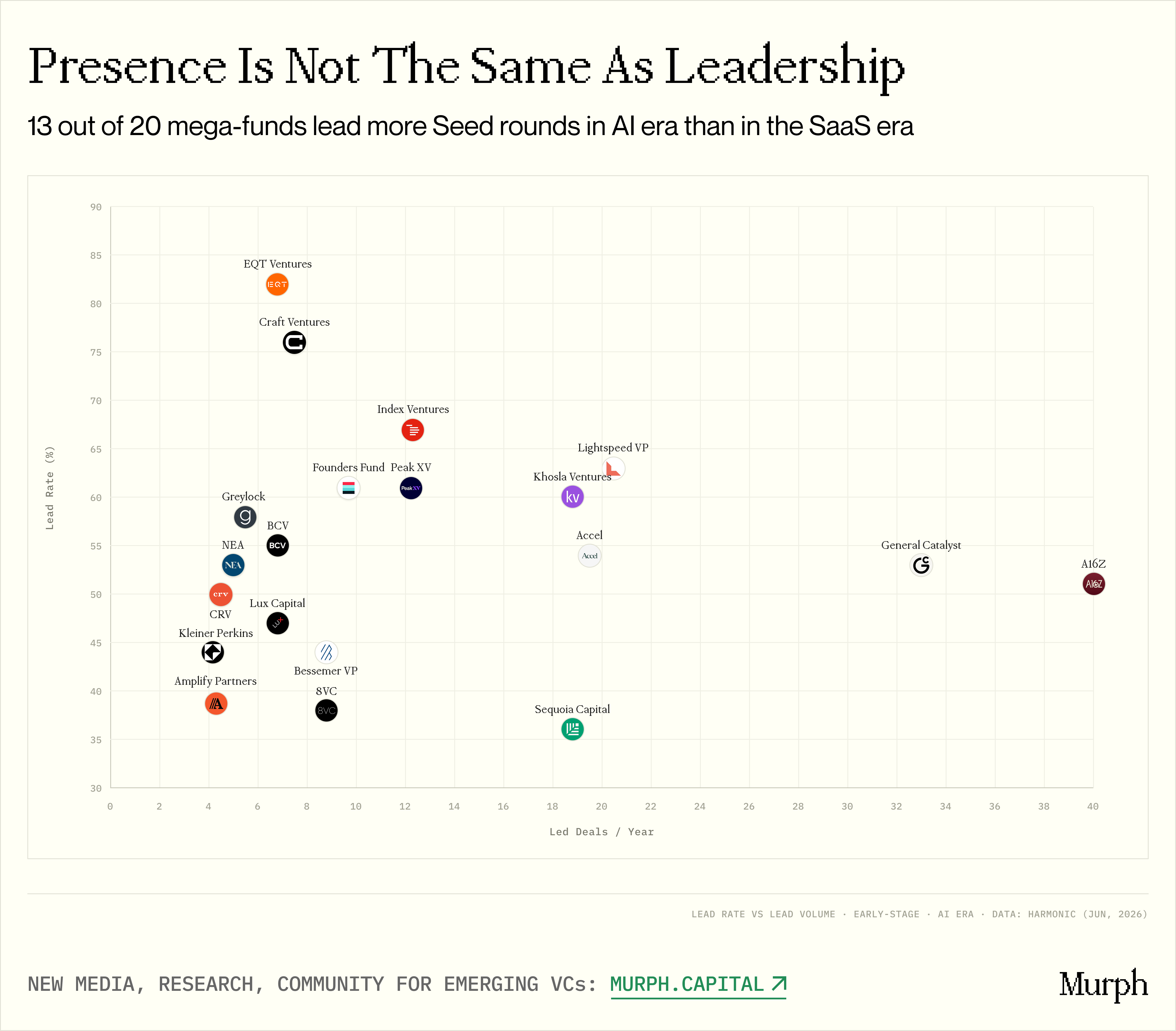
Lead rate analysis reveals four types: conviction leaders (Khosla 60% leads, Lightspeed 63%) are most dangerous; scale leaders (a16z 51%, Sequoia 36% — lower percentage but high absolute leads); active leaders (Greylock rose from 25% to 50%+); and balanced followers (Founders Fund, etc.). Sector-wise, enterprise AI & automation plus AI infrastructure together account for 42% of all early deals, with all 20 funds active. Enterprise AI spending surged from $1.7 billion in 2023 to $37 billion in 2025, a 20x increase in two years. Cybersecurity shows 76 deals but a 62% lead rate; defense & aerospace has 66% lead rate but only 12 active funds. Sectors like climate & energy and logistics are relatively undercrowded, offering breathing room for EMs.
The Conversion Paradox: Scale vs. Quality Trade-off
Mega-fund-backed seed companies reach Series B at 3.7-4.2x the market average, and the gap is widening. However, during the Zero Interest era, funds that scaled most aggressively saw the steepest conversion rate declines: Sequoia tripled deal volume (20→50 deals/year), conversion collapsed from 46% to 14%; Lightspeed quadrupled volume (12→42 deals/year), conversion dropped from 31% to 11%. The only exception, Greylock, kept volume flat (11.0→11.3 deals/year) and saw conversion improve from 29% to 44%. This confirms a persistent tension between deal volume and portfolio quality. Mega-funds have yet to prove they can maintain sourcing ability at scale.
Danger Index Ranking: Survival Strategies for Emerging Managers
The study constructs a Danger Index (max 30) based on three dimensions: deal volume, strategic commitment (percentage of capital to early stage), and price overlap (median round size). Tier 1: General Catalyst (26), a16z (25), Sequoia (24), Accel (23). For an EM competing in AI software at $4-6M rounds against GC and a16z, they must clearly articulate their edge to LPs. In contrast, an EM leading $2-3M climate tech rounds faces structurally lower institutional pressure. Conclusion: mega-fund intrusion into seed is a permanent recalibration of VC. The true advantage for EMs lies not in matching deal flow volume, but in disciplined sector selection, patient underwriting of complex unit economics that mega-funds overlook, and the courage to stay small, high-conviction, and deeply founder-aligned.