

Applied Optoelectronics, or AAOI, reported second-quarter results on Aug. 6, extending its streak to five consecutive quarters of record revenue, according to the company’s earnings release.
The top line set a new high, but the income statement and cash flow statement pointed in a less straightforward direction. In the same quarter, GAAP gross margin fell to one of its lowest levels in the past six quarters, and a GAAP net loss remained even though non-GAAP profit turned positive.
Two businesses are driving the revenue increase
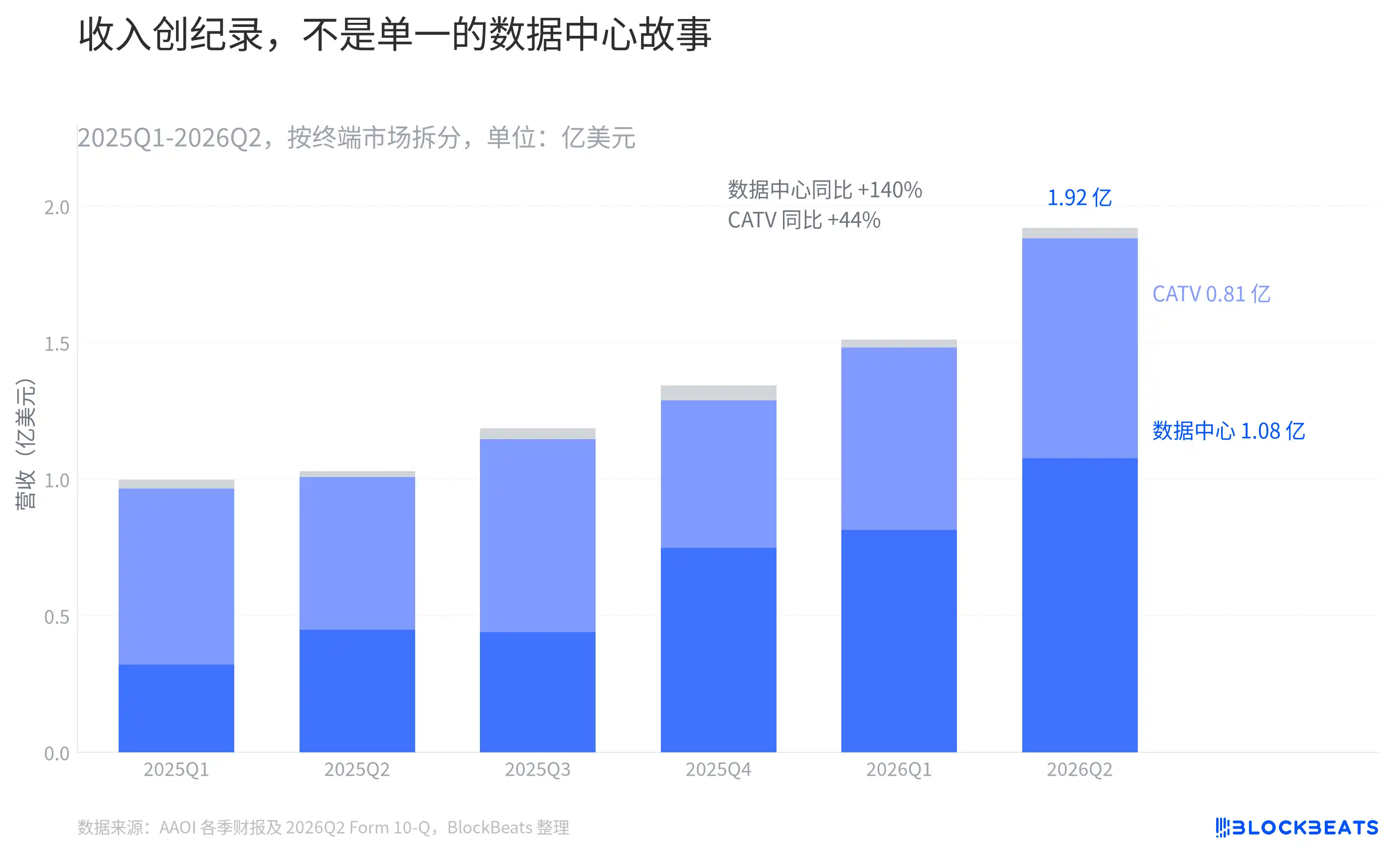
The sharpest growth came from data center products. Company figures show data center revenue rose 140% year over year in the second quarter, while CATV, or cable television broadband, revenue increased 44% over the same period.
That mix matters. AAOI is not relying on a single AI-linked demand chain for its current revenue growth. Data center modules are tying the company more closely to higher-speed network demand, while CATV keeps it exposed to a separate and more mature broadband upgrade cycle. Together, the two segments lifted revenue and reduced dependence on one end-market purchasing rhythm.
End markets, though, are not the same thing as customer concentration. AAOI’s quarterly report said Digicomm, a CATV product customer, contributed 42.8% of consolidated revenue in the first half. The same filing said the customer accounted for about 67.2% of accounts receivable at period end.
AAOI also said it offered Digicomm extended payment terms so the customer could build inventory in advance of network construction. Longer payment terms do not by themselves determine asset quality, but they do widen the gap between revenue recognition and cash collection. For a company buying equipment and expanding facilities, reported revenue and cash on hand are not interchangeable measures.
Why GAAP gross margin fell even as scale increased
Investors often expect larger volume to spread costs more efficiently. AAOI’s second-quarter results did not show that yet. The company reported GAAP gross margin of 27.7% and non-GAAP gross margin of 29.8%.
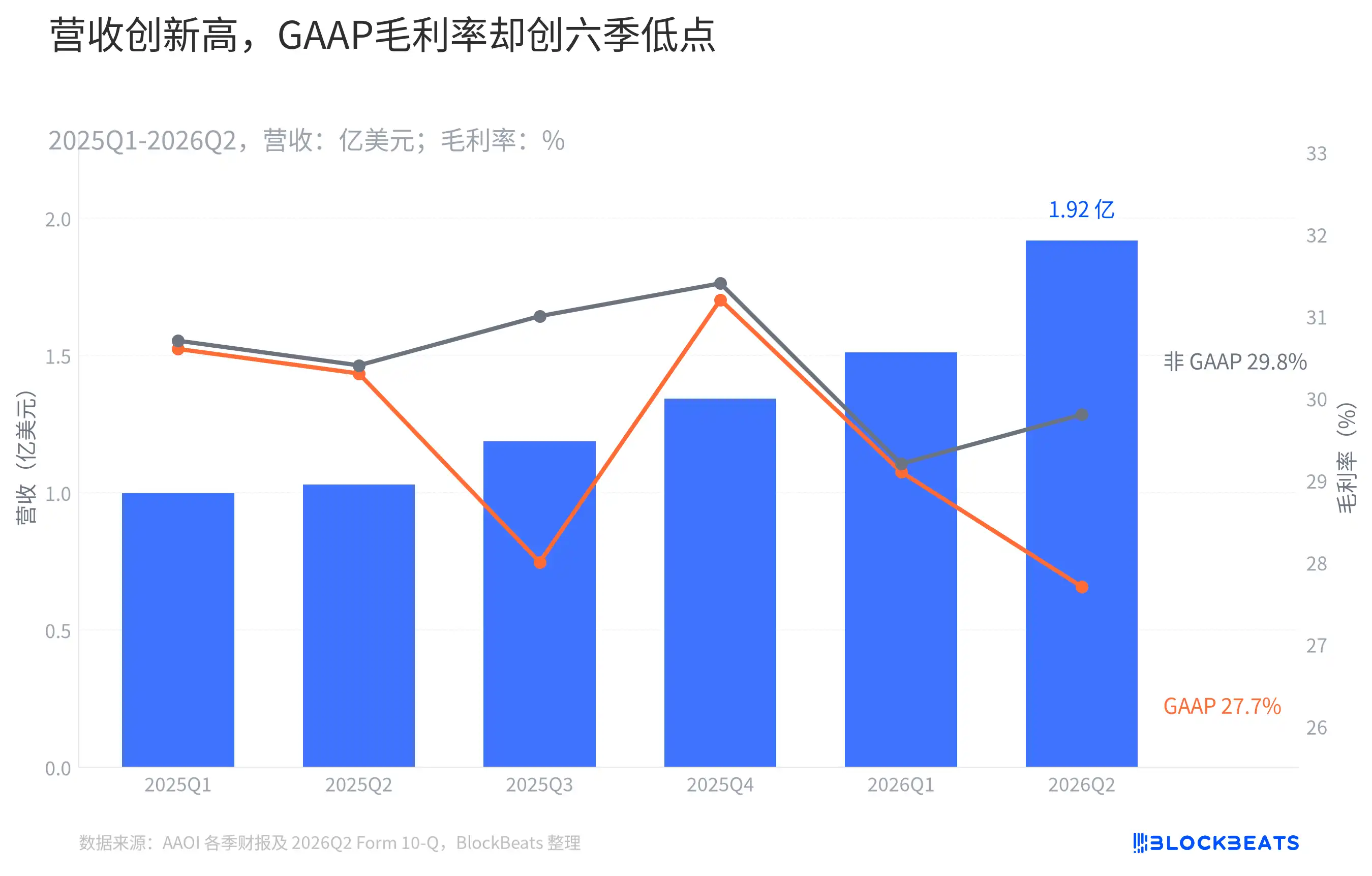
The distance between those two figures reflects costs that remain in the GAAP presentation but were excluded from the non-GAAP view. In its reconciliation table, AAOI said non-GAAP gross margin excluded charges tied to discontinued products. That can help isolate what the company defines as ongoing operating performance, but it does not replace the GAAP measure.
Management said 800G shipments more than doubled from the prior quarter and that the company is advancing capacity for next-generation modules. High-speed module production is not just a matter of running older lines faster. Equipment, process control, and yield all have to move through a new production threshold. Management said demand is still expected to outpace available supply capacity.
That is one of the easiest details to miss in the quarter. Revenue growth shows products are shipping. Gross margin shows whether expansion has already translated into more efficient manufacturing. The two do not move on the same timetable.
What changed when non-GAAP profit turned positive
In the second quarter, AAOI moved from a GAAP net loss to non-GAAP net profit. According to the company, the largest item in that bridge was a tax adjustment related to the excluded items above, totaling $14.26 million. That represented about 50.5% of the full reconciliation difference.
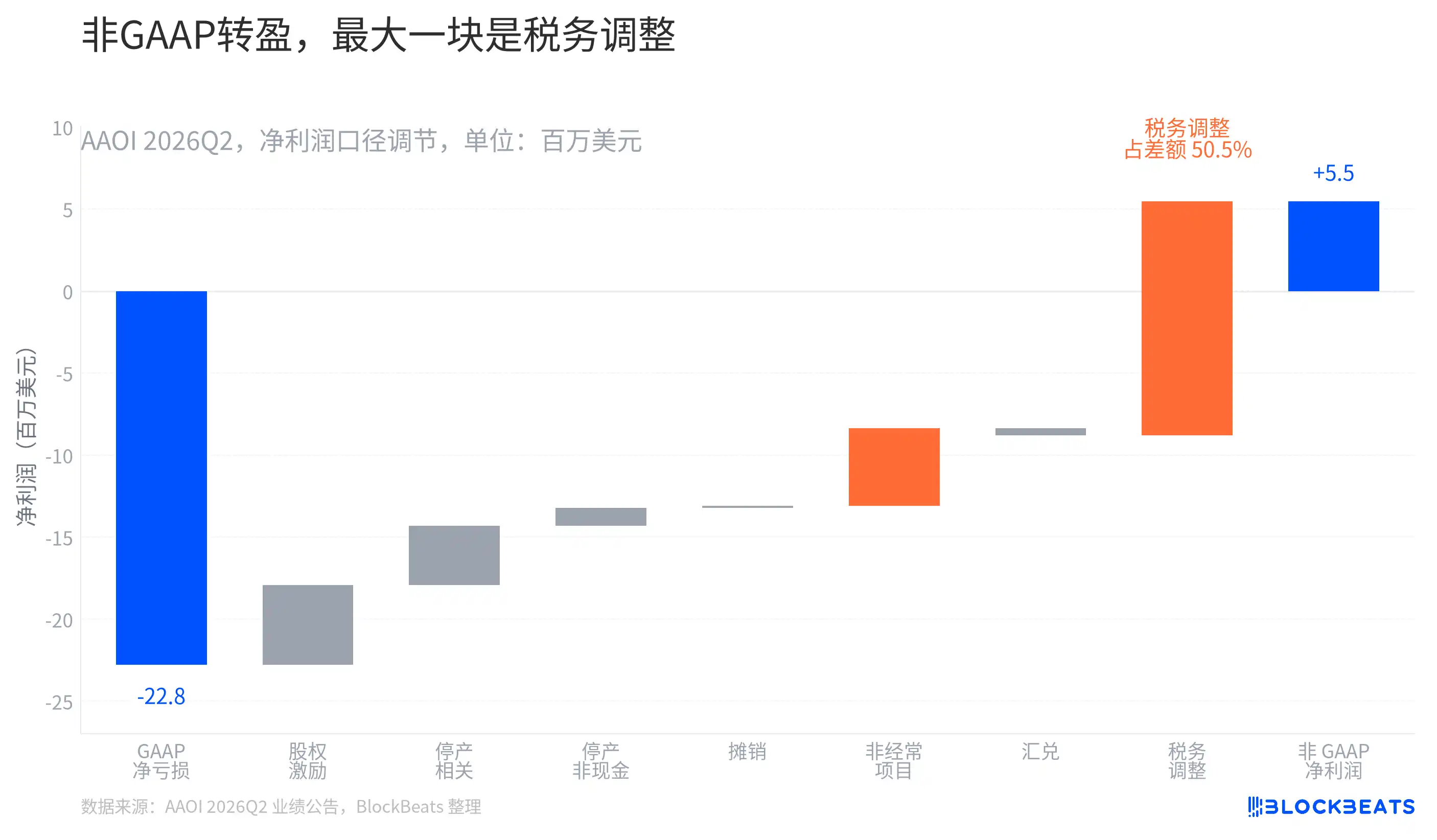
Other adjustments included stock-based compensation, charges related to discontinued products, amortization, non-recurring expenses, and foreign exchange items. Those costs did not vanish. They were removed under the company’s non-GAAP definition. The metric can be useful in assessing ongoing operations, but it should not be treated as a substitute for the GAAP income statement.
A more restrained cross-check came from adjusted EBITDA, which remained negative at $543,000 for the quarter. A positive non-GAAP net profit shows improvement in the adjusted view, but it does not by itself mean the expansion cycle is already funding itself.
Financing is carrying most of the expansion bill
The company’s cash flow statement offered the clearest answer on funding. AAOI’s quarterly report showed that net cash outflow from operating and investing activities combined reached $707 million in the first half. Receivables, inventory, as well as plants, equipment, and prepayments absorbed much of that capital.
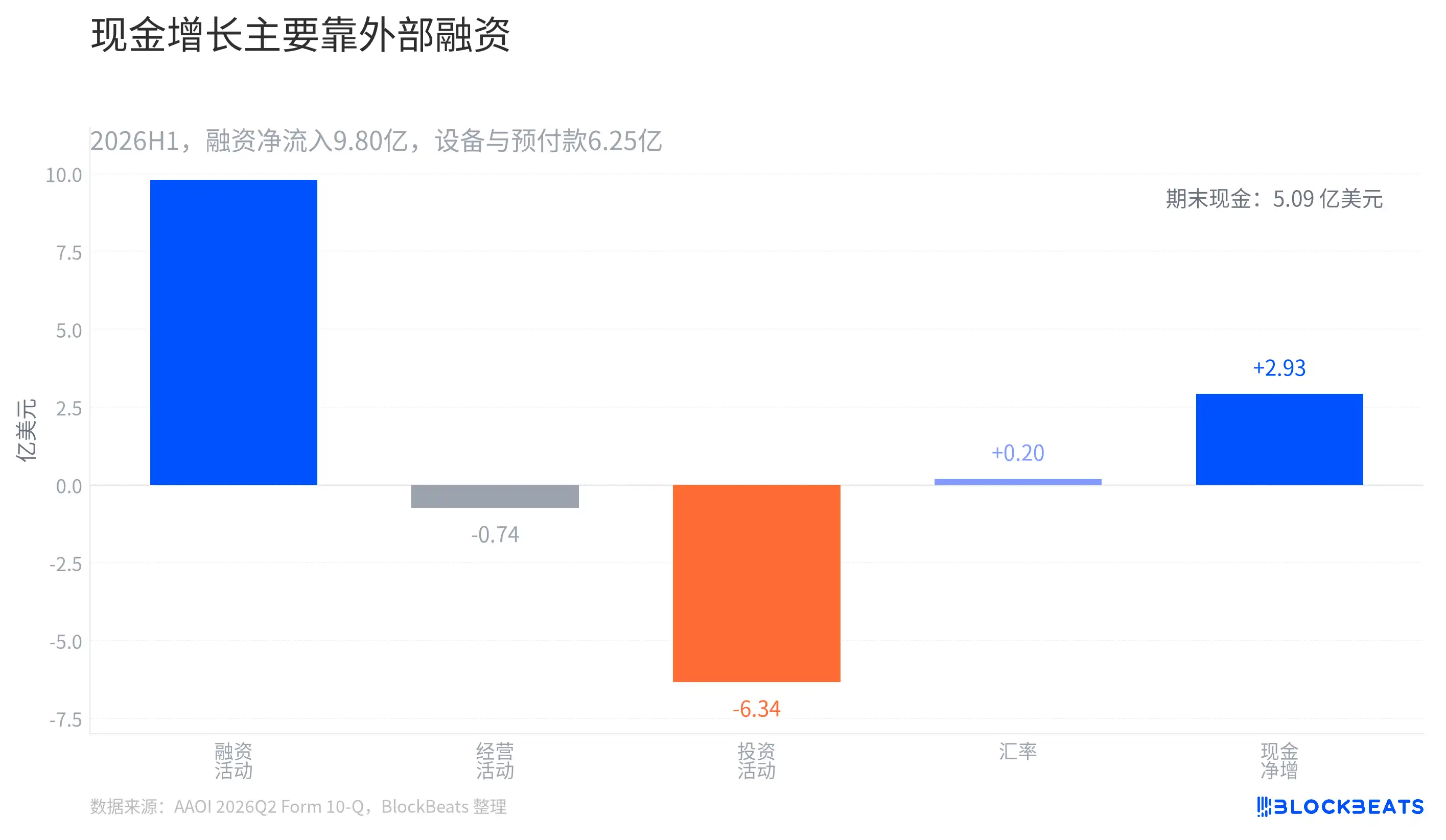
On the other side of the ledger, financing activities brought in $980 million in net inflow. Of that, net proceeds from the sale of common stock totaled $1.028 billion.
By period end, cash, cash equivalents, and restricted cash had risen to $509 million. The quarterly report said the increase was driven mainly by equity financing, not by a broad return to positive operating cash flow.
AAOI also said receivables, inventory, and equipment prepayments continued to tie up capital. Revenue growth is already visible in the financial statements. The funding behind the current capacity build-out is still coming primarily from financing.