

AAVE has drawn renewed attention as altcoins recover, but the protocol’s token buyback program has been paused for months since the Kelp DAO incident in April. That pause has kept the debate over AAVE’s value capture alive.
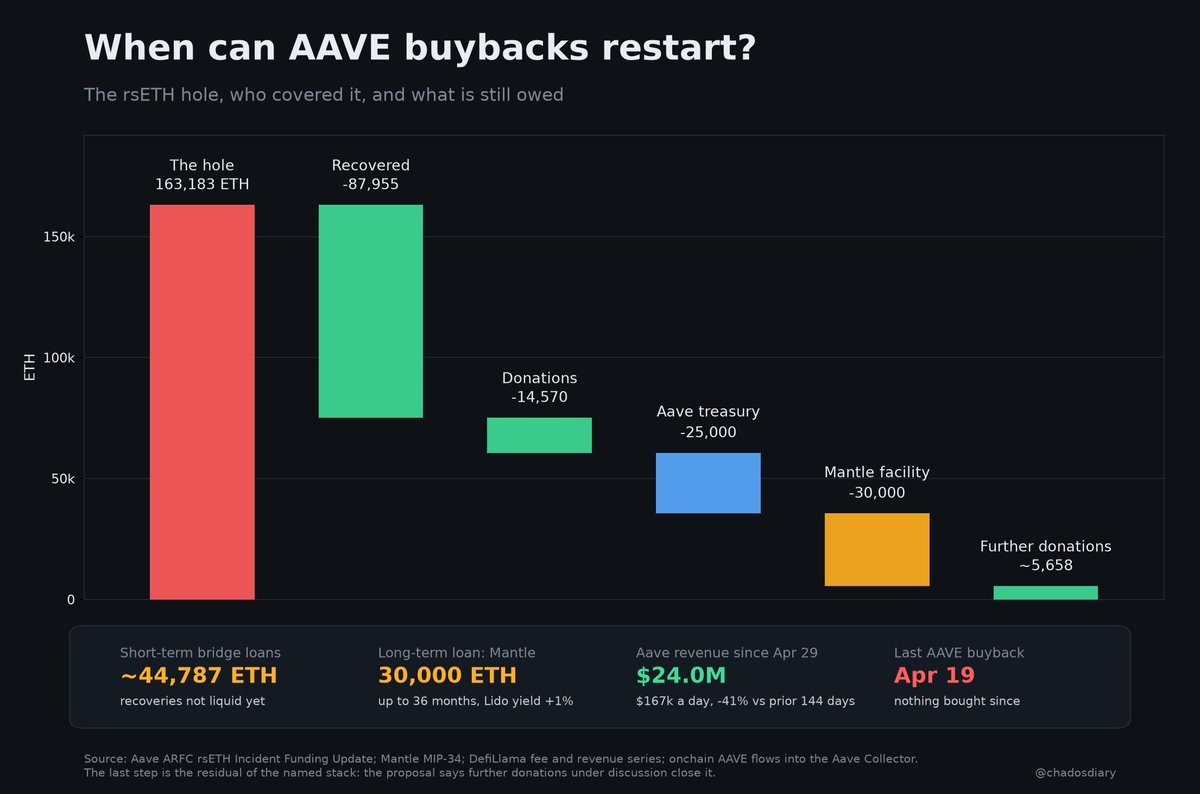
In research on when AAVE buybacks could return, DeFi researcher Chado argued that a restart is unlikely to come easily. The issue is not that Aave has no income. It is that protocol revenue may not be able to flow to AAVE holders before the balance sheet is repaired.
The April 18 rsETH incident remains the starting point
Chado’s analysis traces the current overhang back to the rsETH incident on April 18.
On that day, Kelp DAO’s LayerZero bridge route was attacked, and a large amount of rsETH that was not fully backed by ETH was minted and pushed into several on-chain markets. The attacker then deposited that rsETH into Aave as collateral and borrowed a large amount of WETH.
Aave quickly froze the rsETH and wrsETH markets and moved to contain the risk. Still, once the collateralized borrowing had already taken place, the losses did not disappear just because the markets were frozen. According to Aave’s later disclosure, 152,577 rsETH had at one point been stolen from LayerZero locked assets. Using the reference ratio at the time of 1.0696 rsETH to 1 ETH, that implied a gap of about 163,183 ETH.
Kelp later froze and recovered about 40,373 rsETH, equal to roughly 43,168 ETH. The Arbitrum Security Council froze 30,766 ETH held by the attacker. Liquidations of the attacker’s positions on Aave and Compound were also expected to recover as much as about 12,323 WETH and 1,845 WETH, respectively.
Those four parts added up to about 87,955 ETH, cutting the shortfall from more than 160,000 ETH to roughly 75,000 ETH. The remaining question was who would absorb what was left.
Aave committed 25,000 ETH and took on up to 30,000 ETH in long-term financing
In late April, Aave DAO joined EtherFi, Lido, Ethena, Mantle and others in a recovery plan called DeFi United.
The funding structure that emerged was complex. Ecosystem participants including EtherFi, Lido, Ethena, Ink, BGD and Stani, the founder of Aave, provided about 14,570 ETH in total. That portion was a donation and did not need to be repaid by Aave.
Aave DAO also contributed 25,000 ETH directly from its treasury to cover part of the loss. That amount was not structured as a loan and did not create a future repayment obligation, but it did leave Aave’s balance sheet immediately.
The rest was handled through borrowing. The largest piece came from Mantle, which offered a credit facility of up to 30,000 ETH. Under the plan, the facility could run for as long as 36 months, with an interest rate set at the Lido staking yield plus 1%.
Aave also needed about 44,787 ETH in short-term bridge financing so frozen or pending-liquidation assets could enter the recovery process first.
That makes the accounting easier to read. A gap of about 75,200 ETH was addressed with 14,570 ETH in donations, 25,000 ETH from the Aave treasury, up to 30,000 ETH in long-term financing from Mantle, and about 44,787 ETH in short-term bridge funding. At first glance, the total appears to exceed the original shortfall, but part of that capital was only temporary bridge funding.
Once the short-term bridge piece is excluded, the most direct balance-sheet impact on Aave comes down to the 25,000 ETH already spent and the long-term Mantle financing of up to 30,000 ETH that could weigh on future cash flow.
Retained income fell to about $24 million over 144 days
Chado then looked at Aave’s income over the 144 days after the incident. From April 29 to the time the research was published, the protocol generated about $181.2 million in total fees, but Aave DAO retained only about $24 million, or roughly $167,000 per day.
That was a clear drop from the period before the incident. In the previous 144-day stretch of the same length, Aave DAO retained about $40.5 million in income. On that basis, retained income in the post-incident period was down about 41%.
A static stress test points to roughly 473 days to repay the Mantle facility
Chado compared that income profile with the Mantle financing.
Assuming the full 30,000 ETH facility and using ETH at about $2,639 at the time of the calculation, the loan would be worth roughly $79 million. If Aave continued to retain about $167,000 per day, repaying $79 million would theoretically take around 473 days, or more than one year and three months.
He did not present that figure as a fixed repayment schedule. Nor did he say buybacks must wait 473 days before returning. He described it as a relatively extreme static stress test: if future income stayed at the current level and the DAO directed all retained income to repaying the 30,000 ETH long-term financing, it would take about 473 days in theory.
Chado said he ran the same exercise in April this year. At that time, Aave DAO was retaining about $266,000 per day, and a loan of the same size could have been repaid in about 10 months. With income now lower, the repayment period has stretched to about 15.6 months.
The key question is when revenue becomes free cash flow again
That, in Chado’s view, explains why AAVE buybacks have not returned. Aave still has income, but after the rsETH incident, that income is competing with balance-sheet repair and cannot easily be directed to AAVE holders first.
Aave has already used 25,000 ETH from the treasury to absorb part of the damage and still carries up to 30,000 ETH in long-term financing. Until that structure is worked through, the protocol’s captured revenue may struggle to become free cash flow again at the token level.
For that reason, Chado argued that AAVE’s next leg higher depends not only on the DeFi market itself, but also on two variables: whether protocol income can grow again, and whether the balance sheet can recover over time. Only when the money Aave earns no longer needs to be used first to fill the hole left by the incident can the token’s value-capture logic start working again.