

Abstract, the Layer 2 network under Igloo, the parent company of Pudgy Penguins, said on Oct. 7 that it will shut down on Dec. 15 this year. The project, once pitched as a consumer-focused L2 and backed by strong expectations from the Pudgy Penguins team and many NFT users, is ending after nearly two years of operation.

The announcement quickly split opinion across the market. One side argued that the team did not follow the path some L2 projects have taken by launching a token at the end and raising one last round of capital, framing the move as a relatively clean exit. The other side pushed back hard. In that view, the tens of millions of dollars in operating losses mentioned by Pudgy Penguins CEO Luca Netz, along with earlier engagement campaigns such as the badge system, were paid for in large part by users, while many participants had spent months expecting a future token that will now never arrive.
A consumer-chain thesis that failed to convert
Looking back at Abstract’s trajectory, the report argues that its positioning as a “consumer crypto blockchain network” may never have been a strong business to begin with.
According to Abstract, the network attracted more than 400,000 users and saw more than 144 applications deployed. Luca Netz also said the chain processed more than 325 million onchain transactions and launched Portal and AGW, drawing in global brands including Disney and Red Bull.
On paper, those figures do not look insignificant. Still, the article says the project ran into a strategic dead end similar to what it describes as a misread in the broader “crypto social plus onchain consumption” playbook over the past two years. It did not build a meme ecosystem of its own in the way Solana or Robinhood Chain did, and it also failed to go deep enough into DeFi around institutional and large-holder demand to attract liquidity and create a self-sustaining revenue loop.
Why Abstract is shutting down
The report, drawing on statements from Abstract and Luca Netz, lays out four main reasons behind the closure.
Weak DeFi traction
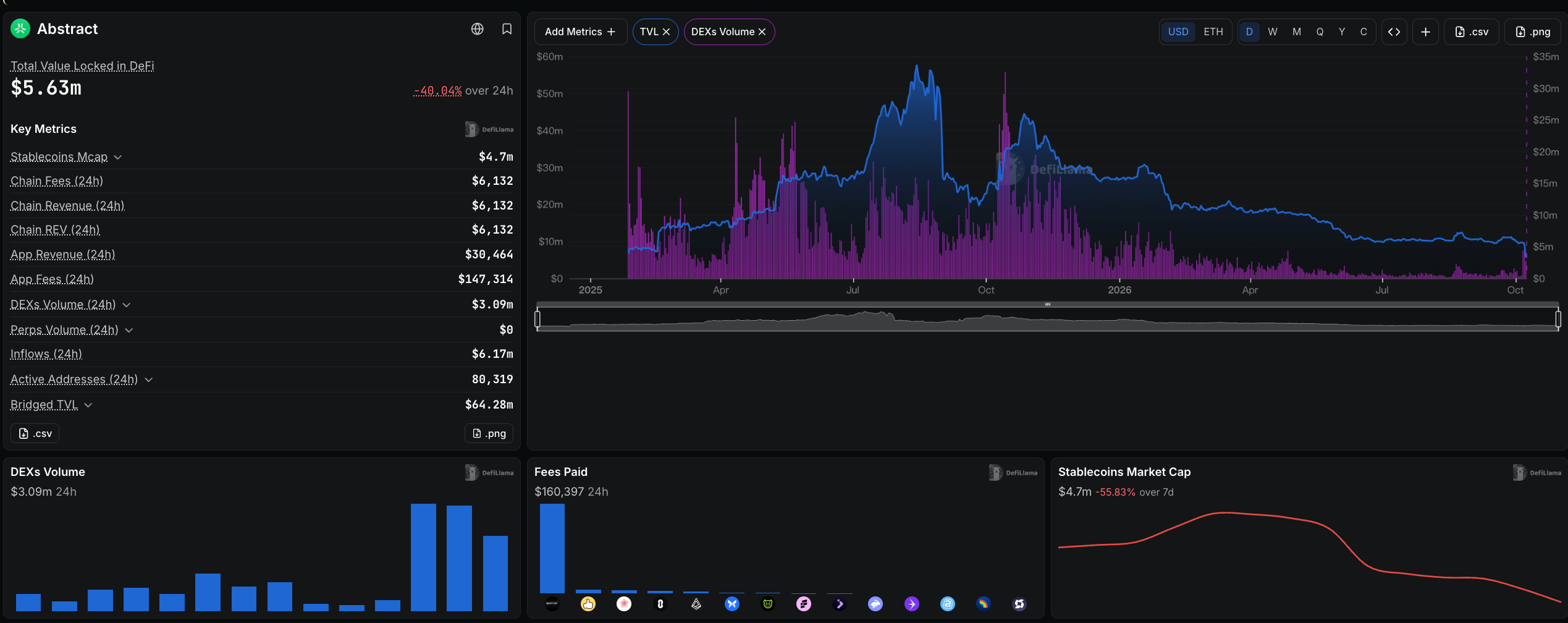
Abstract said cumulative DEX volume reached $6 billion. Even so, the article argues that this was not especially strong over an operating period of nearly two years. DefiLlama data cited in the piece showed Abstract’s DeFi TVL at about $5.6 million, ranking 90th among major L1 and L2 networks, with a 24-hour decline of roughly 40%.
Before the shutdown news, the report says, the network’s DEX volume had long hovered between $300,000 and $1 million. Stablecoin market capitalization was down nearly 60% over seven days and stood at only about $4.7 million.
For an L2 network, the article argues, if DeFi never gains traction, other headline metrics can only go so far. Limited DeFi activity usually means limited real users and weak ecosystem stickiness, making it difficult to generate sustainable income through fees and related business activity.
Low institutional participation and thin liquidity
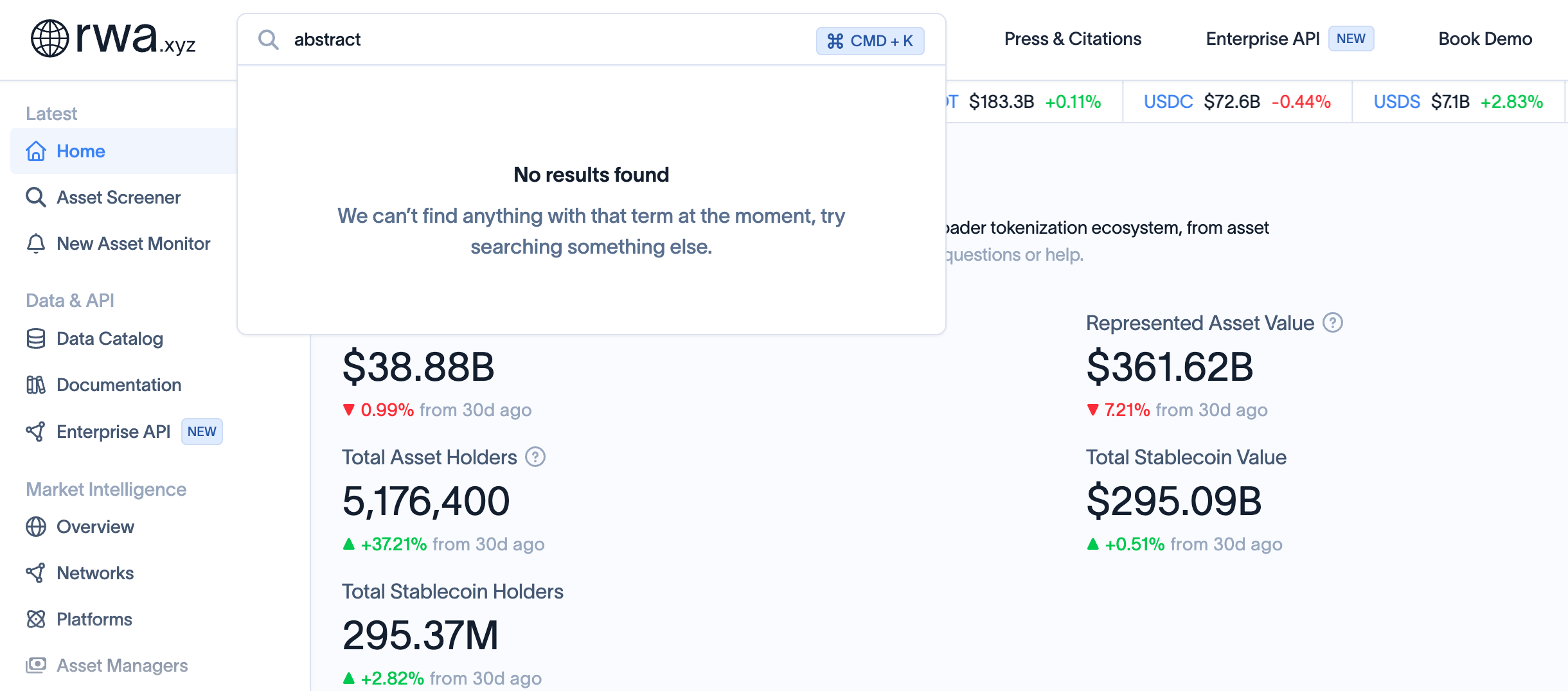
The article describes this as one of the key reasons for the shutdown. Using RWA data as an example, it says Abstract was effectively absent from network rankings tied to RWA TVL. It also says the chain largely missed the main shifts of the past two years, including institutional investment channels, the rise of tokenized real-world assets and stock tokenization trading across crypto and traditional finance.
In the report’s framing, that amounted to a serious strategic mistake.
High operating costs
Beyond the fixed costs tied to running an L2, the article lists sequencer operations, ZK-related data availability and proving costs, bridge and frontend maintenance, infrastructure buildout, team expenses, and ecosystem incentives or developer support.
It adds that partnerships with traditional brands and offline conference activity also required substantial spending. The broader point is that the L2 business is not as cheap as many assume. Early technical development, mid-stage growth operations and long-term ecosystem building all require continuous capital. In that reading, shutting Abstract down was also a move to stop the bleeding.
Falling demand and unclear product-market fit
The article says the market now expects more from L2s and even L1s than surface-level ecosystem activity. What is getting attention, it argues, are networks such as Hyperliquid and Robinhood Chain that can price traditional financial assets earlier, bring in liquidity from traditional markets and attract institutional capital, then turn that into ecosystem-level fee income.
That is precisely the segment Abstract, along with many other L2 networks, could not reach. The report also points to homogenous competition across L2s and the speed of crypto market cycles as additional factors behind the shutdown.
Community reaction: respectable exit or broken promise?
Debate intensified after the shutdown notice.
Yuga Labs VP 0xQuit wrote: “Abstract did the respectable thing. They could have copied Blast and done a TGE to raise a huge amount of money. Instead, they admitted failure and chose to wind the project down without a TGE. Yes, people still lost money, but it could have been worse. Respect.”
Crypto community member Loki agreed. He said Abstract could have done a TGE at any point before shutting down, like many L2 projects with no users, but did not. He also said Pudgy Penguins co-founder and CCO @chefgoyardi and CEO @LucaNetz bought the Pudgy Penguins project with their own money and had never extracted cash from the community, and that Abstract was another example of that integrity. In his words, the best part is that the team can now refocus on Pudgy Penguins.
Others were openly angry, especially users who said they had committed real money, time and effort to the ecosystem.
Micka, described in the article as a heavy Abstract user, posted on X that he had been involved with @AbstractChain since the testnet in July 2024. He said he built a French-language community, published thousands of posts about Abstract and streamed more than 1,500 hours of Abstract mainnet content in 2025. Over one year and 10 months, he wrote, he spent thousands of dollars and accumulated 4 million Abstract interaction experience points. Now, with the project ending in the first phase of the third stage of its roadmap, he said he was “speechless” and would “never trust Luca again.”
Another community member, Chris, said he had sold all of his PENGU tokens. He described the Space used to announce the shutdown as “terrible,” saying it felt improvised and poorly prepared. Chris said he could understand why the team did not want to launch an ABS token TGE and then shut the project down, but what he disliked was the broader framing of the response, including the way the team addressed the value of badges and early user support. He also pointed to Luca’s immediate “no” when asked whether any Abstract users would receive rewards from the Pudgy Penguins ecosystem. Chris said he had spent six straight months putting in major time and effort every week as a streamer, had created content around the vision, and was deeply disappointed by how things ended.
The article also notes that some users resurfaced an interview video from last year’s NFT Paris event, where Luca expressed strong confidence in Abstract’s future and said “Abstract will become the biggest L2 network,” asking people to wait and see. What arrived instead was a shutdown notice.
A broader shakeout question for L2s
The report places Abstract’s closure in a wider industry context. It says that after a wave of shutdowns involving some centralized exchanges, more L2 networks that cannot sustain themselves may also face an exit cycle. It groups Abstract and Blast with earlier failed narratives across NFT, GameFi and SocialFi, arguing that this is not the end of the retreat for what it calls “ghost town” chains.
The article’s final point is blunt: as more models and projects are tested and rejected by the market, teams that cannot build a real connection to traditional finance may need to rethink where they go next.