
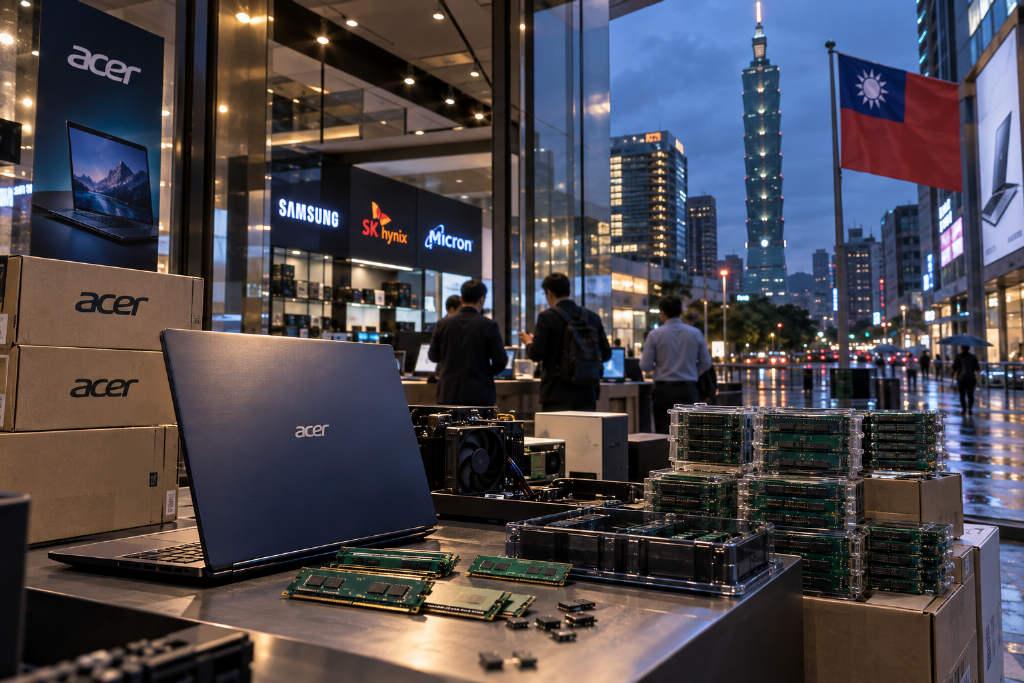
Acer Chairman Jason Chen said consumer DRAM is not facing a real shortage, pushing back against repeated public claims from the three largest memory makers that price increases could last through the end of 2027. Speaking over the weekend at the "Principled Management and AI International Forum" hosted by Global Views and Commonwealth Publishing Group, Chen said those statements are better understood as industry signaling under antitrust rules than as evidence of tight supply.
Chen questions the industry’s bullish pricing narrative
Since the start of this year, Samsung Electronics, SK Hynix, and Micron have each said in earnings calls and public appearances that the memory upcycle could extend into 2027 and even 2028. The report said Apple also accepted a contract price increase from Samsung under pressure, while major PC brands and channel distributors in Taiwan turned to Chinese memory products as procurement became more difficult.
Chen said he does not buy the broader shortage narrative. Under antitrust restrictions, he said, competitors cannot privately coordinate prices and instead can only send signals to one another through public statements. In his words, that is the real backdrop to the aggressive messaging from the three suppliers: 「Those who know will understand it.」
Chinese supply is pressuring consumer DRAM, but HBM is different
Chen said the biggest challenge to the pricing power of the three major suppliers is coming from China. He pointed to ChangXin Memory Technologies, or CXMT, and other Chinese memory companies as holding large amounts of consumer DRAM capacity and using more aggressive pricing to win share, especially in mainstream products such as DDR4.
"Chinese capacity keeps coming online. There is no shortage problem at all. Contract prices are all over the place now, and quotations are chaotic," Chen said.
According to industry sources cited in the report, CXMT has started trial production of fourth-generation high-bandwidth memory, HBM3, but mass production has been affected by immature through-silicon via, or TSV, process technology and very low initial yields. As a result, part of that production capacity has been shifted back to consumer DRAM, adding more supply to the standard memory market and contributing to a recent modest pullback in consumer memory prices.
Chen’s view is that Chinese capacity is eroding the pricing power of the big three in consumer DRAM, including DDR4, DDR5, and LPDDR5. In the HBM market used in AI servers, though, China is still not seen as a near-term threat. The report said HBM remains the real profit center of the current memory supercycle, which is one reason server memory prices have stayed elevated.
Component pricing is split, and Acer still sees more increases ahead
Chen said the current component market is not defined by a uniform rise in prices. What he sees instead is a highly fragmented pricing environment. On the demand side, LPDDR5 and DDR5 9600 tied to new Intel N1 and N1X platforms remain relatively tight in supply. DDR4, by contrast, is clearly oversupplied.
The same split is showing up in CPUs. Aside from small-core processors tied to Microsoft’s low-cost licensing program, where supply is tighter, Chen said there is no shortage across other CPU specifications.
Acer’s response has been to build inventory positions in lower-cost components when opportunities appear. Even so, Chen said the company still faces pressure from quarterly increases in end-product pricing. He estimated fourth-quarter price increases across product lines at 5% to 20%.
PC prices may stop rising in H2 2027, but a decline is far from certain
On the question consumers care about most, when PC prices will peak, Chen was not optimistic. He said Acer’s carrying cost for SSD and memory inventory is not expected to fall below this year’s level until 2027.
He added that there is a lag between lower component costs and retail pricing, and that lag is directly tied to each company’s inventory cost base. Even if raw material costs begin to ease in the first half of 2027, consumers may not see PC retail prices stop rising until the second half of 2027.
Chen said new semiconductor capacity from industry expansion is expected to come online around the middle of 2027. Component prices could form a peak around that period and then move into consolidation. Whether prices go lower after that remains unclear. "No one knows exactly where the turning point is," he said.
He also said that follow-on price increases across components, from PCB and fiberglass cloth to memory, have fed inflation in recent years and eventually prompted central banks to act. With suppliers still treating price hikes as normal, expectations for cheaper PCs remain, in his words, only a hope.