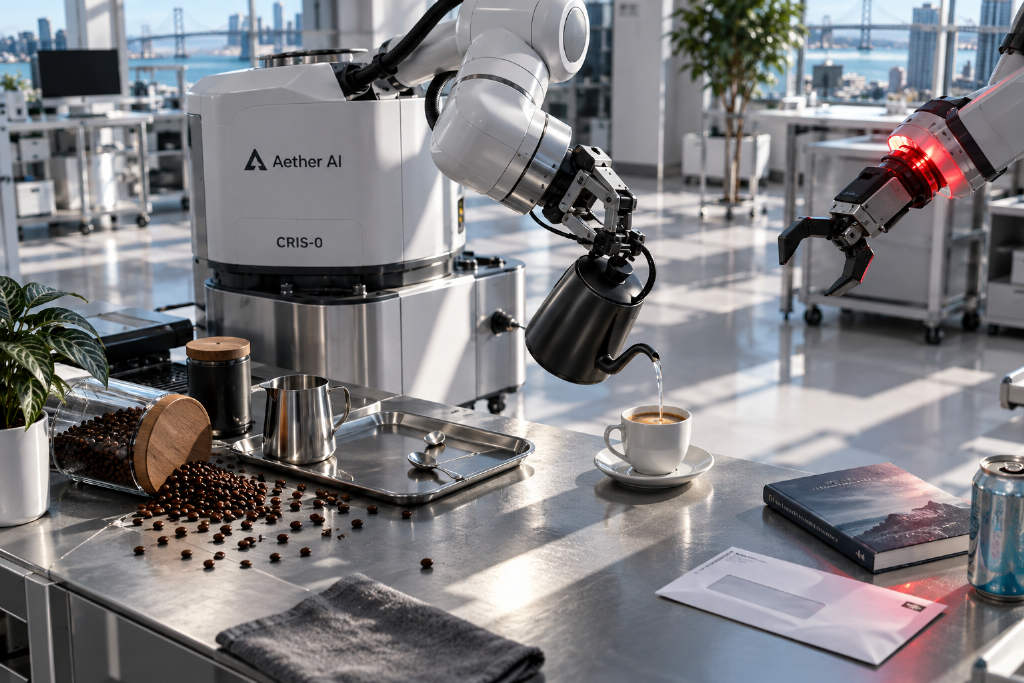
Aether AI has released an official demo of its CRIS-0 robotic system, built around causal reasoning and designed to replan actions in real time when unexpected disruptions occur. In a Coffee Preparation test, the system completed replanning in an average of 2 seconds when objects were moved by hand or lighting changed suddenly, and it recovered effectively in 9 out of 10 random disturbance trials. In longer autonomous tasks, CRIS-0 broke goals into verifiable causal stages and showed commonsense reasoning, including sorting ordinary books separately from private bills and shaking a drink can to judge whether it should be discarded or put back. When given ambiguous instructions, the system used context to extract hidden causal variables and achieved 18 precise pick-and-place results across 20 test prompts. According to the release, CRIS-0 uses a causal-native agent architecture that extracts physical causal variables, calls different functional modules through a unified tool interface, and runs action simulations with an embedded causal world model. Safety checks are built into each causal stage, enabling a 0.2-second emergency stop. Aether AI was founded by Huang Biwei, an assistant professor at the University of California, San Diego and a scholar associated with the CMU causal school.
Aether AI has released an official demonstration of CRIS-0, a robotic system built on causal reasoning and designed to replan actions in real time under sudden disturbances.
Replanning completed in 2 seconds during disturbance tests
In a Coffee Preparation test, CRIS-0 handled manual object displacement and abrupt lighting changes with an average replanning time of 2 seconds. Across 10 random disturbance trials, the system achieved 9 effective recoveries.
Long-horizon tasks were split into causal stages
In longer autonomous tasks, CRIS-0 broke goals into verifiable causal stages and showed commonsense reasoning. Examples in the demo included sorting ordinary books separately from private bills, and shaking a drink can to sense its condition before deciding whether to throw it away or place it back.
When given ambiguous instructions, the system combined context to extract hidden causal variables. In 20 test instructions, it recorded 18 precise pick-and-place results.
Causal-native agent architecture with built-in safety checks
According to the release, CRIS-0 uses a causal-native agent architecture. Its core components include extracting physical causal variables, calling different functional modules through a unified tool interface, and using an embedded causal world model to simulate actions.
Safety judgment is built directly into each causal stage, allowing a 0.2-second emergency stop.
Aether AI was founded by Huang Biwei, an assistant professor at the University of California, San Diego and a scholar of the CMU causal school. The item was cited by Techub from QbitAI.
This article was originally published by Bit.Fan. For more cryptocurrency news and market insights, visit www.bit.fan. Disclaimer:
The market information, project data, and third-party content displayed on this platform are for industry information sharing only and do not constitute any form of investment advice or return commitment.
Cryptocurrency trading carries high risks. Users should fully assess their risk tolerance and make independent decisions. All profits, losses, and legal responsibilities are borne by the users themselves.