

AI agents in crypto are starting to look less like chat interfaces and more like actual workers. That shift, as OdailyHot frames it, is not only about stronger base models. It is also about infrastructure that gives agents the ability to read live data, operate software, connect to wallets, and interact with trading accounts.
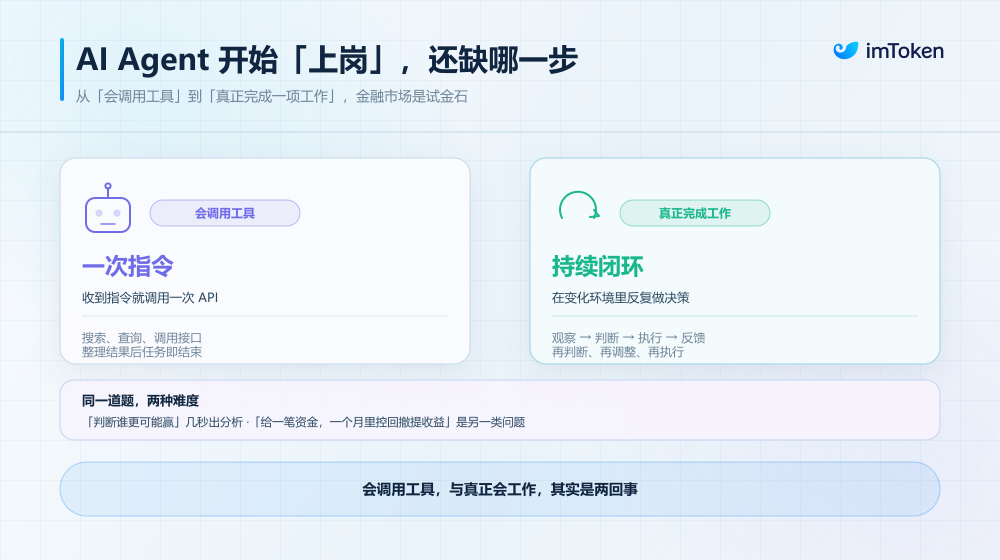
Even so, the article draws a clear line between using tools and completing a real task. An agent that can call an API after receiving a prompt is not the same as one that can keep operating inside a changing environment, read the result of each action, and decide what to do next.
Financial markets make that gap easy to see. An agent can produce a quick analysis on which side of a match is more likely to win. Managing capital over the next month in a prediction market while trying to improve returns under a maximum drawdown constraint is a different kind of assignment. That requires the agent to keep reading news, odds, and the order book, decide when to open, add to, or exit positions, and revise its strategy when its earlier judgment turns out to be wrong.
OdailyHot argues that a recent wave of infrastructure launches is starting to fill in the missing pieces.
AgentPit is pitched as a simulation ground for prediction-market agents
In mid-August, SKALE released AgentPit, a product described in the article as a simulated trading sandbox built for AI agents in prediction markets. It mirrors real Polymarket market data and is compatible with Polymarket’s API. It also uses a production-like central limit order book, CTF tokens, and settlement logic, while replacing real money with simulated USDC.
Developers can let an agent read live quotes, place and match orders, and manage positions inside the environment without risking capital losses. They can also watch multiple agents interact in the same order book and observe the collective behavior that emerges from those interactions.
On the surface, that resembles backtesting and paper trading in traditional quantitative finance. The article says the significance for AI agents runs deeper. One long-running problem is figuring out whether an agent can actually trade, rather than simply answer questions about trading.
Past evaluation of large models has leaned heavily on static benchmarks: solving math problems, fixing code, or summarizing a long text. Real-world decision-making does not come with preset answers. In markets, the article gives a simple example. If an agent believes the fair value of a “YES” contract in a prediction market is $0.7 while the market price is $0.55, buying the contract does not settle the question. The price might fall to $0.45, it might jump on breaking news, and real execution will also depend on moment-to-moment liquidity in the order book.
That means the task cannot end after one prediction. The agent has to face the consequences of its earlier actions and continue operating. OdailyHot identifies that as AgentPit’s main value: it creates a dynamic feedback loop that is much closer to a live production setting — observe, judge, execute, receive feedback, adjust, and execute again.
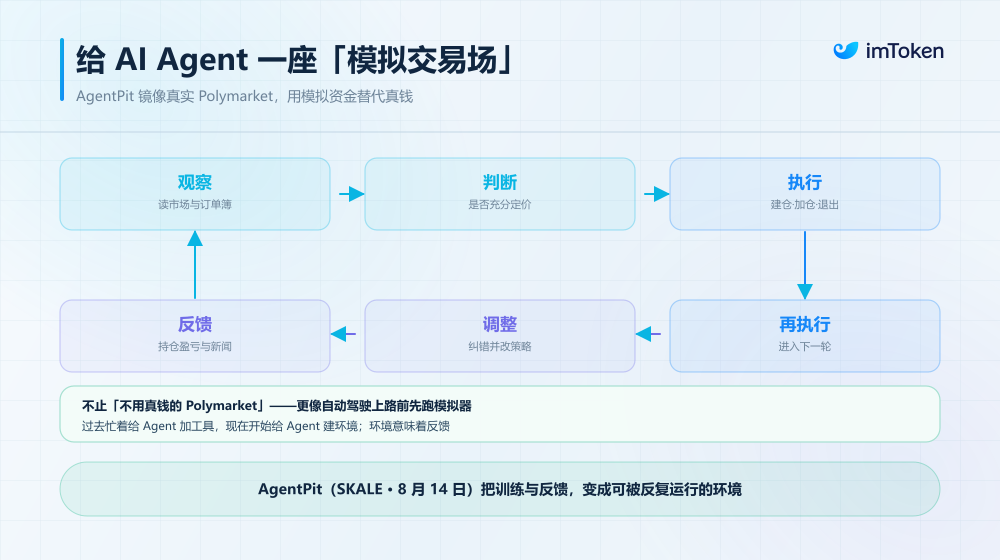
The article adds one important qualifier. “Training” here does not necessarily mean that the model changes its underlying parameters after every trade. What AgentPit provides is an environment for repeatedly running strategies, evaluating outcomes, and iterating on the workflow.
OdailyHot compares this with autonomous driving systems that go through a large number of extreme cases in simulators before getting on real roads. In the same way, a financial agent that may one day manage real funds is unlikely to receive direct control over assets after only a few prompt tests. It first needs to show how it behaves in a continuous decision environment.
Still, strong results in simulation do not mean real capital can immediately be handed to AI. The article says another layer matters even more once money is at stake.
Payments and trading rails are becoming native components for agents
Looking across the past few months, OdailyHot says the operating rails for AI agents are being standardized at high speed by major cloud providers and trading platforms.
One development is machine-native payments. On Aug. 18, Amazon Bedrock AgentCore Payments became generally available. The service lets agents running on AgentCore discover and pay for third-party APIs, MCP services, or specialized data sources on their own. It integrates wallet infrastructure from Coinbase and Stripe / Privy, and natively supports stablecoins and machine payment protocols such as x402.
The problem it addresses is straightforward. If an agent finds that a high-quality real-time data source is paywalled during market analysis, older workflows would stop and wait for a human to pay, buy access, and configure the API key. Under AgentCore Payments, payment becomes an automated node inside the workflow. Users set a budget and strategy in advance, and the agent can initiate micropayments to complete the call without manual intervention. The article notes that wallet private keys and credentials remain isolated from the model itself.
Two days later, on Aug. 20, Binance launched Agent OS and opened agent-native interfaces. Rather than offering a single AI feature, the article describes Agent OS as a financial infrastructure layer built specifically for agents. It combines the Binance API, Wallet Agentic Hub, x402, Skills Hub, and MCP into one stack.
Compatible AI applications can use MCP to access market data, review account information, and, with user authorization, carry out supported trading actions. OdailyHot highlights the permission model as a key part of the design. Users can assign agents dedicated sub-accounts, isolate trading activity and capital from the main account, define the exact permissions available to the agent, and revoke access whenever needed.
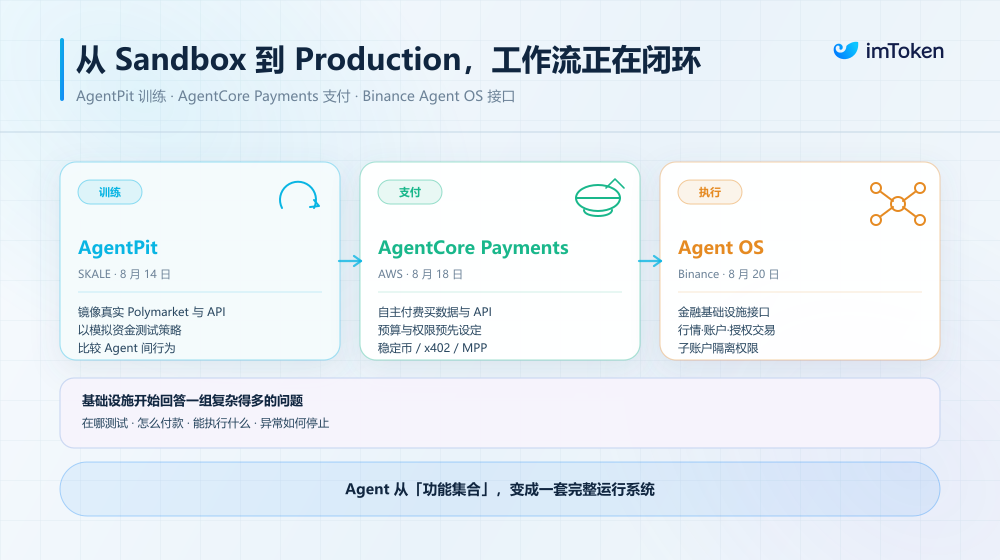
When AgentPit, AWS AgentCore Payments, and Binance Agent OS are viewed together, the article says a more complete workflow begins to take shape:
- AgentPit offers an environment for strategy testing and ongoing feedback.
- x402 and AWS AgentCore Payments open the path for machine-native payments.
- Binance Agent OS exposes market data, account functions, trading access, and on-chain capabilities to agents.
Capabilities that used to sit in separate systems are being connected into one operational flow.
But finance adds a hard constraint. A coding mistake can be fixed with another run. A bad trade can move assets out of a wallet for real. That is why, in the article’s view, no path from simulation to live deployment can avoid the wallet layer.
The point of an agent wallet is not to hand private keys to AI
OdailyHot sketches the future workflow for an AI agent in a fairly direct sequence. First, the strategy is trained and tested in a simulated environment such as AgentPit. Next, the agent gets information and tools through MCP, Skills, and different APIs. Then it uses protocols such as x402 to pay for data and compute resources. After that, it enters the real market and executes trades. From there, it keeps refining the strategy based on actual results.
Once execution starts, the role of the wallet changes sharply from the wallet model used today. Traditional Web3 wallets were built for human-computer interaction. Each signature assumes a human reviews the request on screen and manually confirms it.
That model breaks down for a high-frequency agent that may need to read multiple order-book feeds every second and keep adjusting positions. If a human must sign each action one by one, automation loses most of its value. But giving the AI direct custody of the private key would remove the basic safety boundary.
So the core problem, as the article puts it, is not “how to let AI get the private key.” It is “how to give an agent safe, controllable execution power without giving up final control of the assets.”
OdailyHot presents imToken’s Agent Wallet design framework as one answer to that problem.
Account isolation and session keys
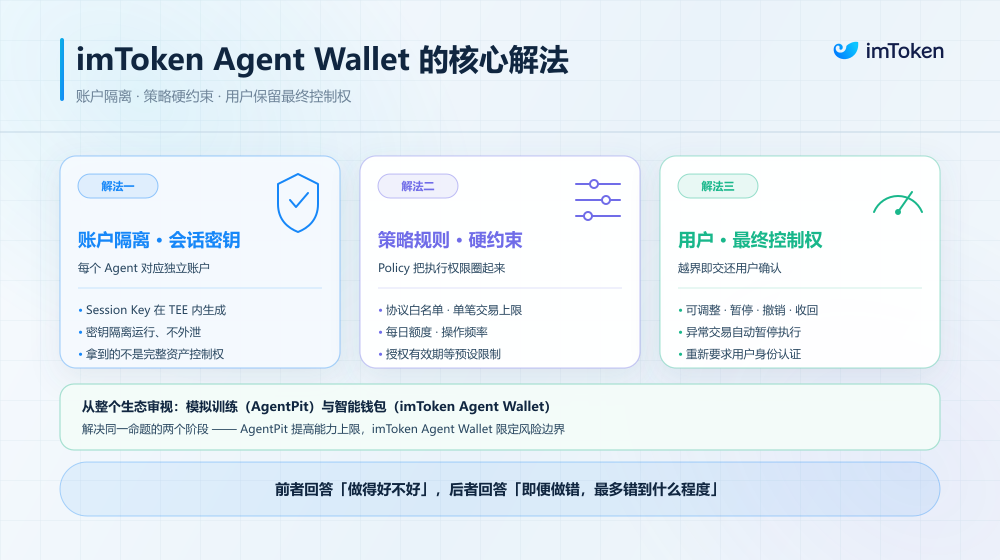
In the design outlined in the article, each agent that receives execution rights is mapped to an independent Agent Account. Its session key is generated and isolated inside a Trusted Execution Environment, or TEE, and does not leave that secure environment.
Hard policy constraints
Each Agent Account is tied to an explicit policy. That includes a whitelist of protocols the agent is allowed to interact with, a per-transaction cap, a daily limit, frequency restrictions, and an authorization validity period. In practice, the agent does not receive an unrestricted wallet. It receives an execution account bounded by rules.
User control remains in place
The agent can only act within the policy scope approved in advance by the user. Operations that go beyond those limits must return to the user for confirmation. The user can also adjust the policy, pause or resume the agent, revoke permissions, and recover funds at any time. If a transaction is flagged as abnormal or outside the preset strategy, automated execution is halted and user authentication is required again.
From that perspective, the article argues that simulation systems such as AgentPit and wallet frameworks such as imToken Agent Wallet are tackling two stages of the same problem. The first tries to raise the ceiling on decision quality. The second builds the security floor for real-world action. Neither is optional.
From learning tools to learning work
OdailyHot closes with a broader framing. After the arrival of AgentPit, it says, AI agents are entering a new stage. They are moving from learning how to use tools to learning how to work.
When those agents eventually leave simulation and enter volatile live markets, the stability of that step will depend not only on how smart the underlying model is, but also on how strong the account structure and authorization boundaries are.
In a real and complex economic system, the article says, the goal is not an agent that never makes mistakes. The goal is an agent whose risks remain inside controllable limits even when mistakes happen.