Artificial intelligence is making it cheaper to manufacture virtual identities at scale, while proving that a person exists behind a screen is becoming a technical service with a market price. The problem has a long precedent: Nikolai Gogol’s Dead Souls described paper assets built from deceased serfs, and today’s systems face a similar challenge through fake accounts, automated bots and synthetic identities.

This article was written by Thejaswini M A for The Token Dispatch and compiled by TechFlow.
The digital version of the “dead souls” problem
Gogol’s satirical novel, published in 1842, follows a well-dressed stranger who travels to a provincial Russian town and offers to buy lists of serfs who have died but have not yet been removed from official census records.
The arrangement made economic sense at the time. Russian landowners paid taxes according to the number of serfs registered under their names, while censuses were updated only at intervals of several years. Landowners wanted to shed the tax burden associated with people who had died. The buyer, meanwhile, could hold those paper headcounts and use them to apply for collateralized loans from the state bank.
The historical logic is direct: any system that distributes benefits by headcount without verifying whether the people actually exist will attract false accounts.
During the internet’s first decades, becoming a person online was effectively free. A user could create multiple email addresses, use a pseudonym on a social network and, in the blockchain world, generate thousands of wallet addresses in a single afternoon.
If every account receives one vote, or every wallet receives an equal airdrop, the participants able to create the most accounts at the lowest cost can claim the largest share. Proof of humanity is not only an identity problem. It is an economic one. Once a digital system needs to establish that its users are human, the key question becomes the price of that proof.
The cost of SMS verification and fake-account markets
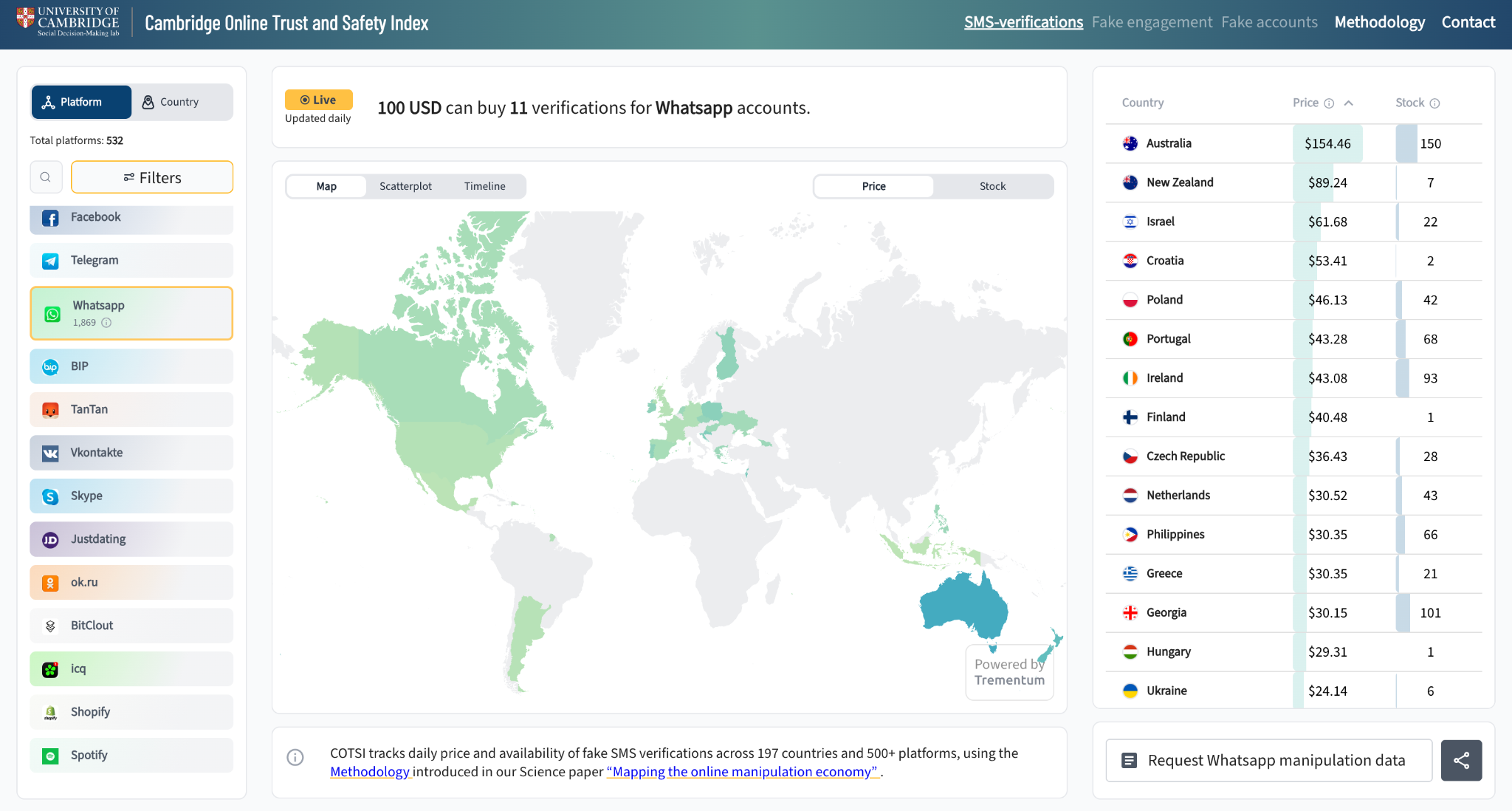
Researchers at the University of Cambridge have tracked the cost of buying SMS verification codes, one of the most common anti-fraud barriers used online. Prices move with demand.
On December 19, 2025, a Telegram verification code cost $0.34, while a Facebook code cost $0.21 and a WhatsApp code cost $0.25. The mass production of fake accounts has become a market with its own supply and demand.
One common method uses large numbers of SIM cards. In September 2025, the U.S. Secret Service seized 300 SIM-card server units and 100,000 prepaid SIM cards. The group involved used the equipment to register tens of thousands of social-media and payment accounts in bulk.
CAPTCHAs also impose a time cost on society. One study estimated that internet users around the world collectively spend about 500 person-years every day identifying distorted letters, selecting traffic lights and completing similar tests. Valued at the U.S. minimum wage, that time represents roughly $1.3 billion per year.
Automated systems are learning to defeat these tests. In 2024, a research team used a multimodal vision model to achieve a 100% machine-solving rate against mainstream image-based CAPTCHAs.
Crypto’s alternative: stop counting heads
In crypto, the creation of fake accounts to manipulate a system is known as a Sybil attack. The term comes from a landmark 2002 paper by Microsoft researcher John Douceur.
Satoshi Nakamoto’s approach in Bitcoin was to stop counting people directly. Voting by IP address would not work because one person can easily rent a large number of proxy IP addresses. Bitcoin instead ties voting power to computing power. Miners prove participation by calculating hashes and consuming electricity, a model known as proof-of-work, or PoW.
Proof-of-stake, or PoS, later tied governance power to staked capital. Computing power and capital are both scarce resources in the physical world, so they cannot be copied indefinitely through free account registration.
That approach still does not solve every problem. Where benefits must be distributed according to the number of real people, a system based purely on capital weight cannot provide one-person-one-vote participation.
World’s Orb and the limits of dedicated hardware
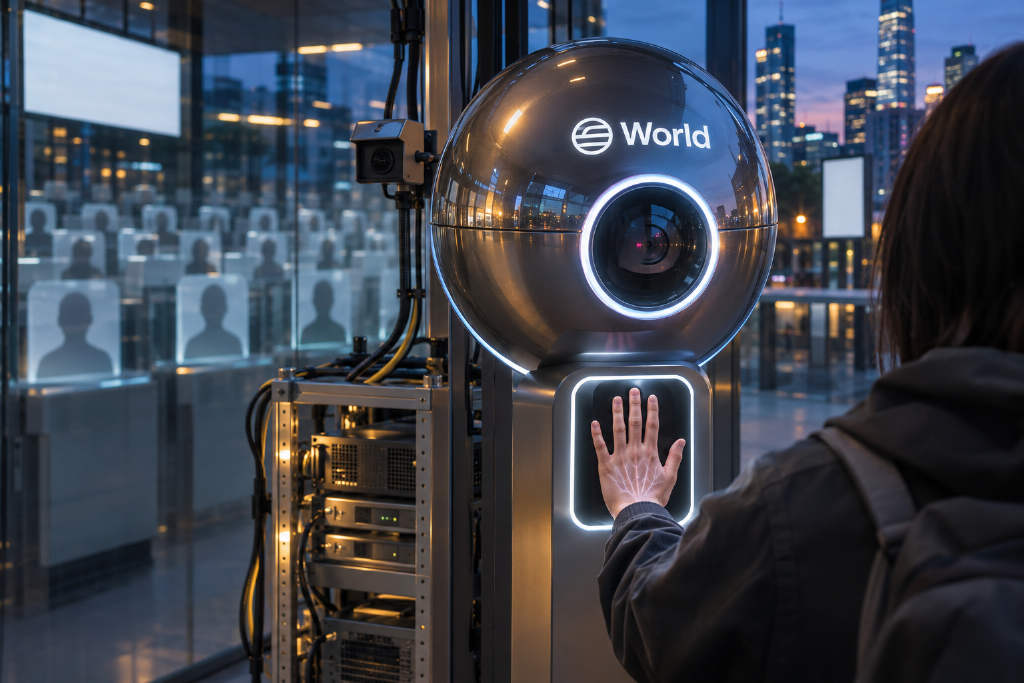
World, formerly known as Worldcoin, has tried to return to direct recognition of the human body. Its main device is the custom-built Orb.
The Orb uses infrared cameras to capture a user’s face and iris. It checks that the individual is a real human and has not already registered, then creates a unique digital identity credential. According to World’s official figures, more than 18 million people have completed verification.
The system depends on dedicated biometric hardware to provide a high level of human uniqueness and resistance to spoofing. If a standard smartphone camera could collect iris data, an attacker could use a fake camera to inject a fabricated video stream. To defend against that kind of injection, World has to manufacture its own Orb devices and tightly control the sensors, lenses and lighting conditions.

Dedicated hardware creates a structural deployment problem. The more precise the device, the greater the barriers to manufacturing, shipping and broad coverage.
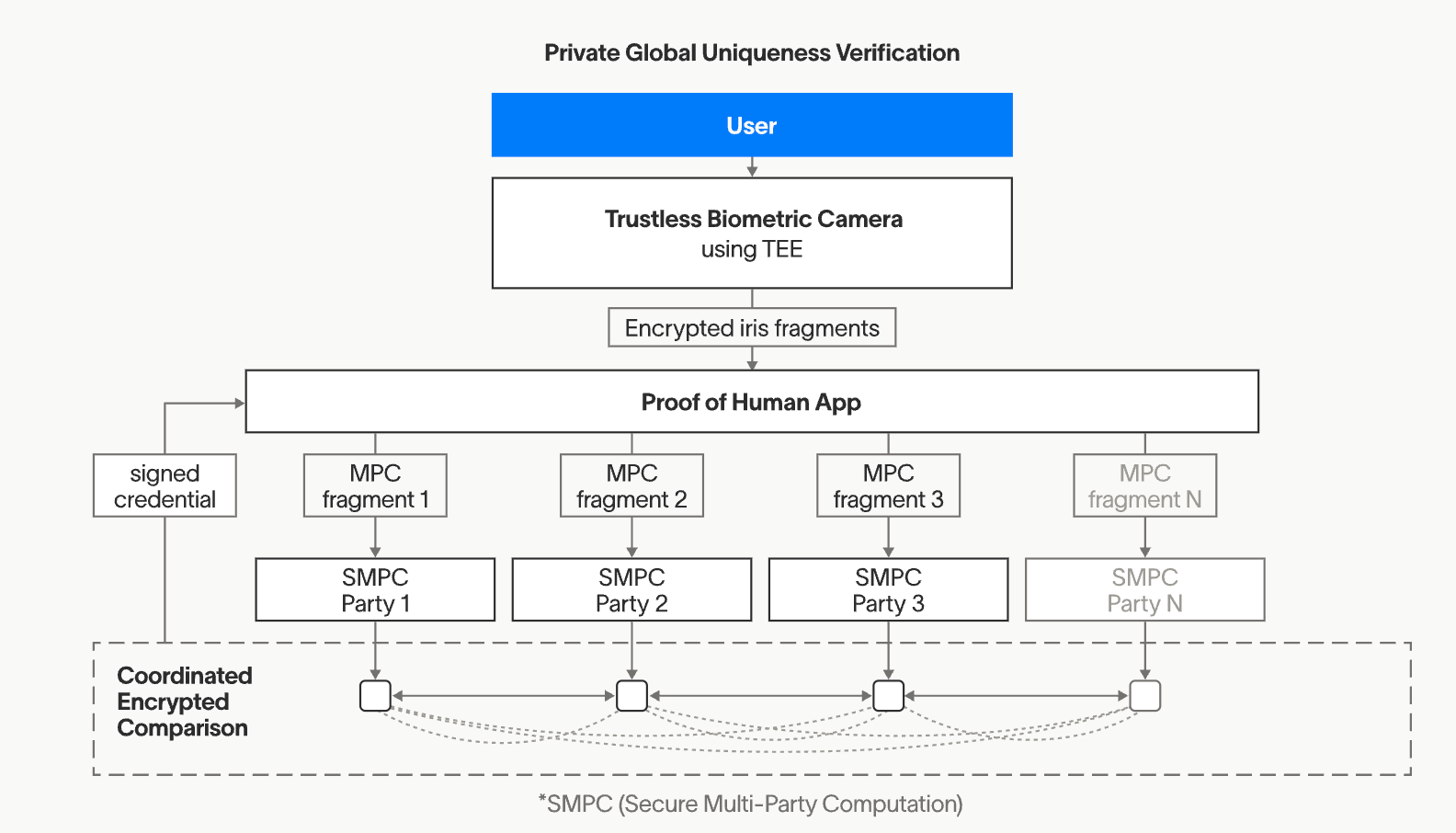
World uses secure multiparty computation, or SMPC, for data storage. The user’s iris code is divided into encrypted fragments and distributed across servers operated by different organizations. This prevents one centralized institution from holding the complete biometric database.
Decentralized biometric systems still require an assessment of attack costs. Attacking Bitcoin requires a huge electricity commitment, while attacking a PoS chain requires buying expensive tokens. In a biometric system, the incentive can look different. If an airdropped token in a poor region is worth more than a resident’s daily living costs, attackers could organize intermediaries to offer small cash payments for in-person iris scans and then resell the resulting credentials for arbitrage.
Palm and vein recognition move toward commercial use
Iris scanning is not the only biometric route moving toward commercial deployment. Amazon has introduced Amazon One palm-payment technology for checkout in physical retail. Tencent’s WeChat has also introduced palm scanning and deployed it at rail-transit gates and convenience stores.
Palm-recognition systems generally combine two types of information: the texture of the palm’s surface lines and the structure of veins beneath the skin under near-infrared light. Because living blood flow produces distinctive infrared absorption patterns, spoofing subcutaneous veins is substantially harder than presenting a flat photograph of a face.
The user experience is also different. Holding out a palm can feel more comfortable than placing an eye close to a metal sphere. Users do not need to remove sunglasses or bend toward a camera. At a transit gate or checkout counter, the gesture fits more naturally into an everyday interaction.
The central trade-off remains similar to World’s. Reaching a very high level of anti-spoofing protection requires dedicated infrared vein sensors. A low-cost standard front-facing smartphone camera alone is not enough to deliver that level of protection at scale.
From the paper serfs in Dead Souls to today’s SMS black markets and automated bots, industries that manufacture false headcounts will continue to appear wherever a system distributes value by the number of people. As synthetic content and intelligent agents become more widespread, the boundary used to identify a real human is moving away from software code and toward biological traits. Iris and palm-based systems still have to balance the security barrier of specialized hardware against the convenience required for global adoption.