
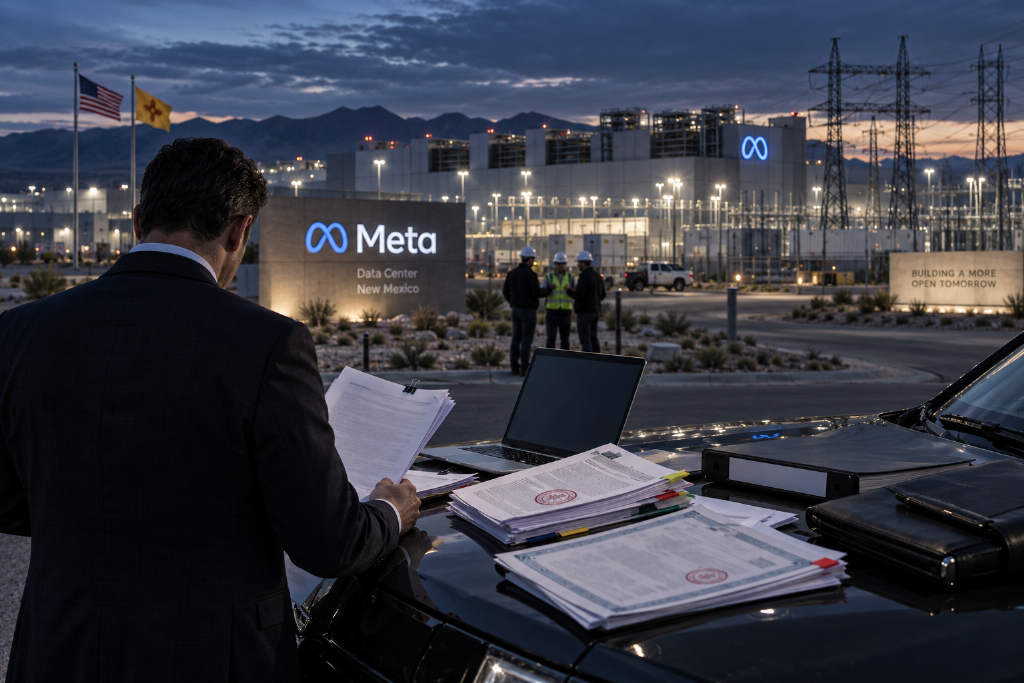
Financing for AI data centers is tightening across both bond and loan markets. Investors are demanding steeper discounts and stronger terms, while some major banks are becoming more selective on project loans. Combined with higher rates and risks tied to AI infrastructure itself, the cost of funding the buildout is rising quickly.
According to The Information, one of the clearest recent examples came from CleanSpark. The Bitcoin miner, which is developing a data center for Meta Platforms, sold $2.3 billion of bonds earlier this month at 98.5 cents on the dollar, one of the largest discounts seen in the past year. The bonds carried a 7.875% coupon, and the issuer also agreed to amortize principal over time to reduce refinancing risk.
Discounted high-yield deals are becoming more common
Morgan Stanley data cited in the report showed that all four high-yield data center bond offerings since July were sold at some form of discount. In the prior 12 months, only three of the 10 largest such deals included discounts.
The high-yield market has already absorbed about $55 billion of AI-related bond issuance this year. Supply is heavy, but investor appetite has changed. Connor Minnaar, a fixed-income portfolio manager at Manulife Investment Management, said discounted pricing is “a new development in the current market.” He added that investors were much more accepting of deal structures earlier this year, and that flexibility has narrowed.
What made the CleanSpark transaction stand out was the identity of the end user. Meta Platforms is an investment-grade company, the kind of tenant that would typically provide substantial comfort to bond buyers. Even so, investors still asked for extra compensation, pointing to concerns around construction timelines and execution risk rather than relying only on tenant credit quality.
A separate August deal pointed in the same direction. Zenith Arc LLC, a developer backed by Coatue Management’s venture arm and infrastructure startup Fluidstack, sold bonds at 99.5 cents on the dollar to finance a data center that will be leased to trading firm Jane Street. After the bonds began trading, their yield moved higher, with investors demanding more compensation than on outstanding bonds carrying the same rating.
Banks are pulling back on project loans
The loan market is also showing signs of restraint. The report said people familiar with the matter indicated that Societe Generale, Sumitomo Mitsui Banking Corp. and Mitsubishi UFJ Financial Group have become more cautious about participating in data center project financings.
All three banks have already played major roles in marquee AI infrastructure financings. Societe Generale led the $7.1 billion debt financing for the first site of the OpenAI-Oracle “Stargate” project. Mitsubishi UFJ and JPMorgan jointly led another $38 billion of financing across two additional Oracle projects. Sumitomo Mitsui helped lead the $18 billion financing for Oracle’s New Mexico project.
Oracle’s New Mexico project has sharpened lender scrutiny
Recent developments at Oracle’s New Mexico project have given lenders another reason to revisit risk. Last week, Oracle sent a force majeure notice to the project developer, a Blue Owl Capital portfolio company, after power-supply delays hit the project. Oracle sought to invoke contractual language that could excuse or defer some obligations because of an event outside its control.
According to the report, people familiar with the matter said the loan was “well structured” from the lenders’ perspective, meaning Oracle would still remain responsible for lease payments even if the site failed to secure power on time. Even so, one banker said Oracle’s force majeure claim could push some banks to seek tighter protections or reassess project risk, which would further limit potential loan supply.
The market is still open, but funding is more expensive
Market participants said no major deal has been pulled, and no active syndication has been abandoned because pricing weakened. Developers are still willing to accept a higher cost of capital in the high-yield market to keep projects moving.
Minnaar said: “At this point it’s still a story about concessionary terms. For a lot of companies, this is a race to get as much capacity online as possible as quickly as possible, and the financing cost is still secondary.”
Still, discounted issuance becoming standard, narrower bank syndicates and an unstable IPO window are reshaping the market for AI data center funding. Projects with lower ratings, limited development experience or longer construction periods are already facing a materially tougher financing environment.
Heavy Big Tech issuance is crowding the market
The pressure is coming from several directions at once. Amazon, Google and Microsoft are expected to spend a combined roughly $700 billion in capital expenditures this year, with that level expected to continue for years. Those companies have already sold nearly $160 billion of investment-grade bonds this year, adding a large amount of supply to the market.
The extra yield investors demand to own bonds from those hyperscalers has risen by about 0.25 percentage point this year, while spreads in the broader investment-grade market have widened by only 0.04 percentage point. Even for issuers with substantial operating cash flow, relative borrowing costs are moving up.
At the same time, some large technology companies are shifting spending to other financing vehicles, which then have to raise money in the high-yield market on their own. Developers building data center capacity for AI companies such as Anthropic and OpenAI are competing in that same market, adding to the supply-demand imbalance.
Higher Treasury yields are amplifying project risk
Rising Treasury yields are adding another layer of strain. Federal Reserve Chair Warsh said last week that large technology bond issuance was creating a “crowding out effect” for investors and was one factor behind the rise in Treasury yields.
For data center developers, higher Treasury yields mean riskier projects need to offer more compensation to attract capital. One banker involved in these deals described the change as an “upward migration” in credit quality and project selection. Investors who once accepted long construction periods or less experienced developers in exchange for yield may now decide they can get a similar return from safer bonds.
For some projects, borrowing costs are approaching the point where economics become difficult. If a project needs a 12% return and debt costs move close to that level, the remaining margin can narrow to the point that the project is no longer financially sustainable.
The IPO route is also under pressure
Volatility in bond markets is spilling into the IPO market, making another funding channel less predictable for AI companies. According to the report, Anthropic posted a net loss of $42 billion last year, and draft IPO documents showed commitments for computing and infrastructure spending of more than $500 billion.
SB Energy and Nscale, both of which are developing data center capacity for OpenAI and Anthropic, have recently made IPO filings public, but the timing of any listing remains unclear. Anthropic had previously been expected to disclose an IPO filing as early as this month, but that has not happened so far.