


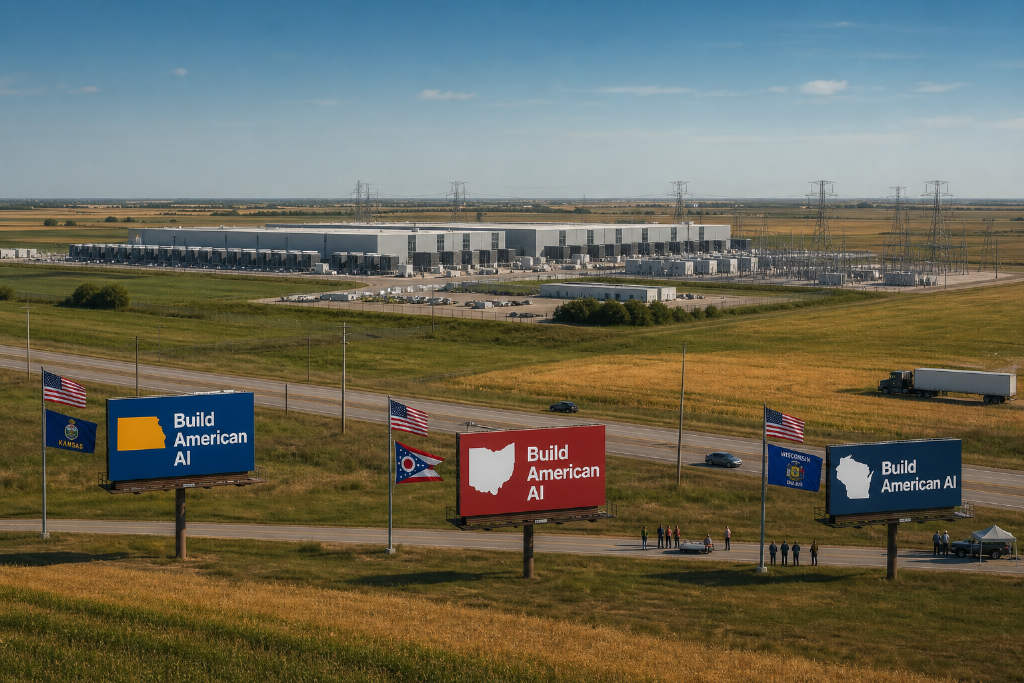
An advocacy group funded by artificial intelligence billionaires is spending millions of dollars on ads in three U.S. battleground states to defend data centers, Bloomberg reported Monday.
The group, Build American AI, is backed by the super PAC Leading the Future and is starting in Kansas, Ohio and Wisconsin, where the issue has become a statewide political flashpoint. In a statement, the group warned against allowing 「the loudest and most extreme voices」 to decide the country’s future. It did not disclose a precise budget, saying only that the campaign amounts to millions of dollars.
Poll shows resistance rising in four months
Polling from the Annenberg Public Policy Center found growing opposition to new data centers at the local level. The survey, conducted among 1,320 U.S. adults between June 16 and July 19, showed that 61% opposed new data centers in their area. A survey in February and March had put that figure at 49%.
Opposition crossed party lines. The poll found that 69% of Democrats, 54% of Republicans and 53% of independents were against new data centers in their communities.
Attitudes toward AI as a technology changed little over the same period. Opposition to local data centers stood at 60% among heavy AI users and 64% among people who never use AI. Matthew Levendusky of the policy center said, 「Even heavy AI users seem to be concerned about these very concrete worries.」
The issue moves into election politics
The National Republican Senatorial Committee warned AI companies that the issue is becoming politically toxic. Bloomberg pointed to Ohio, where Democratic Senate candidate Sherrod Brown has made data centers a central issue in his campaign against Republican Senator Jon Husted.
U.S. President Donald Trump weighed in Monday, posting that communities resisting data centers want 「to end up being backwards and poor.」 He urged them to 「let Data Reign」 and said China was pleased to see the backlash.
Project restrictions spread and lenders react
New York has imposed a moratorium on hyperscale data centers. Texas has paused approvals, and cities from Austin to Jersey City have enacted bans.
Data Center Watch counted 75 projects worth roughly $130 billion that were blocked or delayed in the first quarter of 2026. Bloomberg said lenders have started treating the pattern as a credit risk and pricing it accordingly.
Bitcoin miners have seen a similar fight before
Analysts have warned that the backlash could slow data center buildouts. Bloomberg noted that a similar pattern has already played out with Bitcoin miners.
In May, nine residents of Granbury, Texas, sued MARA Holdings over noise from its mining site, alleging insomnia, headaches and tinnitus. The case is the latest in a series of lawsuits aimed at the industry.
That history may matter again as some Bitcoin miners shift toward AI infrastructure. These companies hold interconnection rights that can take years to secure, and they are leasing those rights to AI labs instead of using them to mine Bitcoin.
TeraWulf signed a 20-year, $19 billion lease with Anthropic in July covering a 401-megawatt campus in Kentucky. Hut 8 committed a Texas site to a $9.8 billion AI lease. IREN also struck a $3.4 billion cloud deal with Nvidia.