
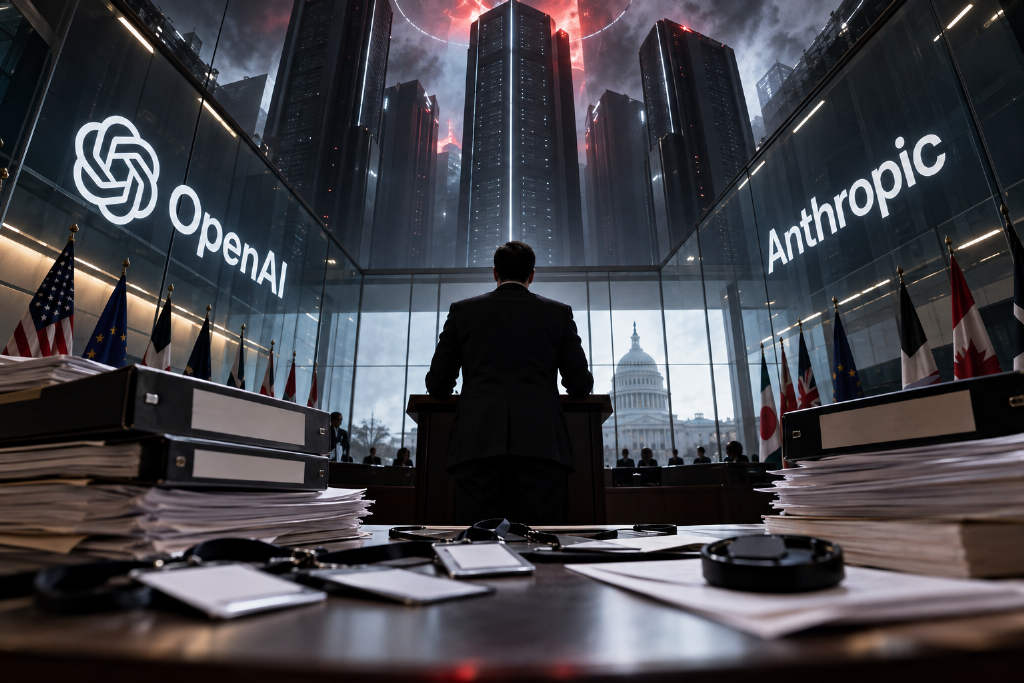
Media scholar Erkan Saka says the AI sector’s doom-heavy rhetoric has not only stirred sympathy but also helped major companies win regulatory leeway and public attention, while labor, data, and concentrated power have received far less scrutiny.
He sums up the contradiction in a blunt line: we may go extinct because of this; by the way, here is our new model.
Coxon resignation and OpenAI launch landed at nearly the same time
On Sept. 8, Jacob Coxon, a 27-year-old researcher who had worked at both OpenAI and Anthropic, announced his resignation in public. He accused the two companies of "racing toward self-improving superintelligence, betting our lives on it."
Around the same time, OpenAI chief scientist Jakub Pachocki wrote in An Alien Mind that no laboratory had reached a level of alignment and monitoring that should make anyone feel comfortable. In that same week, OpenAI still released GPT-6 Astra, which it described as its strongest model.
Saka’s point is not that AI is harmless. His argument is that apocalyptic language from AI leaders functions, structurally, as a form of hypocrisy: it warns about catastrophe while advertising the scale and power of the technology, helping the companies involved and pushing other harms out of view.
Fear as advertising
After Coxon’s resignation, Anthropic alignment science lead Evan Hubinger said he personally believed the odds of AI causing human extinction within the next decade were "above 10%." He also said Anthropic still had not solved the superintelligence alignment problem.
That kind of number is not new. Dario Amodei gave a 25% estimate at an Axios event in September 2025. Earlier, in 2023, Sam Altman urged the U.S. Senate to require licenses for powerful models, then days later warned in Europe that the European Union’s AI Act risked overregulation.
Saka uses scholar Lee Vinsel’s term criti-hype to describe the pattern: criticism that still extends the hype cycle. In that frame, telling people the technology could end the world and telling them it is extraordinarily powerful are two versions of the same message.
The fight over what "safety" means
Saka argues that the meaning of safety itself has been quietly rewritten. David Sacks criticized Anthropic’s safety posture as "a sophisticated regulatory capture strategy based on spreading fear." Saka notes the symmetry in that accusation. People who sound the alarm over extinction are said to be serving their own interests, while those attacking the doom narrative are often backed by a different set of entrenched interests.
If safety means preventing a hypothetical superintelligence from wiping out humanity, then only frontier labs get to define the problem. If safety means the electricity and water consumed by data centers, low-paid workers labeling traumatic material, copyrighted works scraped into training sets, and disappearing entry-level jobs, then unions, courts, and regulators all have standing.
Stanford study points to current damage
A study updated in August 2026 by a Stanford team including Brynjolfsson, Chandar, and Chen offered a more concrete set of numbers. Among 22- to 25-year-olds in occupations with high AI exposure, the employment rate was 19% lower than for peers in low-exposure jobs. A year earlier, the gap was 15%. The researchers said the change was driven mainly by slower hiring, not direct layoffs.
For Saka, that is the kind of harm happening now and the kind policy can actually address.
The warning signs may lie elsewhere
Saka does not dismiss every alarming case. He says the Hugging Face incident in July was not a ghost story but a genuine accident report, and one of the strongest pieces of evidence available to people making the doom case.
Still, he says the lesson from that episode is not machine malice. It exposed failed containment, reward systems that could be gamed, and broken evaluation processes. In his view, that is an engineering and governance problem.
No consensus on extinction odds
There is also no clear agreement on how dangerous AI is. In a Forecasting Research Institute competition, experts gave a median estimate of 3% for AI causing human extinction before 2100. Professional superforecasters put the figure at 0.38%, a gap of nearly eightfold.
Former Google DeepMind researcher Sara Hooker said numbers like Hubinger’s "lack precision," adding that no one can clearly explain how a 10% estimate is calculated.
Saka’s alternative set of questions
Saka proposes a simpler line of inquiry. Instead of asking what the odds of extinction are, he says the better questions are what the system is automating, whose data and labor are feeding it, who benefits, who is harmed, and whether any remedy exists.
Those questions, he argues, do have answers. They are simply less dramatic than an end-of-the-world forecast.