

Why AI infrastructure stocks jumped on Oct. 27
U.S. AI infrastructure stocks staged a broad rebound on Oct. 27. The Philadelphia Semiconductor Index rose 3.6%, and all 30 constituents finished higher. Broadcom gained 4.00%, Oracle rose 3.55%, Cerebras climbed 10.10%, and CoreWeave added 7.94%. The Nasdaq Composite closed up 1.18%, while the S&P 500 added 0.60%.
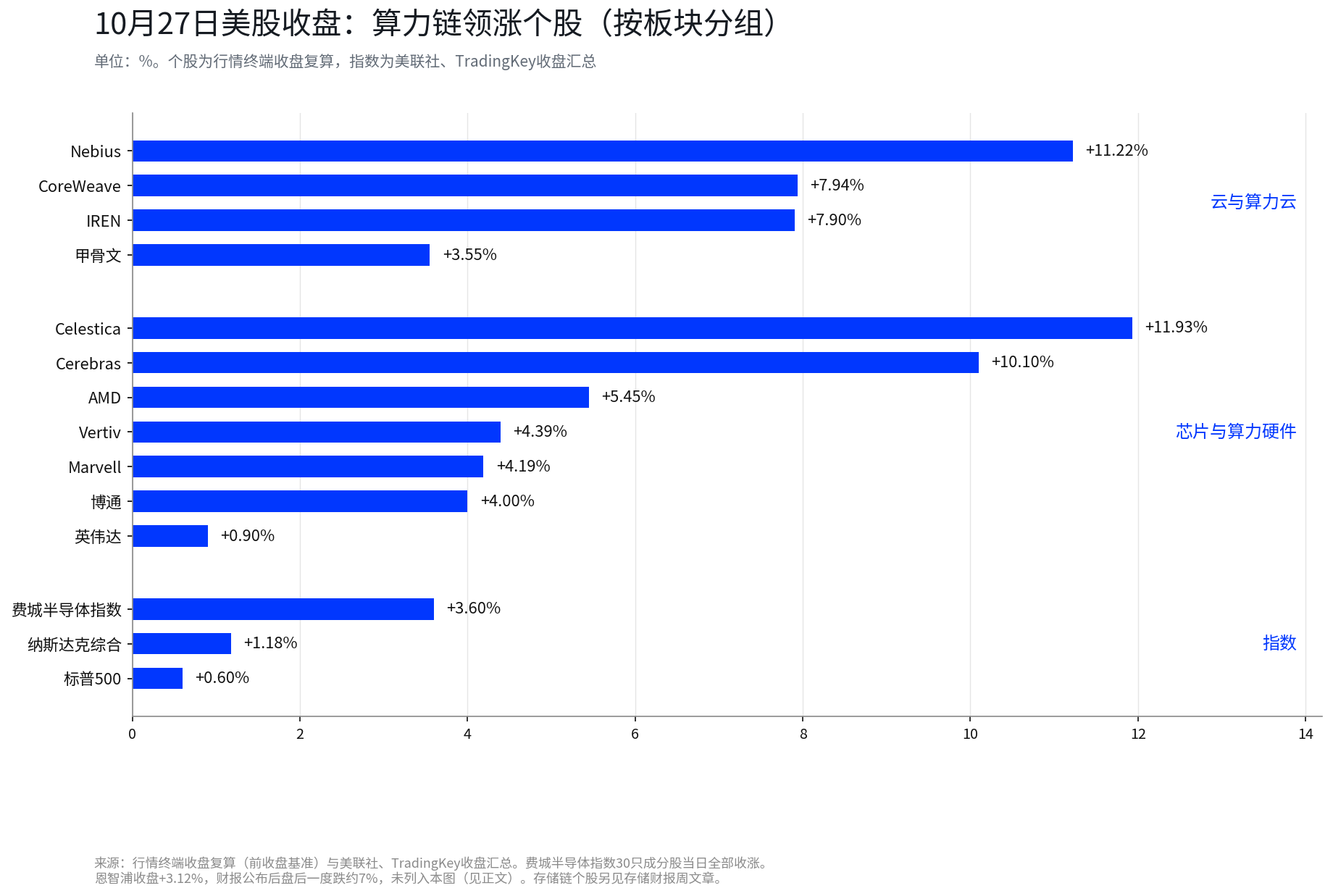
The move was not limited to chipmakers. Compute cloud company Nebius rose 11.22%, IREN gained 7.90%, and hardware supply-chain company Celestica climbed 11.93%. By contrast, NVIDIA was up only 0.90% on the day. NXP Semiconductors closed 3.12% higher, but at one point fell about 7% in after-hours trading following its earnings release.
The pattern suggests investors were not simply buying every stock tied to AI. The strongest gains were concentrated in companies linked more directly to infrastructure expansion, equipment procurement, and compute leasing. Attention also shifted. The question was no longer just whether the AI boom could continue, but which companies would capture orders, secure financing, and eventually convert that spending into profit.
Two catalysts stood out. First, Anthropic filed for an IPO, and disclosures in the filing, along with media summaries, pointed to a very large set of long-term compute spending arrangements. That gave investors a clearer view of how much cloud capacity, accelerators, and data center resources model developers may need over the next several years. Second, Broadcom announced a $63 billion financing arrangement. Bank of America, Blackstone, Citigroup, and Morgan Stanley are participating in financing that will support Anthropic’s procurement of Broadcom AI accelerators and networking equipment, with deliveries expected to begin in 2027.
Taken together, the two developments carried a meaning beyond a simple read that AI demand remains strong. Long-term contracts improve visibility into future demand. Financing structures provide funding support for part of that demand. Investors had been worried about whether rising capital spending by technology companies would ultimately pay off. Now the market is starting to see how compute demand could move through contracts and financing structures into actual deployment. That still does not answer the return question. Between contract value, financing size, and final profit sit delivery, utilization, customer payment capacity, and operating cash flow.
$807 billion in compute commitments: clearer demand, not booked revenue
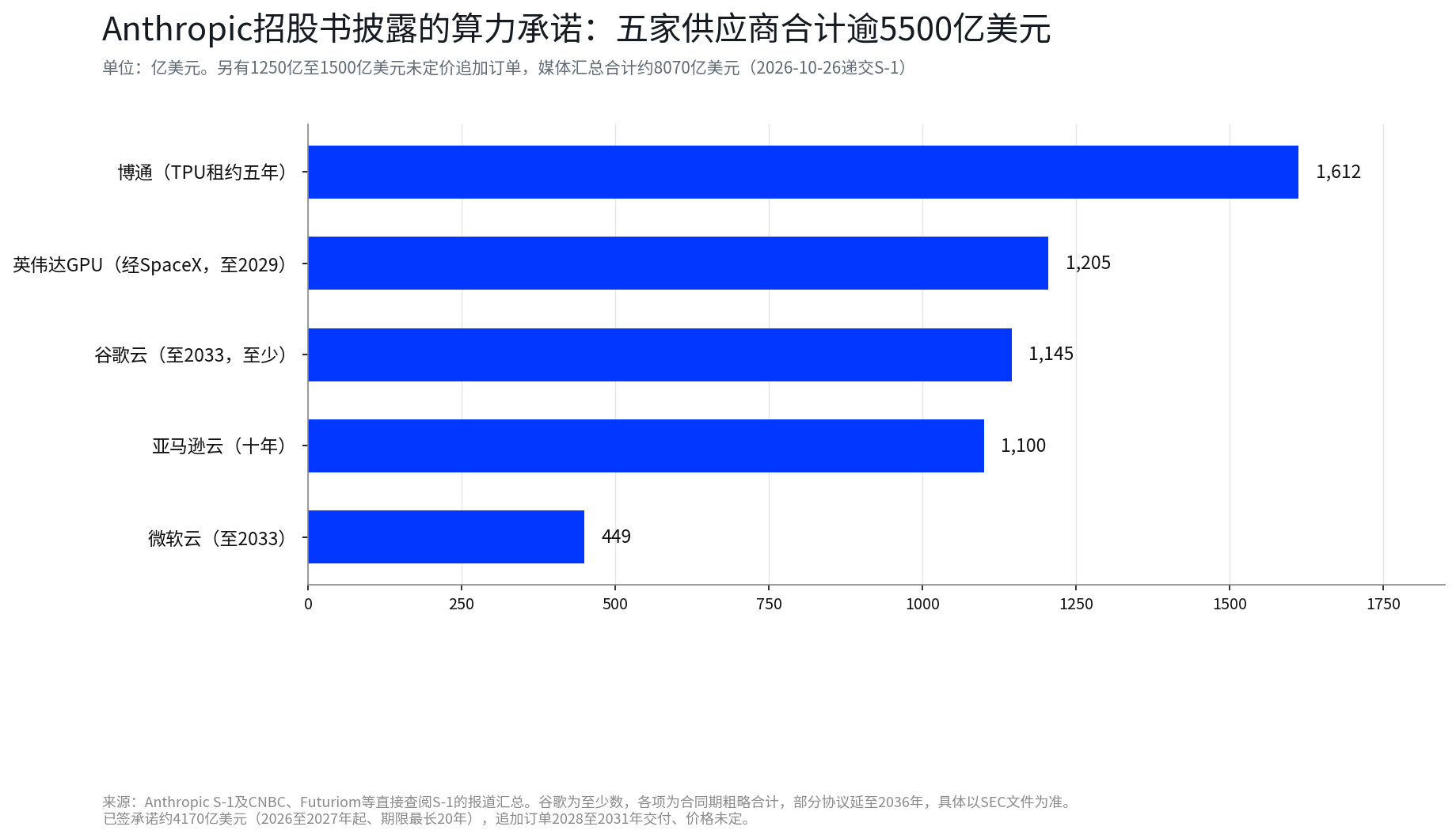
According to media summaries of Anthropic’s IPO filing and related agreements, the company’s compute and infrastructure spending arrangements could total as much as about $807 billion. The figure covers long-term cloud services, equipment leases, procurement agreements, and some future compute arrangements. Suppliers mentioned in those reports include Broadcom, Google, Amazon, Microsoft, and procurement channels tied to NVIDIA.
Media reports also said signed agreements correspond to roughly $417 billion in payment obligations. In addition, some incremental compute arrangements scheduled for delivery from 2028 to 2031, with pricing not yet fixed, could add another $125 billion to $150 billion in payment obligations.
Those numbers are large, but the first point is about definition. The $807 billion figure is a media estimate of long-term spending arrangements. It is not revenue already recognized by Anthropic, and it should not be treated as a single firm order that is fully effective and fixed in amount. Anthropic’s S-1 did not disclose a total figure for compute commitments, and media tallies differ. The $417 billion figure and the additional $125 billion to $150 billion range are among the clearer numbers cited across reports. Other reports put the aggregate total anywhere from $542 billion to $657 billion. Contract terms, payment conditions, and execution certainty also vary, and some arrangements involve future delivery or capacity that has yet to be finalized.
What matters more is how these long-term agreements change the way investors look at compute demand. In the past, the market mostly inferred chip shipments, data center construction, and supplier revenue from capital spending guidance issued by cloud providers such as Microsoft, Google, and Amazon. Long-term spending arrangements by model companies add another piece from the demand side. Training frontier models requires massive compute. Serving enterprises and consumers also requires ongoing inference capacity. To secure enough compute in the future, model developers may reserve resources in advance and accept minimum payment obligations.
For suppliers, that can improve visibility into future revenue. At least within the scope covered by contracts, demand no longer depends entirely on how much equipment a customer decides to buy quarter by quarter.
Still, contract size is not the same as commercial value. Signing a contract does not mean revenue can be recognized immediately. Multi-year agreements may require staged equipment delivery or cloud service provision, and revenue is recognized over time as performance obligations are met. Long-term contracts also do not remove customer credit risk. If a model company’s commercialization lags expectations and revenue falls short of compute payment obligations, execution and financing pressure can rise even if the contract remains binding. Growth in compute demand also does not mean a higher return on compute investment. Model usage can increase, but if revenue per call does not cover compute, energy, and infrastructure costs, scale may not improve profit.
That is why the $807 billion figure is better understood as a reference point for future demand than as a profit forecast. The market may be willing to pay for better demand visibility, but whether that premium holds depends on whether model companies can turn compute into recurring revenue.
$63 billion financing structure: AI buildout starts to test credit markets
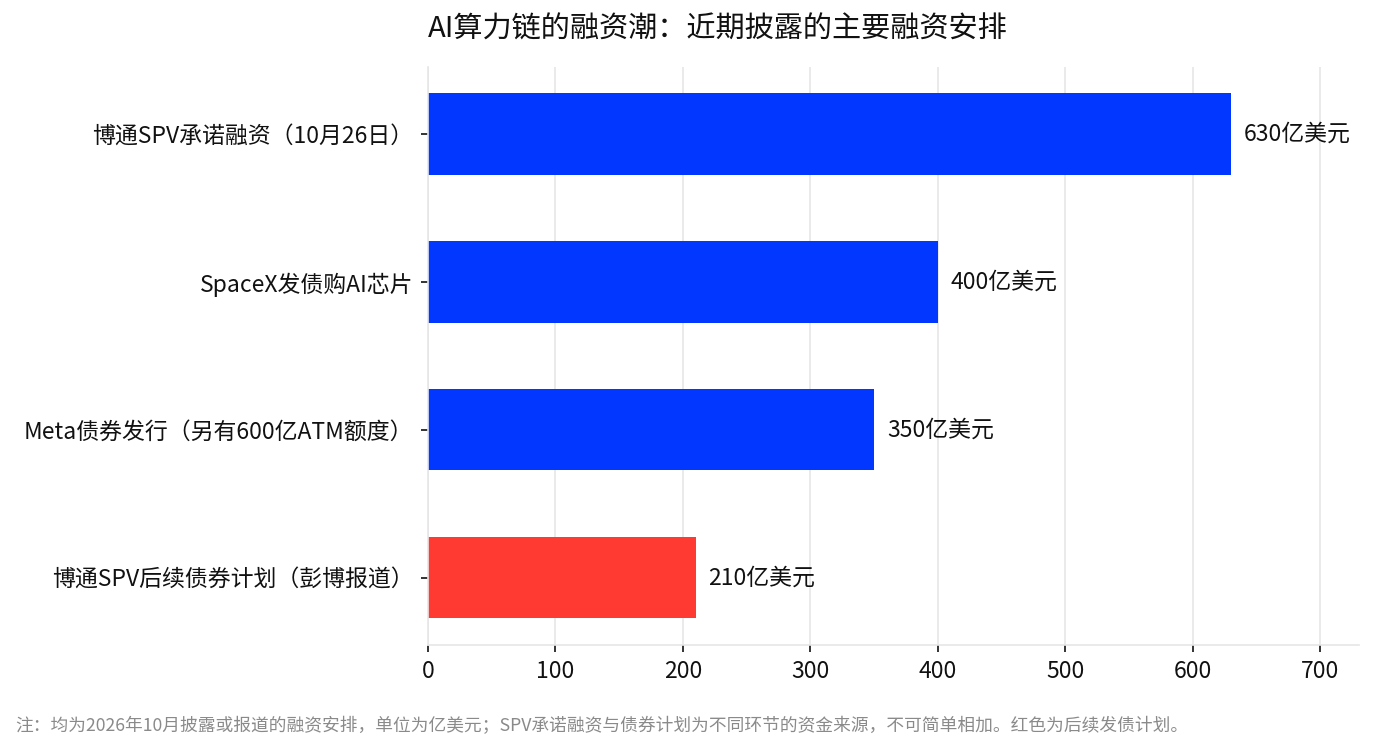
If long-term contracts answer who needs compute, Broadcom’s financing arrangement goes a step further and addresses who pays for it. On Oct. 26, Broadcom said Bank of America, Blackstone, Citigroup, and Morgan Stanley will participate in a $63 billion financing arrangement. Under the structure, a special purpose vehicle, or SPV, will purchase Broadcom XPU AI accelerators and networking equipment and then lease the equipment to Anthropic. Deliveries are expected to begin in 2027. Broadcom will also provide residual value support tied to the first-lien financing portion.
The structure links chip procurement, outside financing, equipment leasing, and residual value support. For the end customer, compute deployment can be funded through leasing and financing. For the equipment supplier, the source of funds and the execution path become clearer. It also reflects a shift in the AI infrastructure buildout. Compute investment is no longer only a question of how much capital spending a technology company decides to add. It is also becoming an asset-financing business that draws in financial institutions.
Other recent financing arrangements point in the same direction, showing that AI infrastructure funding needs are spreading into bond markets and other credit channels. But financing commitments differ in size, use of proceeds, and completion status. Published commitments should not be treated as cash already in hand.
More important, the SPV does not make risk disappear. In a traditional procurement model, a company buys equipment directly and bears the capital outlay. Through an SPV, the equipment can be held by a separate vehicle and leased to the end user. That can bring in more funding sources, but it does not change the basic requirement that the compute project must generate enough cash flow. If Anthropic cannot make payments as agreed, or if the secondary value of AI accelerators comes in below expectations, the financing structure can still come under pressure. Broadcom’s residual value support deserves close attention. It may help lenders assess equipment value, but it also means Broadcom has not fully stepped away from the value risk tied to those assets.
Whether this kind of transaction can work over time depends on at least three practical conditions:
- Whether financing costs are reasonable. The higher the debt rate and credit spread, the more cash return the project must generate.
- Whether residual values hold up. AI chips evolve quickly, and the remaining value of equipment in long-term leases is not fixed.
- Whether customers can keep paying. If a model company’s commercial revenue does not keep pace with compute spending, a more complex financing structure can also make risk transmission more important.
So the significance of the $63 billion financing package is not that the AI industry now has unlimited funding. It is that compute expansion has found a new way to organize capital. That may speed up deployment. It may also amplify volatility if demand or financing conditions weaken.
Oracle broadens chip options as inference demand opens room for rivals
On Oct. 27, Oracle said it would expand deployment of NVIDIA Vera Rubin systems, with related cloud infrastructure planned to scale to multi-gigawatt levels. At the same time, Oracle said it plans to offer Google TPU compute on its cloud platform for the first time and bring in Cerebras inference solutions. Some NVIDIA systems will also use Oracle’s Acceleron networking chips.
Not all transaction values behind those partnerships were disclosed, so a multi-gigawatt deployment cannot be translated directly into booked orders or profit. Even so, the announcements reveal a change in cloud procurement strategy. A large cloud provider is adding more hardware choices for different workloads.
That shift matches the stage of AI application development. Large-scale model training places high demands on top-end accelerators, high-bandwidth interconnects, and software ecosystems, where NVIDIA has built a clear advantage. As models move deeper into enterprise use, inference is becoming more important. That is the stage where models are called repeatedly to perform real tasks.
As AI agents begin to handle multi-step work, a single task may involve multiple model calls. Customers care not only about whether a model can complete the task, but also about response speed, cost per call, throughput, and energy efficiency. For high-frequency, repetitive, or specialized workloads, purpose-built chips may offer a more competitive option. That opens room for architectures such as Google TPU and Cerebras. They do not need to beat NVIDIA in every workload. If they can lower cost or improve speed in specific scenarios, they can win customers.
At the same time, Oracle is expanding NVIDIA system deployment, which shows this is not a story about NVIDIA being displaced. A more accurate reading is that the AI compute market is moving from relatively concentrated hardware procurement toward more granular choices based on workload, cost, and performance. As that happens, the investment case for different companies starts to diverge.
- NVIDIA still needs to prove the combined strength of its accelerators, systems, and software ecosystem.
- Broadcom needs to turn demand for custom accelerators and networking gear into sustained profit and cash flow.
- Specialized chip companies such as Cerebras need to show that technical advantages can lead to real customer payments, scaled deployment, and sustainable profitability.
Getting onto a major cloud platform is an important commercial step. It is not a moat by itself. Customers will still decide procurement size based on actual usage cost and business results.
Orders and stock prices are rising, but cash flow has not caught up
The Oct. 27 rebound put AI infrastructure names back at the center of the market. Financial results across the group also show that demand growth does not convert evenly into shareholder returns. Based on currently available data, Broadcom and Oracle have more established revenue scale and cash flow foundations. Compute cloud companies such as CoreWeave are growing faster, but they also need to spend heavily on equipment. Cerebras remains in the stage of expanding commercial deployment and testing its profit model.
Broadcom: strong cash flow base, but extra equipment risk
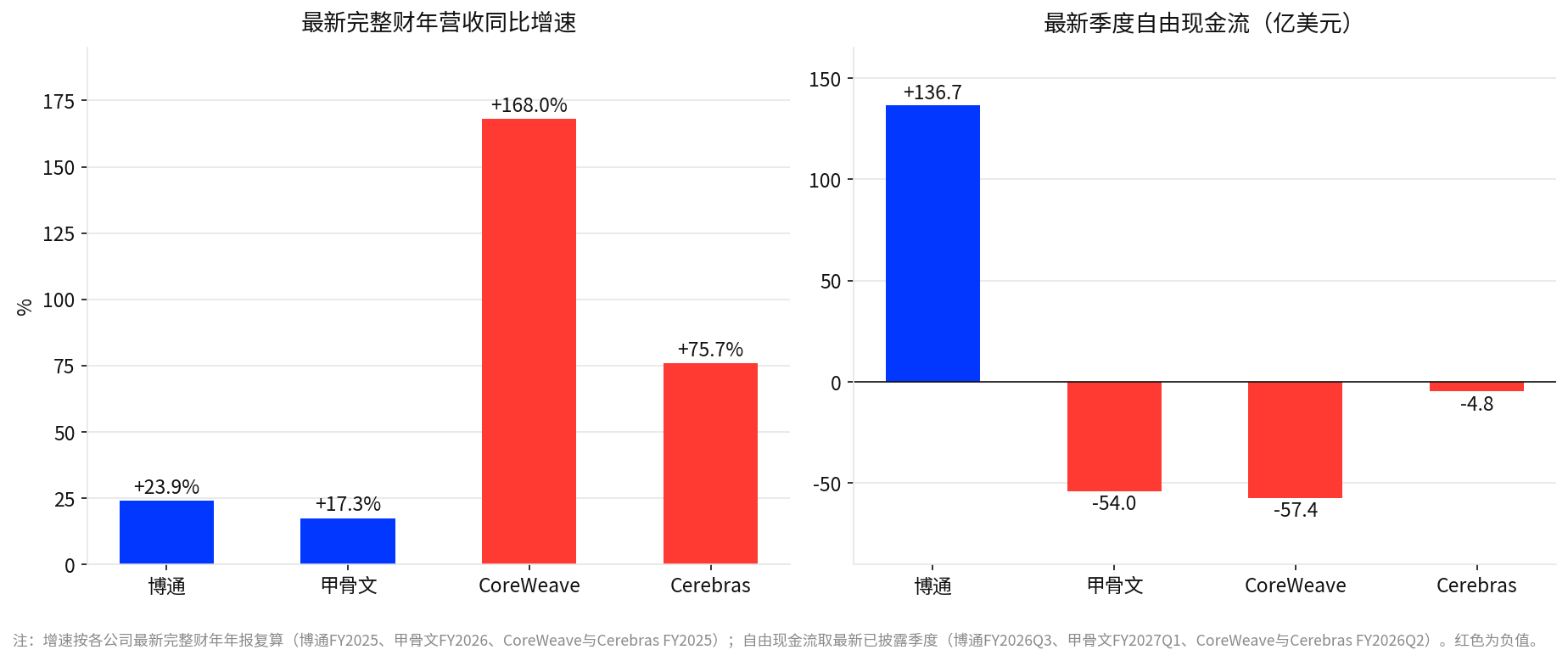
Broadcom’s latest quarterly revenue was $29.591 billion, net income was $13.088 billion, operating cash flow was $14.197 billion, capital expenditures were $532 million, and free cash flow was $13.665 billion. Its latest full fiscal-year revenue was $63.887 billion, up 23.9% year over year.
Those figures show Broadcom has both growth exposure to AI accelerators and networking equipment and a strong cash flow base. Compared with compute cloud companies that must buy large amounts of equipment, its business model does not require the same scale of infrastructure capital spending.
But the $63 billion financing arrangement also introduces a new test. Residual value support means that if equipment values fall, part of the risk may move back toward the supplier. Investors will need to watch delivery timing, margins, customer concentration, and any financial exposure tied to residual support. For Broadcom, the issue is not only how fast AI revenue can grow. It is also whether that revenue can keep turning into cash and whether the new financing structure changes what had been a relatively favorable risk-return profile.
Oracle: fast expansion, rising payback pressure
Oracle’s latest quarterly revenue was $19.345 billion, operating cash flow was $23.103 billion, capital expenditures were $28.499 billion, and free cash flow was negative $5.396 billion. Its latest full fiscal-year revenue was $67.358 billion, up 17.3% year over year.
Quarterly capital spending running above operating cash flow shows Oracle is using current funds to build future compute capacity. Multi-gigawatt cluster expansion and the addition of more chip architectures can broaden its cloud product set, but they also mean the company must keep funding equipment, data centers, and related infrastructure.
If new capacity wins customer orders and maintains high utilization, today’s capital spending may become the base for future revenue. If customer demand falls short, the payback period on equipment can stretch and financing pressure can rise. That makes cloud infrastructure revenue, capital spending, free cash flow, and contract execution more important to track than procurement scale alone.
CoreWeave: rapid revenue growth, equally large funding needs
CoreWeave’s latest quarterly revenue was $2.575 billion, capital expenditures were $6.422 billion, and free cash flow was negative $5.743 billion. In fiscal 2025, revenue rose from $1.915 billion in the prior fiscal year to $5.131 billion, up 168% year over year.
The growth is easy to understand. Compute demand is expanding, customers need to rent GPUs and related infrastructure, and compute cloud providers are capturing more revenue. But this business also requires continuous equipment purchases, data center construction, and funding for expansion.
Quarterly capital spending at about 2.5 times revenue means revenue growth has not translated into free cash flow. As long as demand holds, financing remains available, and utilization stays high enough, the model can keep expanding. But if financing costs rise, or if equipment refresh cycles move faster than cash recovery, growth can also pressure the balance sheet. For CoreWeave, order and revenue growth matter, but so do debt, capital spending, utilization, and whether free cash flow can improve over time.
Cerebras: Oracle cloud access helps, but customer revenue still matters
Cerebras’ partnership with Oracle gives its inference chips a new distribution channel. A large cloud platform can expand potential customer reach and lower the barrier for customers to try a new architecture. But opening a commercial channel does not mean the profit model has already been proven. Cerebras’ latest quarterly revenue was $180 million, down from $193 million in the previous quarter, and net loss was $451 million. Its fiscal 2025 revenue was $510 million, up 75.7% year over year.
The stock’s 10.10% gain reflects a positive market response to the new partnership opportunity. But compared with established chip suppliers, Cerebras still has a much smaller revenue base, and its losses remain significant. The next questions are whether customers keep using its products, whether its inference economics show an advantage, and whether new deployments can generate enough revenue and profit.
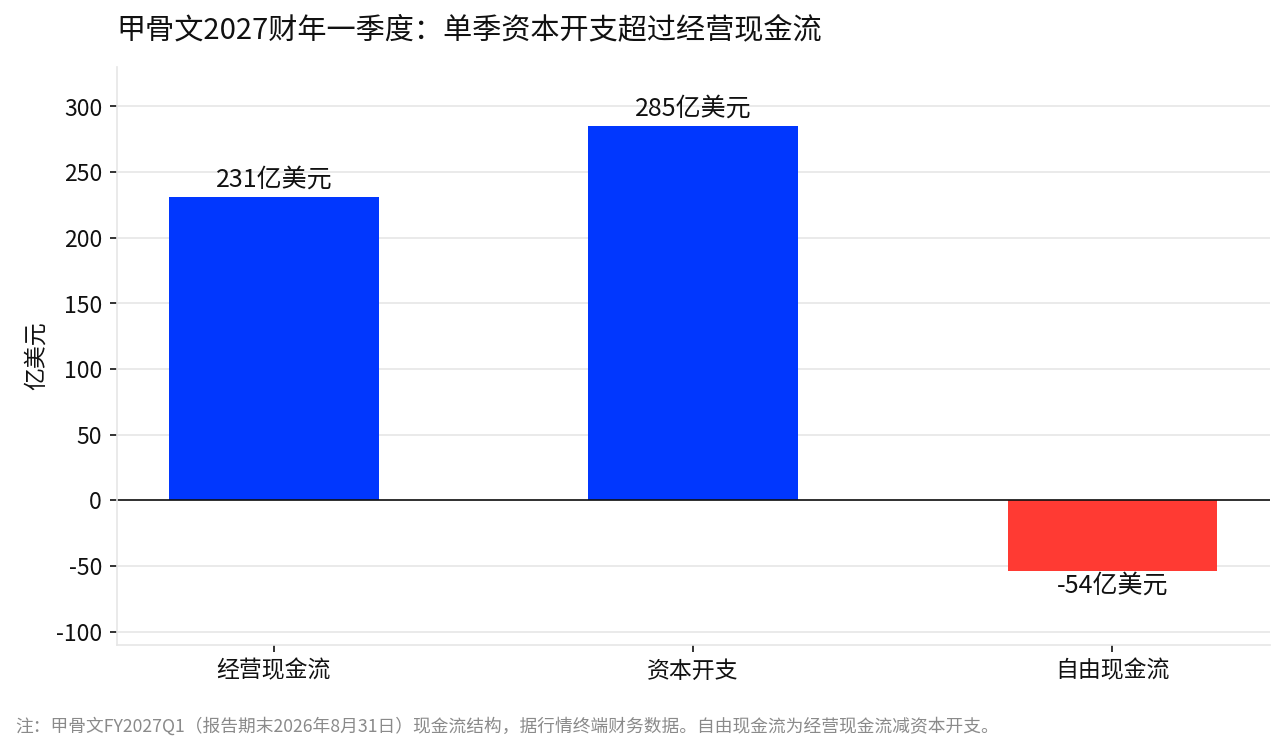
These four companies sit at different points in the value chain. They cannot be judged only by revenue growth, and a single quarter of free cash flow is not enough to settle long-term value for all of them. What they do show together is straightforward: compute orders can create growth expectations, but only controlled costs and sustained customer payments can turn growth into shareholder returns.
What the market still needs to see
This rebound restored part of the market’s confidence in AI compute demand, but operating data still need to catch up if valuations are to hold. The first area to watch is capital spending by large technology companies and revenue from cloud businesses. If AI investment keeps rising while enterprise demand, cloud revenue, and margins improve, the growth case for hardware suppliers becomes more durable. If capital spending keeps climbing while revenue and cash flow do not improve in step, the market may revisit the return question.
The second area is financing conditions. The $63 billion arrangement showed a new way to organize capital, but debt costs, credit spreads, equipment residual values, and end-customer payment capacity will determine whether similar deals can be repeated. The larger the financing package, the more the project itself must generate enough cash flow.
The third area is whether inference can become a profitable business. Rising model call volume is only one signal of demand growth. Unit compute cost, response speed, power consumption, and software compatibility across architectures will determine whether customers are willing to pay over time. For specialized chip companies and compute cloud providers, market attention still has to turn into customer usage, revenue growth, and better unit economics.
Demand is clearer. Returns still need proof.
Anthropic’s long-term compute spending arrangements, Broadcom’s $63 billion financing structure, and Oracle’s multi-architecture procurement strategy show how the AI infrastructure chain is changing. On the demand side, model companies are securing compute resources in advance through long-term agreements. On the funding side, financial institutions are moving into equipment procurement and lease financing. On the supply side, chipmakers and cloud platforms are competing across training, inference, and different workloads.
Together, those shifts make it easier for the market to estimate how large compute demand could become over the next several years, and they create new growth opportunities for related companies. But better demand visibility does not mean risk has disappeared, and broader financing channels do not mean projects are guaranteed to make money.
The $807 billion figure is not realized revenue. The $63 billion financing package is not risk-free funding. Both show that compute demand is gaining more explicit contractual support and more varied financing structures, but neither solves the capital return problem for any company.
The next stage for the market may be less about how much more money will be spent on AI infrastructure and more about how much revenue and cash flow that spending can produce, and which companies can protect margins in a more competitive market. Orders determine the opportunity for growth. Financing affects the speed of expansion. Cash flow determines whether the business can hold up over time.



