
AI stocks bounced in early August, but the heat has already come off
U.S. AI-linked stocks started August with a broad rebound. Many of the main names in the AI supply chain rose more than 10% in the first week of the month, Nvidia climbed for five straight sessions, and Marvell added nearly 20%. That followed a bruising July, when AI-related shares gave back a large part of their earlier gains.
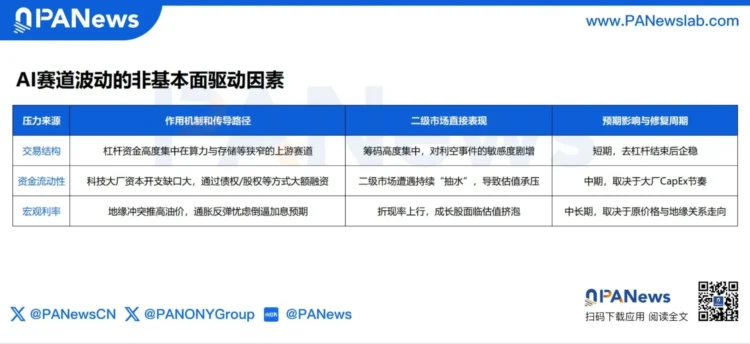
The rally came after a sharp deleveraging wave in late July. Semiconductor and compute-upstream names saw a clear valuation reset, and the market briefly turned anxious about whether the AI trade had run too far. Morgan Stanley China chief economist Xing Ziqiang said the recent volatility was not about weaker fundamentals. In his view, it was a phase of “halftime break” driven by crowded positioning, fundraising pressure from large companies, and higher oil prices that lifted rate-hike expectations. That view has also become a common read across Wall Street banks.
AI remains a core market theme, but the frenzy has cooled. Capital is shifting gears.
The first half was about compute. The second half is about proof
In the first half of the AI trade, investors crowded into chips and other compute names, rewarding the “pick-and-shovel” story. Morgan Stanley’s research team now thinks the second half may split in two directions. One points to applications, where investors will look for real cost cuts, operating leverage and cash-flow conversion. The other points to the physical world, where energy, assets and infrastructure become the scarce inputs.
Goldman Sachs and Morgan Stanley both say the market is moving from model training to large-scale inference deployment. That makes the old story of simply stacking more compute and chasing bigger parameter counts less convincing. Valuation anchors are shifting toward business-model execution and real-world resource constraints.
Three pressures hit the “pick-and-shovel” names
The first pressure was crowded positioning. In the first half of the year, AI was a textbook crowded trade. Leverage and momentum money poured into chips, semiconductors and storage, pushing positioning to historical highs. That made the market more fragile and set up a forced de-risking when consensus trades began to unwind.
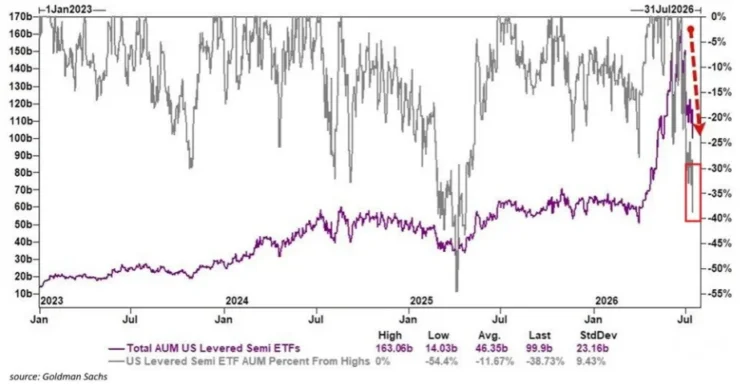
By late July, that unwind was visible in the data. According to Goldman Sachs, assets under management in leveraged semiconductor ETFs fell from about $163 billion at the June peak to $100 billion, a drop of nearly 40% and the biggest decline since April 2025. Semiconductors accounted for about 63% of all outflows from U.S. leveraged ETFs during the same period.
The de-leveraging also washed out a layer of pure narrative trading, which helped cool the excess around AI.
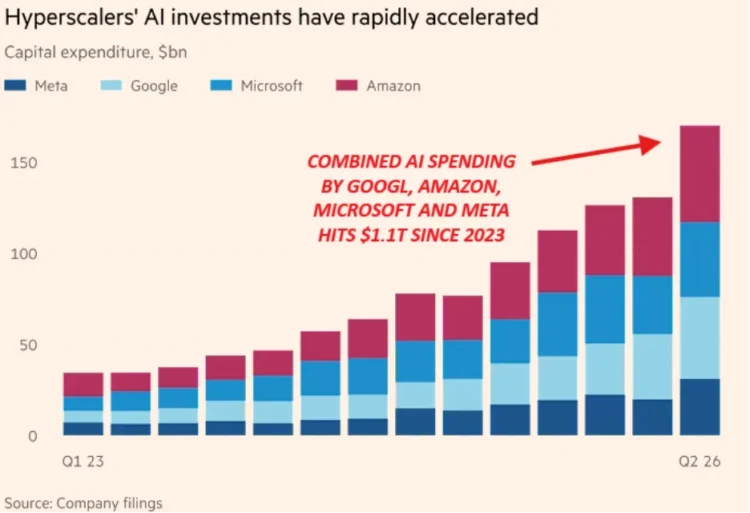
The second pressure was liquidity drain. Global hyperscalers are planning to pour hundreds of billions of dollars into AI infrastructure, but cash flow cannot fully cover the gap. Big tech has therefore turned repeatedly to equity issuance and large corporate bond deals. According to the Financial Times, cumulative AI capital spending by the four major Silicon Valley giants had reached $1.1 trillion by the end of the second quarter. JPMorgan’s research team also said AI-related debt now accounts for more than 15% of the U.S. investment-grade bond market, making it the single largest debt bucket. If downstream monetization disappoints, excessive leverage could become a credit-risk issue.
That spending pulls liquidity out of the public market. The more aggressively compute grows, the stronger the drain on capital supply.
The third pressure came from rates. Rising oil prices, driven by Middle East tensions, revived concerns that inflation could prove sticky again and pushed rate-hike expectations higher. Higher risk-free rates raise the discount rate applied to future cash flows. For AI names that are still in the investment phase and have not yet converted spending into cash flow, that means more valuation pressure.
AI applications are now competing on ROI
The second half of AI investing looks more like a test of financial execution. In the first half, anything with an AI label could command a premium. In the second half, parameter count matters less; return on investment matters more. Investors will care about whether AI can cut costs, lift revenue and generate cash.
As inference costs keep falling, application companies with strong closed ecosystems, proprietary data and sticky customers are better placed to stand out. Firms that embed AI into game development, ad targeting or digitized workflows can lower unit operating costs and turn AI into an internal efficiency engine and a pricing tool.
That also pushes vendors away from model size and toward deployment. Palantir (PLTR) is one of the few application names that has already shown financial growth, while most others still need more market evidence.
HALO assets are back in focus
“The end of AI is energy and raw materials,” Goldman Sachs said last month, and the market is starting to treat that as a working thesis. HALO stands for Heavy Assets, Low Obsolescence. It refers to physical assets with high barriers to entry and little risk of being displaced quickly by technology, such as copper mines, power grids, infrastructure equipment and nuclear resources.
Goldman’s The HALO Effect report says global markets are going through a repricing of scarcity. Over the past decade, investors favored lightweight, fast-scaling software models. AI has lowered the bar for information processing, which compresses the ceiling on valuations and margins for software and IT services. At the same time, replacement costs for physical assets have risen sharply because of inflation and supply-chain regionalization.
Foundation models are improving on a weekly basis, and the threshold for algorithms and software services is getting flatter. Some asset-light SaaS companies that rely on simple code or intermediary services now face disruption from AI agents. Algorithms can be beaten by open-source models, software can be rewritten by AI agents, but grids cannot be copied overnight, copper mines cannot be conjured out of thin air, and nuclear plants cannot be built in a day.
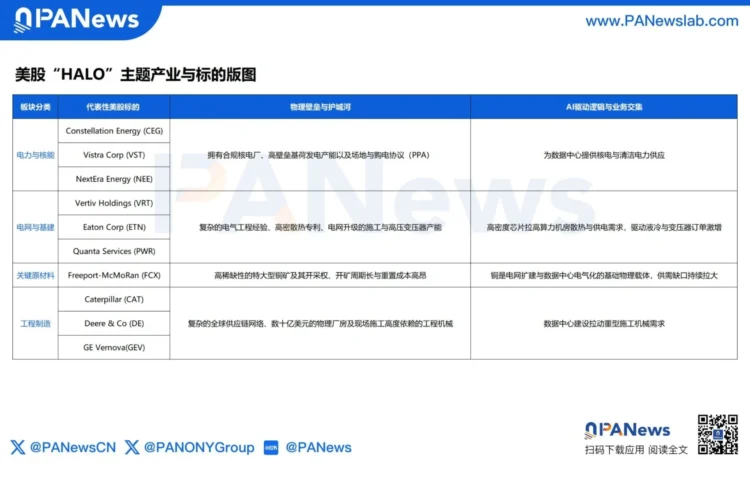
Wall Street’s HALO framework covers four main areas: power and nuclear, grids and infrastructure, critical materials, and industrial manufacturing. Each is a physical bottleneck that AI buildout cannot avoid.
Power, grids, copper and industrial equipment are drawing interest
In power and nuclear, Constellation Energy (CEG), Vistra Corp (VST) and NextEra Energy (NEE) are drawing attention. With public-grid expansion limited, their licensing advantages and behind-the-meter direct supply model are making them key power providers for data centers. Tech giants are signing multi-year power purchase agreements with floor prices, turning a once-stable utility stream into a more highly valued asset.
In grids and infrastructure, high-power GPUs have pushed traditional air cooling toward its physical limits, and data centers are moving toward liquid cooling. Vertiv (VRT), with its edge in precision cooling and thermal management, stands to benefit. Eaton (ETN) and Quanta Services (PWR) control distribution equipment, transformers and high-voltage grid construction, which determines how fast the grid can actually expand.
In critical materials, Freeport-McMoRan (FCX) holds high-quality large copper deposits and mining rights. Copper is essential for power transmission, transformer windings and data-center wiring. Long mine development cycles and declining ore grades are also reducing supply flexibility, which keeps widening the long-term supply gap.
In industrial manufacturing, Caterpillar (CAT) and Deere & Co (DE) have large factories, proprietary engineering know-how and global supply chains. Those physical moats are not easy to replace with code or algorithms, and they continue to win orders as infrastructure spending rises.
In the second half of AI investing, assets once viewed as old economy — Eaton transformers, Caterpillar excavators and copper mines — are being assigned new strategic value. That repricing is also laying the physical base for a much larger wave of AI infrastructure spending.
Still, HALO assets take time to build and require heavy capital. If commercial adoption in AI applications slows, the upfront spending on power and compute infrastructure could create excess capacity and stranded assets.
For capital markets, the “halftime break” looks less like a pause and more like a necessary phase of sorting winners from the rest. The next round of excess returns is likely to flow toward real business use cases on one side, and hard assets on the other.
Only companies with both monetization power and a physical moat are likely to stay ahead when the second half runs long.