
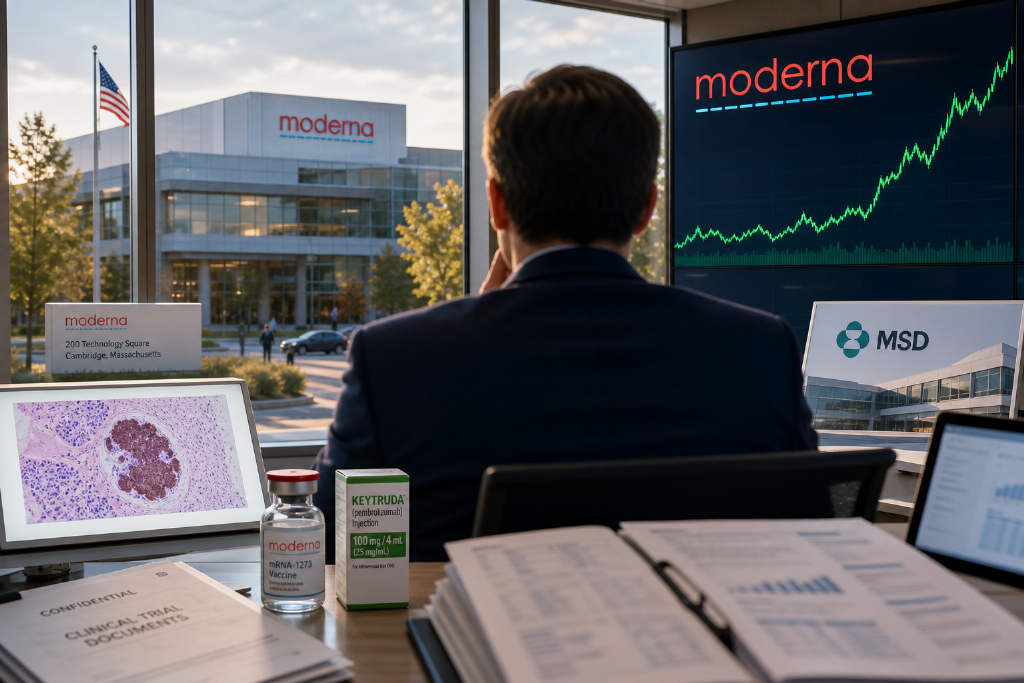
Moderna and Merck said on Aug. 19 that an interim Phase 3 analysis of their mRNA cancer therapy used with Keytruda met its targets in melanoma patients. The announcement drove Moderna shares up 176.97% in a single day to $174.38, marking the strongest trading session since the company went public. Its market value climbed from about $25 billion to roughly $69 billion overnight. Merck, the drug’s partner, also rose more than 9% intraday and set a record high.
The move was triggered by a Phase 3 clinical update showing that the mRNA therapy combined with immunotherapy reached the study’s predefined goals in melanoma. Even so, the headline result leaves several open questions, including how large the benefit is, how broadly the approach can be applied, and whether the market reaction has run ahead of the available data.
What the therapy is
The product commonly described as a “cancer vaccine” is formally named intismeran autogene. It is a personalized neoantigen therapy. The Phase 3 study disclosed on Aug. 19 is INTerpath-001 (NCT05933577), which enrolled 1,137 patients in a 2:1 randomized, double-blind design. Participants were patients with completely resected stage IIB to IV cutaneous melanoma.
This is an adjuvant setting. The treatment is intended to reduce the risk of cancer coming back after surgery, not to treat patients with already widespread end-stage disease. Under the dosing plan, intismeran is given once every three weeks for up to nine doses, together with Merck’s Keytruda once every six weeks for up to nine cycles. The full regimen lasts about 56 weeks, close to one year.
According to the disclosed result, the study met its primary endpoint of recurrence-free survival and its key secondary endpoint of distant metastasis-free survival, outperforming Keytruda alone.
In Moderna’s press release, the company described the result as the first successful Phase 3 trial for an mRNA cancer therapy, the first successful Phase 3 trial for a personalized neoantigen therapy, and the first time an adjuvant regimen has beaten Keytruda monotherapy as a standard treatment.
Merck Research Laboratories president Dean Y. Li and Moderna chief executive Stéphane Bancel both praised the outcome. Trial principal investigator Georgina Long, a professor at the Melanoma Institute Australia, said the combination “has the potential to establish a new treatment paradigm in adjuvant melanoma.” The companies said they plan to present full data at international medical meetings and discuss filings with regulators. Bancel said the treatment could win approval as early as 2027.
How it works
The therapy is designed to teach the immune system what to look for in a specific patient’s tumor. Medical teams first sequence the patient’s tumor sample to identify mutations unique to that cancer. An algorithm then selects as many as 34 neoantigens, protein features found in the tumor but not in normal cells.
The matching mRNA sequences are then synthesized and packaged in lipid nanoparticles, or LNPs, before being injected into the upper arm muscle. After cells read the mRNA, they produce those neoantigen proteins, allowing the immune system to train T cells that can recognize and attack that patient’s tumor. From tumor sampling to the first dose, the manufacturing process takes about six weeks.
That differs sharply from COVID-19 vaccines. COVID vaccines are preventive products given broadly. This cancer vaccine is therapeutic, made one patient at a time and fully customized. In stricter terms, it is closer to a therapy than a traditional vaccine.
Why Keytruda is part of the regimen
Helping the immune system identify the target is only part of the process. Cancer cells can suppress T-cell activity, which means the immune system may still fail to attack even after recognizing the tumor. Keytruda is a PD-1 inhibitor, and its role is to release that brake.
In the framework outlined in the report, intismeran identifies the target while Keytruda removes immune suppression. That is why INTerpath-001 was built as a combination study from the start rather than as a standalone vaccine test.
Keytruda is already widely used across multiple cancers, including lung cancer and melanoma. It works by blocking the mechanism tumors use to suppress the immune system, reactivating the patient’s own T cells so they can detect and destroy cancer cells.
Whether it can work across cancers is still unclear
Melanoma was a logical first target because it is relatively favorable for this approach. The report says melanoma has a median tumor mutational burden of about 276 nonsynonymous mutations, compared with about 244 for lung cancer. More mutations generally mean more candidate neoantigens, which makes vaccine design easier.
Pancreatic cancer sits at the other end of the spectrum. It has a lower mutational burden, and its tumor microenvironment is especially effective at suppressing immune activity, making it one of the hardest cancers to treat.
Merck and Moderna’s INTerpath program currently spans nine Phase 2 and Phase 3 studies, covering non-small cell lung cancer, bladder cancer, renal cell carcinoma, and earlier-stage studies in pancreatic cancer and gastric cancer. The melanoma trial reported this time also excluded ocular melanoma, mucosal melanoma, and unresectable metastatic disease.
Why the result does not settle the debate
The companies’ press release said the study “met” its endpoints, but it did not include the hazard ratio, confidence interval, p-value, event count, absolute recurrence rate, or Kaplan-Meier survival curves. Those figures are central to judging how large the treatment effect really is.
Overall survival data are not mature either. The study hit its mark at the first interim analysis and was unblinded at that point. The primary completion date had been set for October 2029, while the full study completion date is listed as September 2030, leaving a long path before a final verdict.
The clearest numerical reference for now comes from the earlier Phase 2 KEYNOTE-942 trial, which enrolled 157 patients in an open-label design and included only stage III and IV patients. In that study, the combination reduced the risk of recurrence or death by 49% (HR 0.51, 95% CI 0.294 to 0.887) and reduced the risk of distant metastasis or death by 59% (HR 0.411, 95% CI 0.200 to 0.843). Four-year recurrence-free survival was 72.4%, compared with 49.1% for Keytruda alone. Overall survival trended in the combination’s favor but did not reach statistical significance.
Citi analysts, according to the report, described Moderna’s pipeline as a “show-me story,” meaning the company still needs to deliver more evidence.
Several practical issues also remain unresolved: how durable the benefit will be, whether manufacturing can support personalized production for more than 10,000 patients a year, how pricing and insurance reimbursement will be handled, whether the approach can extend beyond lung cancer to other tumors, and what the long-term safety profile of repeated customized LNP-mRNA dosing will look like.