
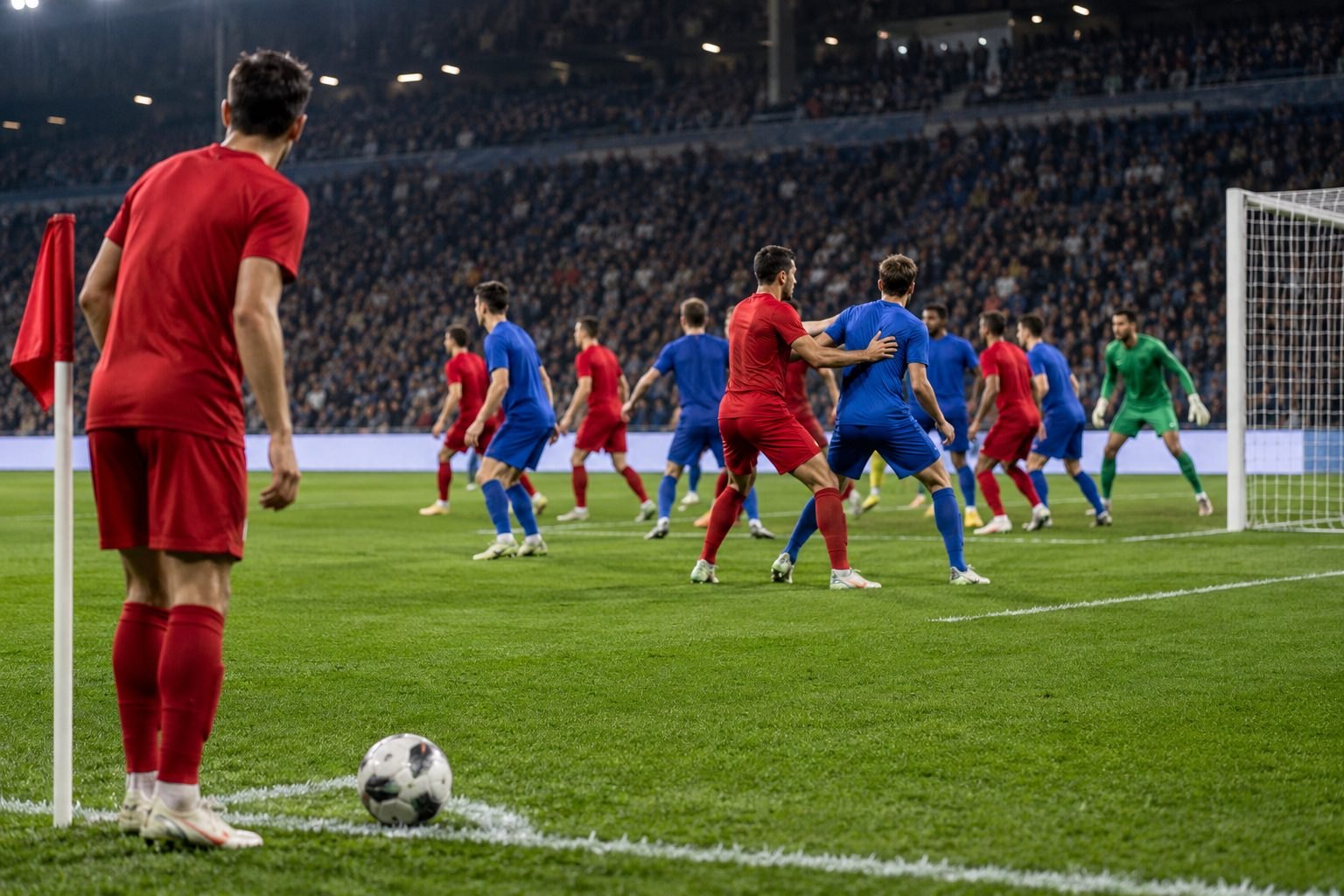
Yes, but only in limited cases. Under the existing VAR protocol, the VAR can already step in for some offences before the ball is in play, and an IFAB trial approved in April 2026 adds a narrow extension for attacking offences before an attacking free kick or corner kick.
What the existing protocol already allows
An offence before the ball is in play does not enter VAR review just because it happens before a corner or near the penalty area. The trigger is the type of offence, or whether it continues as/after the kick is taken.
The existing protocol applies to any player. If the offence is a potential sending-off offence involving violent conduct, spitting, biting or extremely offensive, insulting and/or abusive action(s), or if it continues as/after the kick is taken, the VAR can intervene.
When VAR can step in before the kick is taken
Here are the situations in which VAR can or cannot intervene before the restart.
| Situation | Can the VAR intervene? |
|---|---|
| An offence before the ball is in play that is a potential sending-off offence involving violent conduct, spitting, biting or extremely offensive, insulting and/or abusive action(s) | Yes, under the existing VAR protocol |
| An offence before the ball is in play that continues as/after the kick is taken | Yes, under the existing VAR protocol |
| In the trial: an attacker's offence at an attacking free kick or corner kick, after the referee's signal for the kick, with a direct and immediate impact | Yes, if the on-field match officials did not identify it |
| In the trial: an attacker's offence before the referee's signal that is not a potential sending-off offence and does not continue as/after the kick | No |
| A defending-team offence before the ball is in play | The trial does not extend to it; only the existing protocol grounds apply |
Why the trial exists
The trial was approved at an IFAB Special Meeting because there is a growing trend of attackers tactically fouling defenders before the ball is in play at attacking free kicks and corner kicks. The actions include holding, pulling, pushing and blocking.
Those offences can help create a goal, a goal-scoring opportunity or a penalty-kick situation. They can also be hard for the on-field match officials to spot because many players may be inside or close to the penalty area, players are spread across a large area and moving in different directions, and many may be holding or pushing each other at the same time.
What the trial adds, and what it does not add
The trial does not turn every pre-kick foul at a set piece into a VAR matter. It applies only when an attacker commits an offence before the ball is in play at an attacking free kick or corner kick, the on-field match officials do not identify it, and one of the review grounds is met.
Those grounds need to be kept separate. If the offence continues as/after the ball is kicked, the existing protocol already allows intervention. If the review is based on direct and immediate impact, the offence must have happened after the referee's signal for the kick to be taken, by hand/arm and/or whistle.
Direct and immediate impact is a closed list. It covers an offence that helps the attacking team to score or create a goal-scoring opportunity; and/or negatively affects the defending team's ability to prevent a goal; and/or results in the defending team conceding a penalty kick; and/or committing a red-card DOGSO offence, with DOGSO meaning denying an obvious goal-scoring opportunity; and/or committing a second-yellow-card DOGSO or SPA offence, with SPA meaning stopping a promising attack.
The extension applies only to an attacking-team offence before the ball is in play from a free kick or corner kick. It does not extend to a defending-team offence. In IFAB's example, if a defender pushes an attacker before a corner kick is taken, the defender can be warned, cautioned or sent off depending on severity, and play restarts with the original corner kick because a penalty kick cannot be awarded when the ball was not in play.
What happens after a review
Under the trial, when the VAR intervenes, it will usually recommend an on-field review so that the referee can make the final decision. The VAR does not decide whether the offence is given.
If the referee decides after the review that an offence occurred, the appropriate disciplinary action is taken or cancelled. If the offence happened before the ball was in play, the kick is retaken. If the offence continued as/after the ball was kicked, a free kick is awarded to the defending team instead.
Competitions cannot join the trial informally. They must apply to IFAB through their national FA or confederation, follow the protocol in full with no variations unless IFAB gives written approval, and send feedback and technical data to IFAB.
FAQ
Can VAR check holding at corners?
Sometimes, not as a general rule. Holding before the ball is in play is reviewable only if it fits one of the existing protocol grounds, or in the trial if it is an attacking offence after the referee's signal and it has a direct and immediate impact.
If it happens before the signal and does not continue as/after the kick, the trial does not open a review on impact alone.
Can a goal be ruled out for a foul before a corner is taken?
Yes, if the offence is one that can be reviewed and the referee confirms it after an on-field review. The trial was created for situations where an attacking offence before the kick can directly help produce a goal or a goal-scoring opportunity.
The final decision remains with the referee, not with the VAR.
Does the trial also cover attacking free kicks?
Yes. The extension applies to attacking free kicks and corner kicks, and only to attacking-team offences before the ball is in play.
The trial is ongoing, with feedback to be collected from participating competitions.
Does the trial let VAR review defending-team fouls before a corner?
No. The extension is limited to attacking-team offences before the ball is in play from a free kick or corner kick.
For a defending-team offence before the ball is in play, the existing protocol grounds still apply, and a penalty kick cannot be awarded for an offence committed while the ball was out of play.