
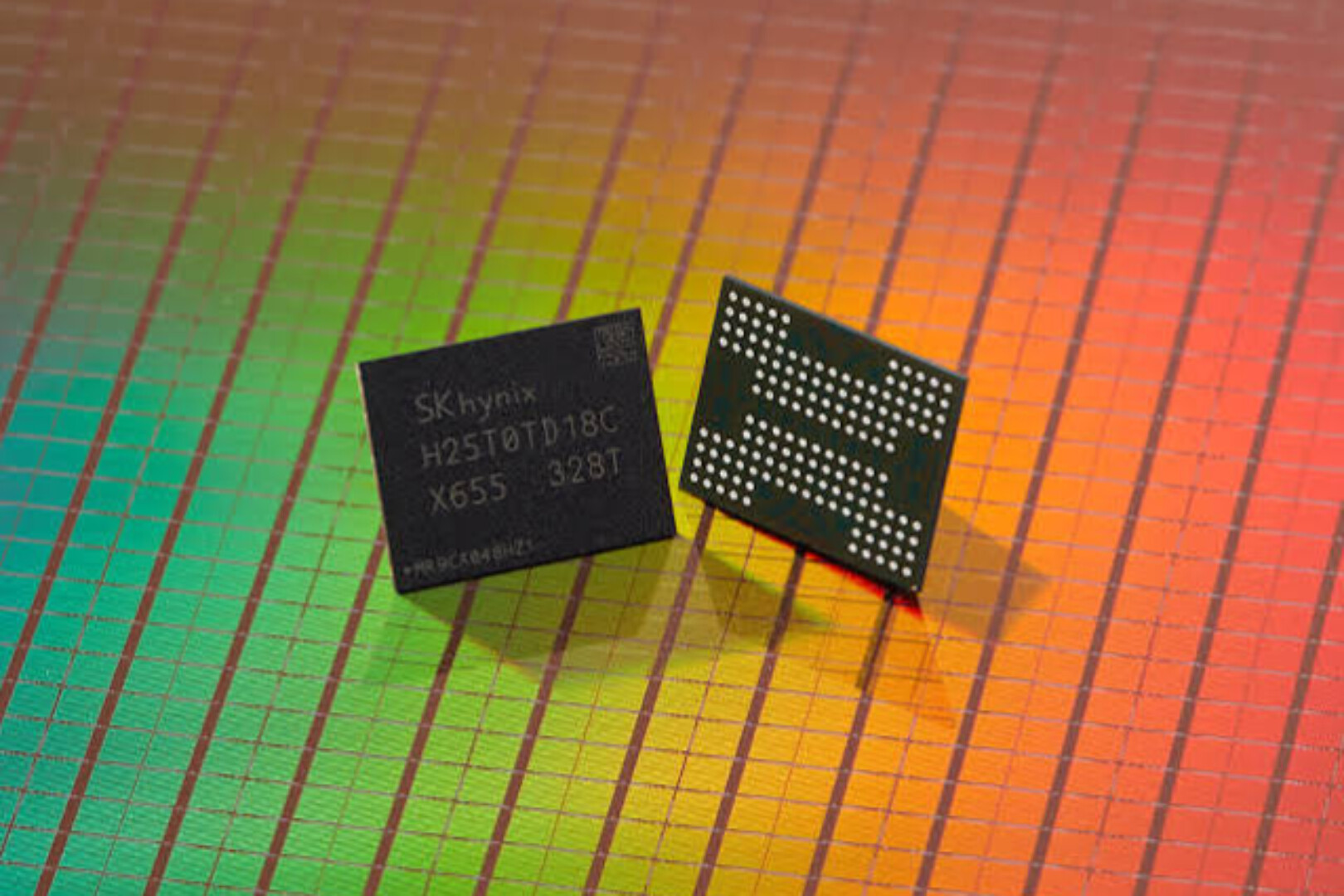
Why Morgan Stanley sharply raised targets across the storage supply chain
Morgan Stanley’s latest report delivered a major re-rating across selected storage names, with the most notable move on Silicon Motion (SIMO.O). The bank raised its target price from $155 to $400, valuing the company at 23x expected 2027 EPS, and said it expects SIMO’s revenue to reach a record high in 2026. The report also lifted Longsys from RMB 300 to RMB 673 and Phison from TWD 2,248 to TWD 2,588.
Still, this was not a blanket upgrade on every NAND-linked company. Morgan Stanley kept both Longsys and Phison at Equal Weight, which is important for interpreting the call correctly. The report is not arguing that every memory module vendor will benefit equally from a rising flash market. Instead, it suggests that the next phase of the NAND cycle will reward companies with direct exposure to AI infrastructure storage demand, especially in enterprise SSDs and adjacent controller segments, rather than the broader consumer storage ecosystem.
That distinction matters because the bank’s thesis is not centered on a routine SSD price recovery. Its core argument is that AI data centers are reshaping the underlying demand mix for NAND. Historically, flash cycles were heavily driven by smartphones, PCs, and consumer SSD inventory swings. Morgan Stanley now sees a transition toward enterprise storage, AI server boot drives, and cloud procurement under longer-duration agreements. In other words, this is less about a standard cyclical rebound and more about a structural demand migration toward data-center-centric storage consumption.
AI servers are shifting NAND demand away from consumer electronics
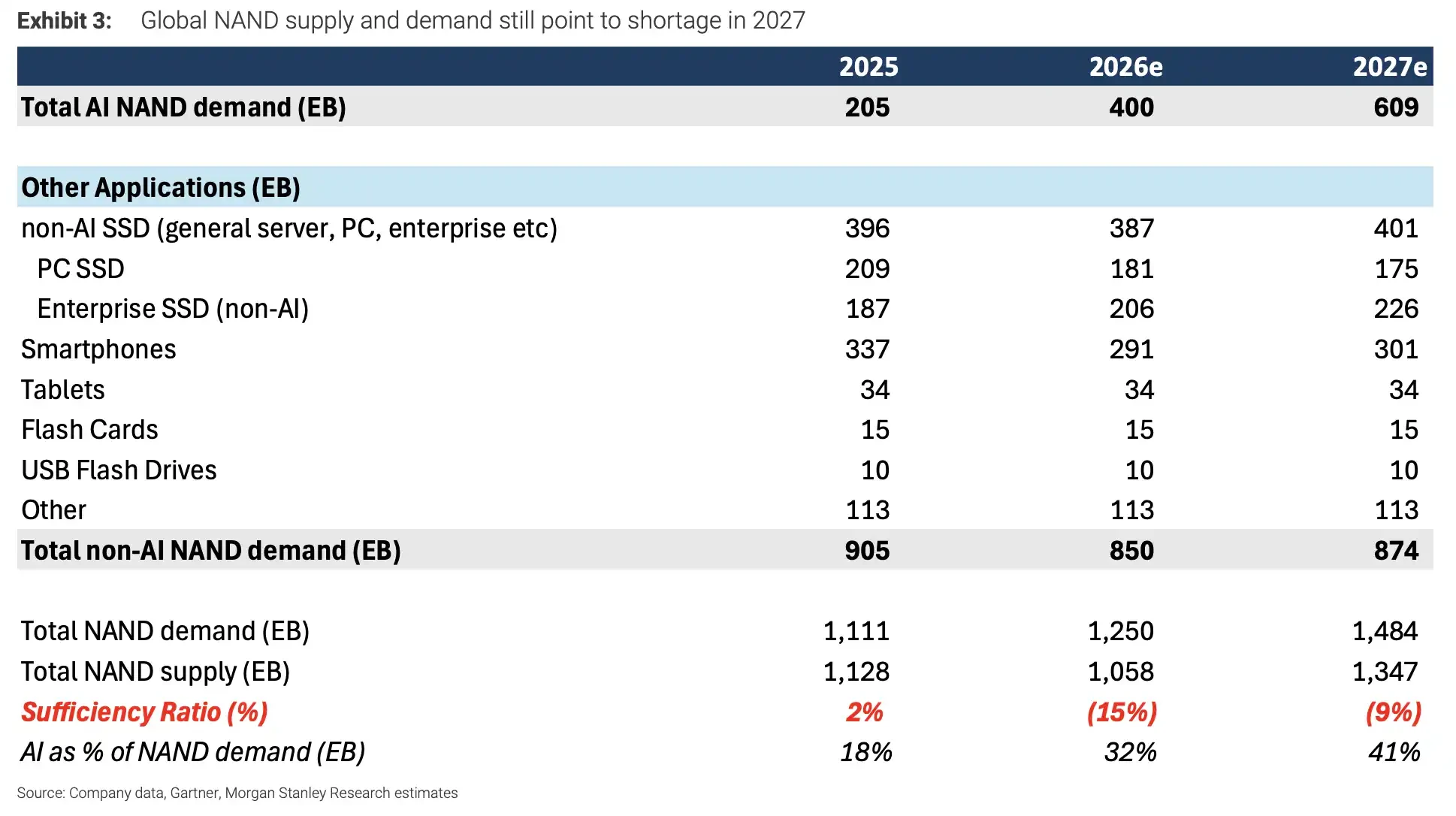
The central conclusion of the report is that AI-related NAND demand can remain a powerful support for the market through 2027. Morgan Stanley estimates that the global NAND market will still show roughly 2% oversupply in 2025 due to the residue of the previous inventory glut. But that balance is expected to swing dramatically afterward, turning into a 15% shortage in 2026 and remaining in a 9% deficit in 2027 even as supply continues to expand.
The bank’s supply-demand figures are explicit. Total NAND demand for 2025, 2026, and 2027 is projected at 1,111 EB, 1,250 EB, and 1,484 EB, while supply is estimated at 1,128 EB, 1,058 EB, and 1,347 EB. That moves the market from a mild surplus to a severe shortage, then to a still-tight environment. Morgan Stanley’s point is that this tightening is not being driven by aggressive assumptions for smartphones and PCs. In fact, its assumptions there remain relatively conservative, with NAND content per device broadly flat and end-unit shipments still modeled lower by the firm’s hardware team.
Instead, the real engine is enterprise and cloud demand. AI servers do not only require GPUs and HBM. They also require significant local storage, enterprise-grade SSDs, and boot drives that support startup, system management, and ongoing operation. Once cloud service providers begin procuring under long-term agreements, both the pricing pattern and the timing of NAND demand can look very different from the old consumer-driven cycle. That is the strategic shift at the heart of the report.
Morgan Stanley expects AI-related NAND demand to grow 60% year-over-year in 2027 to reach 609 EB, accounting for 41% of total NAND demand. This is a striking number because it implies that AI will become one of the largest individual forces shaping the flash market. As AI’s contribution rises, NAND pricing and availability become increasingly sensitive to hyperscaler capex, enterprise SSD qualification, and the allocation behavior of upstream suppliers.

Price action is already diverging between data center and consumer products
Channel data in the report suggests the divergence has already started to show up in pricing. For 3Q26, Morgan Stanley’s channel checks indicate that TLC enterprise SSD pricing rose about 30% quarter-on-quarter. Server DRAM increased around 20%, while legacy DRAM products such as DDR3 and DDR4 were up 30% to 40%. By contrast, consumer NAND price increases were noticeably smaller.
The reason is straightforward. Smartphone and PC customers are operating under tighter profit constraints and are less able to absorb the same level of input cost inflation. Data center customers, especially those tied to AI deployments, have a very different spending profile and a stronger urgency around system qualification and deployment schedules. As a result, the strongest pricing momentum is appearing in products associated with servers, cloud infrastructure, and enterprise storage rather than across the entire NAND complex.
This matters for investors because it changes how the cycle should be read. In prior periods, broad-based SSD or handset restocking often drove the narrative. In the setup Morgan Stanley describes, pricing power is much more concentrated. The biggest upside sits where supply is strategically important to AI infrastructure and where demand is less discretionary. That creates a more selective market backdrop, benefiting some controllers and enterprise storage exposures far more than mainstream consumer-oriented vendors.

Why SIMO is being re-rated: enterprise SSD controllers and AI boot drives
SIMO received the most aggressive valuation revision because Morgan Stanley sees it as directly exposed to two of the most attractive parts of the AI storage stack: enterprise SSD controllers and AI server boot drive modules. The report identifies the company’s MonTitan enterprise SSD business as its most important new growth engine over the next several years.
According to the bank’s estimates, MonTitan will contribute 5% of SIMO revenue in 2026, 13% in 2027, and 19% in 2028. At the same time, boot drive modules are expected to begin scaling materially, contributing about 15% and 21% of revenue in 2026 and 2027, respectively. Those are meaningful figures because they imply a rapid shift in the company’s business mix away from a market perception centered mostly on consumer controllers.
For AI servers, the boot drive is not the most visible component, but it remains operationally essential. It supports system startup, management, and runtime storage functions. As AI server shipments increase, demand for the associated controllers and modules should rise in parallel. Morgan Stanley’s bullish SIMO call is therefore not only a memory-pricing view; it is also a product-mix and positioning call. The bank is effectively arguing that SIMO is moving into segments where spending intensity is rising and where the market may be willing to pay a higher multiple.
That said, the report does not present this outcome as guaranteed. The $400 target price assumes that enterprise SSD and boot drive ramps proceed smoothly, customer qualifications continue, and AI server demand does not slow materially. If any of those assumptions fall short, the implied valuation support becomes harder to defend. So while the upside case is significant, it remains conditional on execution and end-market durability rather than already realized earnings.
Why Longsys and Phison may benefit, but not without limits
Longsys and Phison are also positioned to gain from tighter storage supply and stronger AI server demand, but Morgan Stanley stopped short of giving them more aggressive ratings. The report points to a practical constraint facing module vendors in a tight NAND market: upstream manufacturers are more likely to prioritize capacity allocation toward large cloud customers and core CSP accounts.
That means module houses may not receive enough incremental supply to fully capture the upside from rising prices. Higher NAND prices can help through inventory revaluation and stronger ASPs. A better enterprise mix can also support margins. But if actual shipment volumes are constrained by allocation decisions at the supplier level, the revenue elasticity of module vendors becomes limited. This explains why target prices can move higher while ratings remain at Equal Weight.

The report also highlights the role of long-term agreements, or LTAs. These contracts can offer some downside protection against falling prices. Morgan Stanley expects Kioxia’s 2027 LTA coverage to exceed 50%. However, LTAs are not an unqualified positive. Micron has also indicated that such agreements often include both price floors and ceilings. That structure can reduce the risk of steep price declines, but it may also cap upside during periods of extreme shortage.
Module vendors, for their part, are trying to use models such as TCM to shift more inventory burden toward customers and stabilize long-term gross margins in the 25% to 35% range. Even so, that outcome depends on customer acceptance, the severity of supply tightness, and whether the product mix is premium enough to justify more resilient pricing.
2028 is the key boundary for the bullish NAND thesis
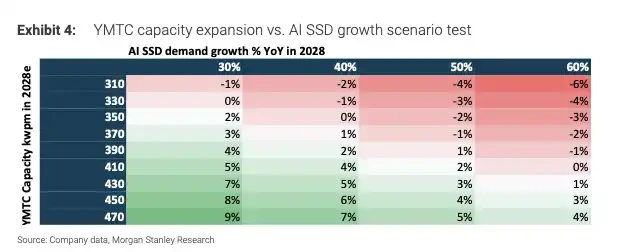
The report makes clear that the biggest test of this bullish storage scenario lies in 2028. Under Morgan Stanley’s base case, the NAND market could still show roughly a 5% shortage by then if AI NAND demand continues to grow 60% year-over-year and YMTC capacity remains around 310kwpm. Under those assumptions, the market would stay tight enough to preserve pricing support.

But the picture changes quickly under a different scenario. If YMTC expands capacity to 470kwpm while AI growth slows, the NAND market could move from shortage to near balance or even back into oversupply. That scenario analysis is important because it captures the core uncertainty of memory cycles. Tight inventories and strong short-term price action often reinforce optimism, but storage markets can reverse quickly if supply discipline weakens.
The report also notes that some consumer-side order reductions have already appeared and that smartphone and PC customers have limited tolerance for higher prices. As a result, consumer NAND may hit its pricing ceiling earlier than enterprise-oriented products. This is another reason the current cycle should not be read as a broad, uniform recovery across all flash categories.
Ultimately, the report leaves the market with a more important question than whether SSD prices will rise. The real question is whether AI demand can stay strong enough to absorb the supply additions coming over the next two years. For SIMO and other companies tied to controllers and AI storage infrastructure, 2026 may mark the beginning of a meaningful enterprise and AI revenue ramp. For the broader NAND cycle, however, the decisive variables remain 2028 YMTC expansion, CSP capex intensity, and whether suppliers maintain enough discipline to prevent the market from slipping back into surplus.