
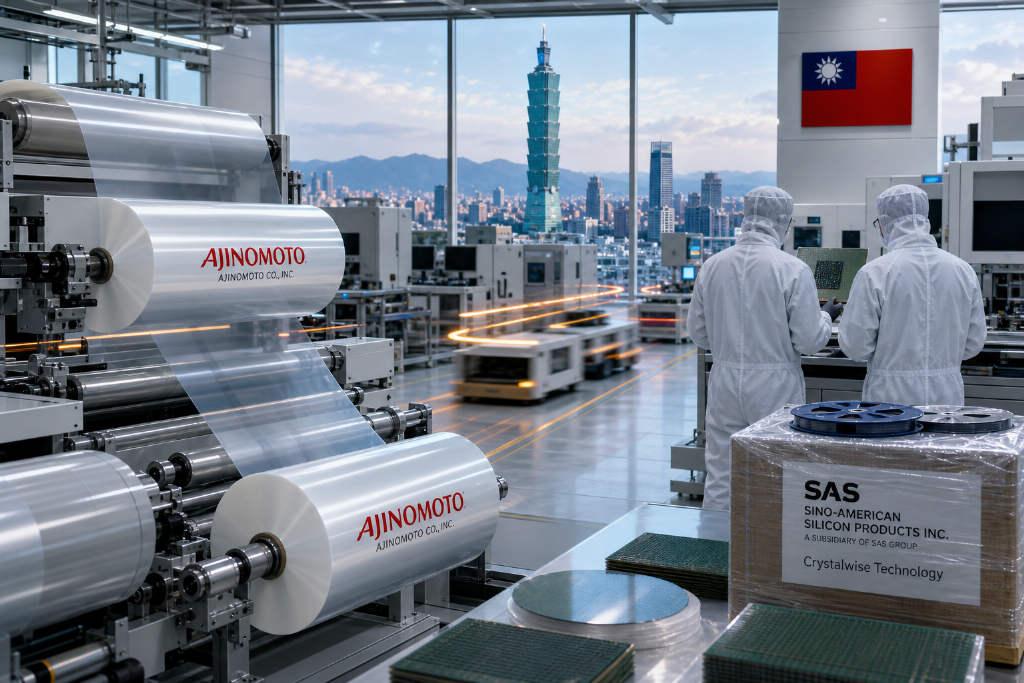
Ajinomoto, the dominant supplier of ABF build-up film, has reportedly reduced shipments to some customers as AI-driven demand keeps tightening the upstream materials chain for advanced substrates. According to the source report, some Chinese manufacturers were told their supply could be cut by about 30%, putting Taiwan-based Sino-American Silicon Products Inc. (SAS, 5483) and its subsidiary Crystalwise Technology in focus as possible beneficiaries of order diversion.
AI infrastructure demand is tightening ABF material supply
Global investment in AI infrastructure continues to lift demand for accelerators from NVIDIA, AMD and Intel. That has pushed up demand for FC-BGA substrates and, in turn, for build-up film, a key raw material used in ABF substrates.
The report says the market for build-up film has only a small number of suppliers, and even fewer have room to expand capacity quickly. As a result, the current supply-demand gap is not expected to be resolved in the near term.
Ajinomoto is near capacity and has moved to selective shipments
Ajinomoto’s monthly capacity has exceeded 2 million square meters, but its production lines were already close to full utilization in the second quarter of this year, according to the report. The company began a capacity expansion program in 2023 worth about JPY 25 billion and plans to raise capacity by about 50% before 2030. Even so, the new output is expected to take years to come online, leaving the near-term supply gap unresolved.
Citing Economic Daily News, the report says Ajinomoto controls more than 90% of the global ABF build-up film market and has long held pricing power. With capacity tight, the company has adopted a selective shipment approach, giving priority to domestic Japanese customers and core overseas clients. The products involved mainly feed into the FC-BGA substrate supply chain used for AI accelerators.
People cited in the report said Ajinomoto has notified some Chinese customers that supply volumes may be reduced by about 30%. That has raised pressure on downstream substrate makers to look for second-source suppliers and could reshape parts of the supply chain.
Crystalwise Technology becomes a name to watch
Against that backdrop, Crystalwise Technology, a subsidiary under the SAS Group, is drawing more attention. The company was founded in 2015 and was formally brought into the SAS Group at the end of 2024. SAS now holds about 50.8% of the business.
The source report describes Crystalwise as Taiwan’s first local manufacturer to complete independent research and development and enter mass production of insulating build-up film. Its products are positioned around material toughness and crack resistance, and formulations can be adjusted based on customer process requirements. The company’s products have already passed certification with multiple domestic and overseas clients and are now in the small-volume shipment stage.
Order diversion potential depends on scaling output
With Ajinomoto cutting supply to some customers, substrate makers have stronger incentives to introduce a second source. The next key question is whether Crystalwise can move from validation and small-volume deliveries to large-scale mass production.
For SAS, any redirected orders would matter not only for near-term business momentum but also for its broader semiconductor materials strategy. The report says that as AI keeps expanding ABF substrate demand, and as supply-chain diversification and localization continue, local Taiwanese build-up film suppliers may gain a more prominent strategic role.