
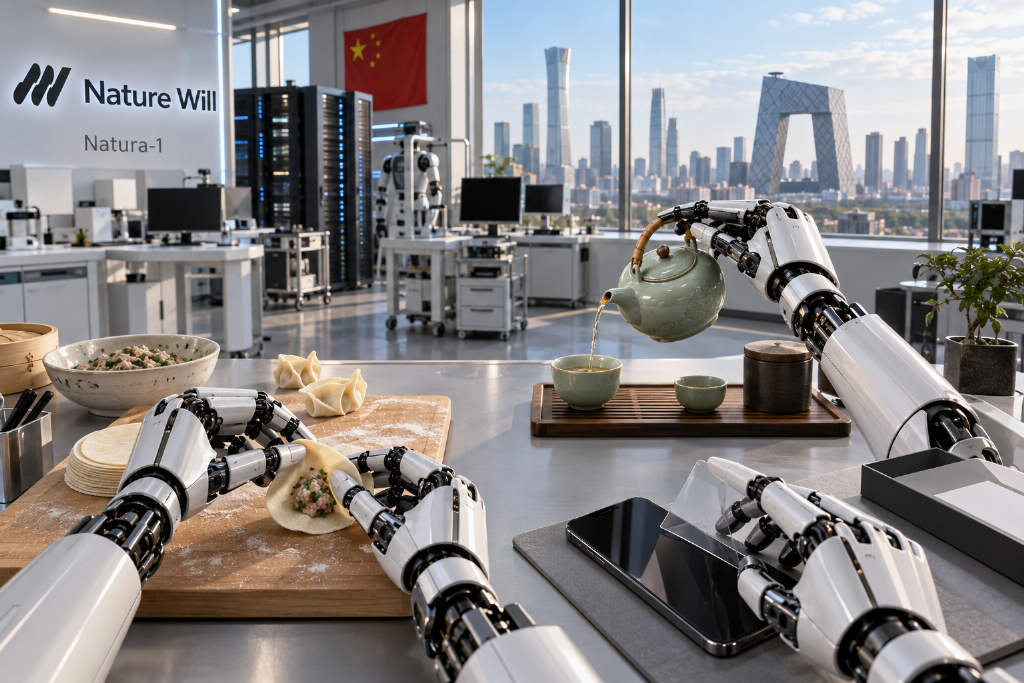
Wrapping a wonton is routine for most people. For a robot, it is not. One hand has to support a thin wrapper that keeps changing shape, the fingers need to sense the filling and the wrapper’s rebound, and both hands must hand off the object at the right moment.
Nature Will, an embodied AI company based in Beijing, says its newly released Natura-1 can now handle that kind of task. In a 1-minute-12-second video shown at normal speed and in a single take, a pair of robotic dexterous hands completes the full wonton-wrapping process.
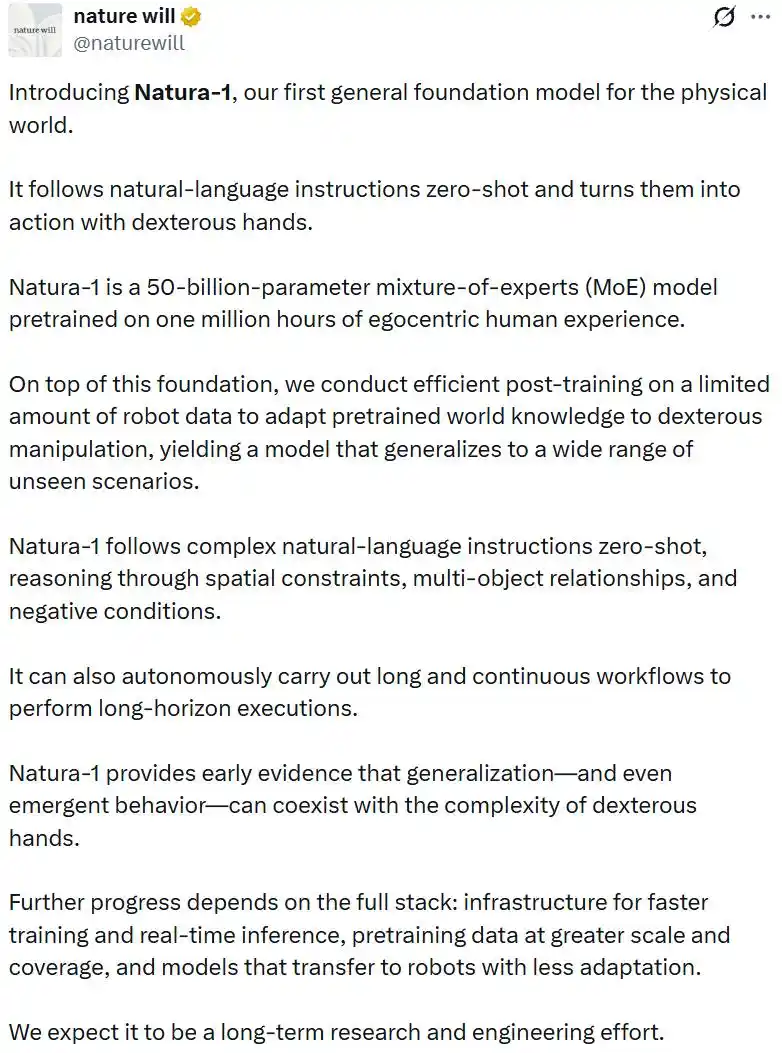
The system behind the hands is Natura-1, a 50-billion-parameter mixture-of-experts, or MoE, model. Nature Will said the model was pretrained on 1 million hours of first-person human experience data and uses language and vision as inputs while driving a 20-degree-of-freedom dexterous hand in a 100-millisecond control loop.
If the wonton demo answers whether a robot can perform a delicate task well, the company is aiming at a harder question: can the same system move straight into a task it has never specifically practiced?
Why dexterity and generality have been hard to combine
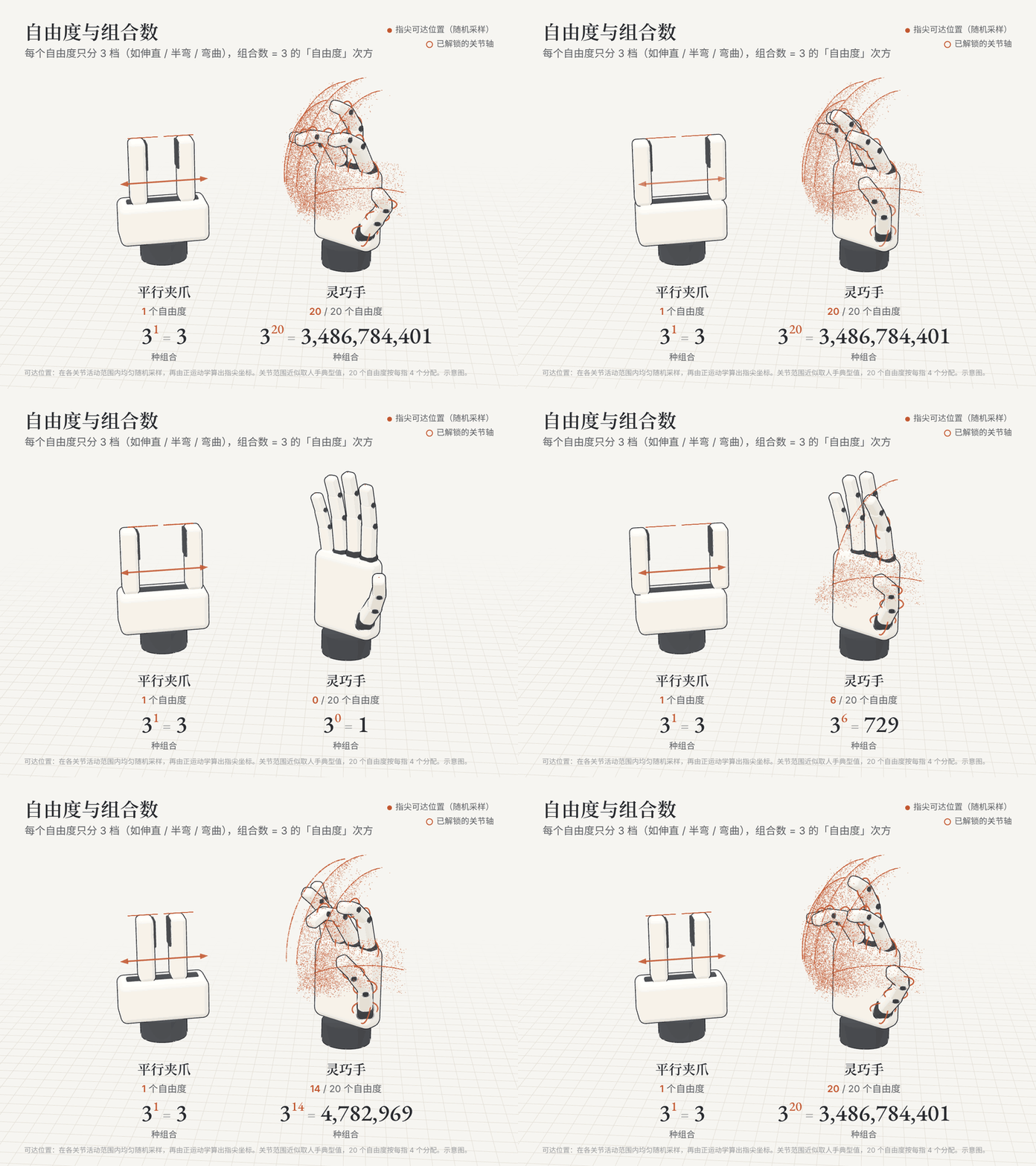
Dexterous manipulation is difficult on its own. Human hands have more than 20 degrees of freedom, and many everyday objects are soft, deformable, or springy. Every contact changes the state of the object, so a robot has to keep adjusting while acting. The control burden rises quickly as the number of degrees of freedom increases.
Parallel grippers simplify control, but they also limit what a system can do. Actions that depend on support, twisting, or coordinated two-handed motion are much harder to execute. In Nature Will’s view, that tradeoff has pushed earlier work toward two ends: general strategies built around grippers, or dexterous systems tuned for a single task.
On the generality side, the company points to progress such as π0.7. But bringing that kind of generality to dexterous hands runs into a data problem first. Generalization depends on large and diverse training data, while real robot data is expensive and teleoperation data collection for dexterous hands is slow and difficult.
Nature Will also described a deeper loop: robots can only collect data where they already know how to operate, and they can only operate where data already exists. If that loop is going to break, the data has to come from outside the robot.
That has pushed more teams toward a ready-made source of experience: humans.
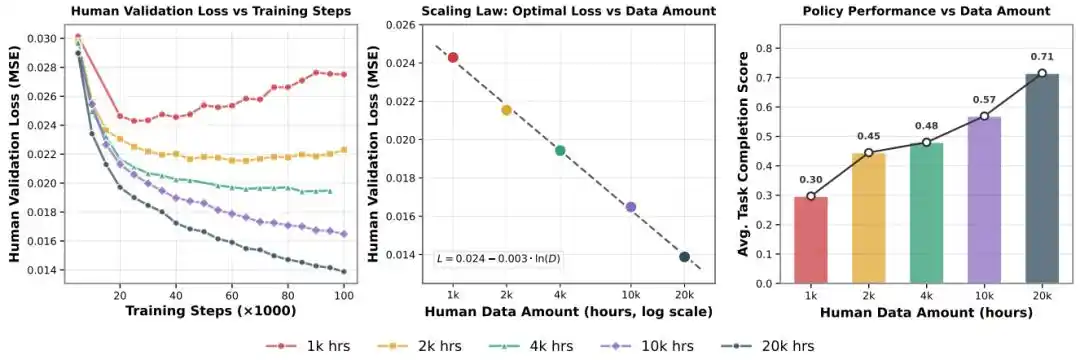
In February, EgoScale from Nvidia and other institutions used 20,854 hours of first-person human manipulation video to pretrain a vision-language-action model and reported a log-linear relationship between data scale and validation loss. Once deployed on a 22-degree-of-freedom dexterous hand, the average success rate was 54% higher than a baseline without human-data pretraining.
About half a year later, that scale moved up by roughly 50 times. On Aug. 10, U.S. robotics company Dyna Robotics released its world-action model DYNA-2, pretrained on more than 1 million hours of first-person human video with no robot data in pretraining. According to Dyna, when the dataset was scaled from 1,000 hours to 1 million hours, the model’s average normalized score across 14 robot tasks rose from 20% to 53%.
Still, both efforts kept one extra step in the loop. Human experience had to be adapted to specific tasks. EgoScale used a small amount of human-robot alignment data for intermediate training, while DYNA-2 used up to 10 hours of robot data for post-training on each evaluation task.
Nature Will’s question is narrower and tougher: on a high-degree-of-freedom dexterous hand, can human experience transfer to new tasks without task-by-task adaptation?
Natura-1: one model, two targets
Nature Will was founded in January 2026 by Ding Ning, an assistant professor in the Department of Electronic Engineering at Tsinghua University. The company describes itself as a research-driven firm centered on foundation models for the physical world, with a goal of Physical AGI: a general foundation model that can close the loop among perception, prediction, reasoning, and action in the real world.
The company told Jiqizhixin that the work rests on two judgments. First, a general foundation model for the physical world may be possible. Second, first-person human data is now in a position to be collected at scale.
Nature Will said the methodology follows the path taken in large language models, where model scale, data scale, and infrastructure grow together. The team told Jiqizhixin: 「We followed the idea from large language model research that model scale and data scale should grow together. Early on, we used smaller models and smaller datasets to validate the architecture quickly, then expanded step by step after confirming the direction, rather than deciding from day one that we had to build a 50B model.」
Natura-1 is the company’s first general foundation model for the physical world. Training has two stages: pretraining on 1 million hours of human experience data, then an efficient round of post-training on limited robot data to adapt the world knowledge learned in pretraining to dexterous manipulation.
Unlike systems that split instruction understanding, world prediction, and action generation into separate modules, Natura-1 is a single MoE Transformer trained jointly on language, images, video, and actions. It is built around two capabilities:
- Dexterous manipulation, using a dexterous hand for multi-finger coordination, object pose adjustment, and complex contact.
- Zero-shot instruction following, where the model acts in unseen scenes and tasks directly from natural-language instructions, including spatial constraints, multi-object relations, and negative conditions.
Six single-take long-horizon demos
Nature Will tested Natura-1 at three levels. Long-horizon tasks were used to check how precise and sustained a trained skill could be. Zero-shot tests were used to see whether the model could handle tasks it had not practiced. A final set of observations covered what the team described as emergent behavior, asking whether the model could come up with a workaround when a task did not go smoothly.
Beyond wrapping wontons, the company released five more demos: making tea, preparing a yogurt bowl, packing a parcel, applying a phone screen protector, and writing calligraphy. The longest clip runs for more than three minutes. All were shown at normal speed, in a single take, with no human intervention.
Each demo includes multiple subtasks. The robot has to deal with liquids, particles, soft tools, and flexible components in one continuous flow.
In the phone screen protector demo, which lasts about three minutes, Natura-1 first wipes the screen, then places an alignment frame with a preinstalled protector over the phone and presses it into place with both hands. One hand then braces the phone and frame against a fixture while the other pulls out the release liner in one continuous motion. The fingertips then press along the edges to push out bubbles.
In the parcel-packing task, the model switches grasp styles across raffia, a plush toy, and a notebook. One hand holds down a box lid that springs back, while the other uses a tape dispenser to seal the box, then adds a label and scans the barcode.
These actions keep changing object shape and contact conditions as they unfold. The model has to correct itself from live feedback rather than follow a fixed trajectory from start to finish.
The company stressed that these six demos show the depth of performance after task fine-tuning. Whether the capability carries over to unseen tasks is a separate question, and that is where the zero-shot tests come in.
Zero-shot means no extra data collection for the test task
Nature Will told Jiqizhixin that its use of “zero-shot” means the model finishes pretraining and real-robot post-training, then receives a test instruction and executes it without collecting task-specific data or adding extra training for that test task.
The team built a benchmark covering 12 capability dimensions. The test tasks, their scenes, and their action combinations do not appear in the post-training data. Next to each test video, the company also placed the closest demonstration from the training set so outside viewers could judge the difference.
One example asks the robot to place an apple into a bowl, place a bottle onto a tray, and then carry the tray away. The training set only contains separate actions such as “pick up fruit” and “lift a tray that is already loaded.” Natura-1 combined them and carried the tray without touching another tray nearby.
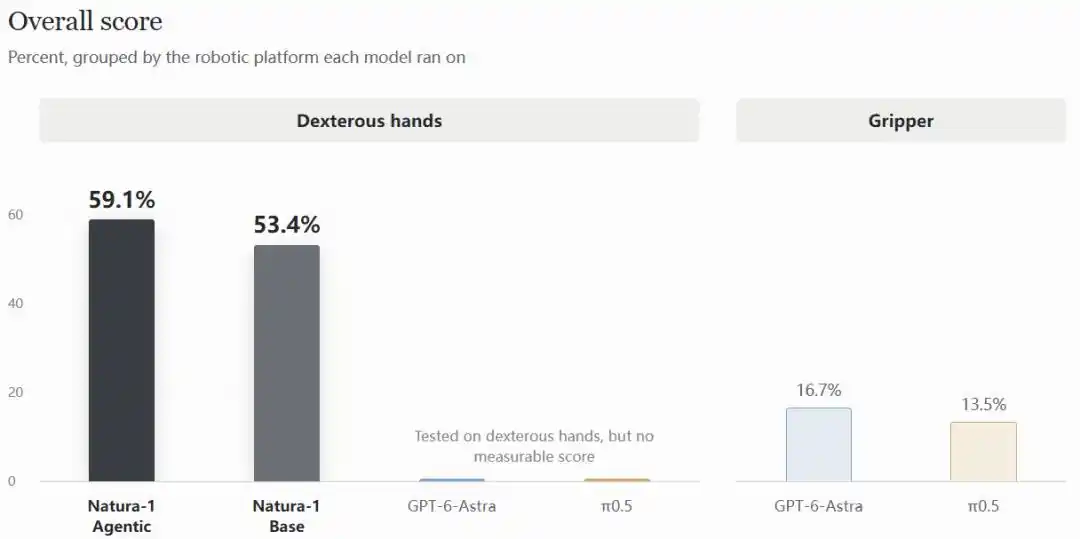
On this benchmark, π0.5 and OpenAI’s GPT-6 Astra, used as a control policy through code generation, scored no points on the dexterous-hand platform. On a gripper platform, they scored 13.5 and 16.7, respectively. Natura-1 scored 53.4 on the dexterous-hand platform in its Base version and 59.1 in its Agentic version.
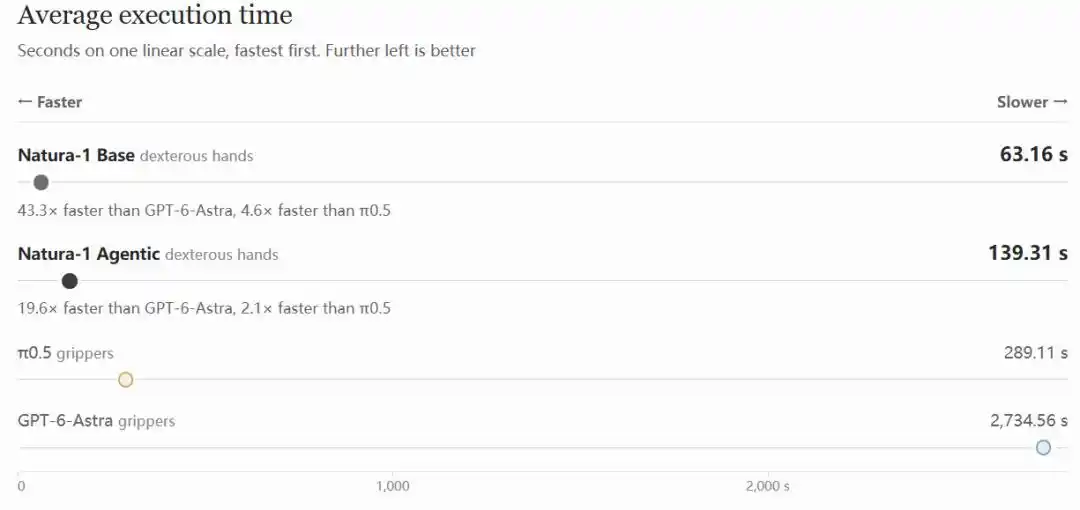
Nature Will also said Natura-1 held a clear advantage in execution time.
The team also tried open-ended instructions that researchers came up with on the spot, including deliberately tricky prompts. In one case, the robot was asked to place a toothbrush case and a water bottle into a basket in three different ways: with both hands at the same time, left hand first then right, and right hand first then left. Nature Will said Natura-1 followed each instruction as given.
The company also narrowed what it means by “unseen.” Because pretraining data is broad, related objects and actions may already appear there. In that sense, “unseen” mainly refers to the real-robot post-training stage. The team gave the example of pressing the space bar on a laptop: that task does not appear in robot post-training data, but similar actions may well exist in human video.
That definition gets at the point of this route. The question is whether experience in human video can be called on directly in the real robot when there is no matching robot dataset. As the team put it: 「We are not only asking whether the model can still grasp when the object changes. We are also asking whether it can organize what it already knows and complete a task requirement it was not specially trained for.」
Observed emergent behavior
The team said it also saw behavior that was not part of the planned tests.
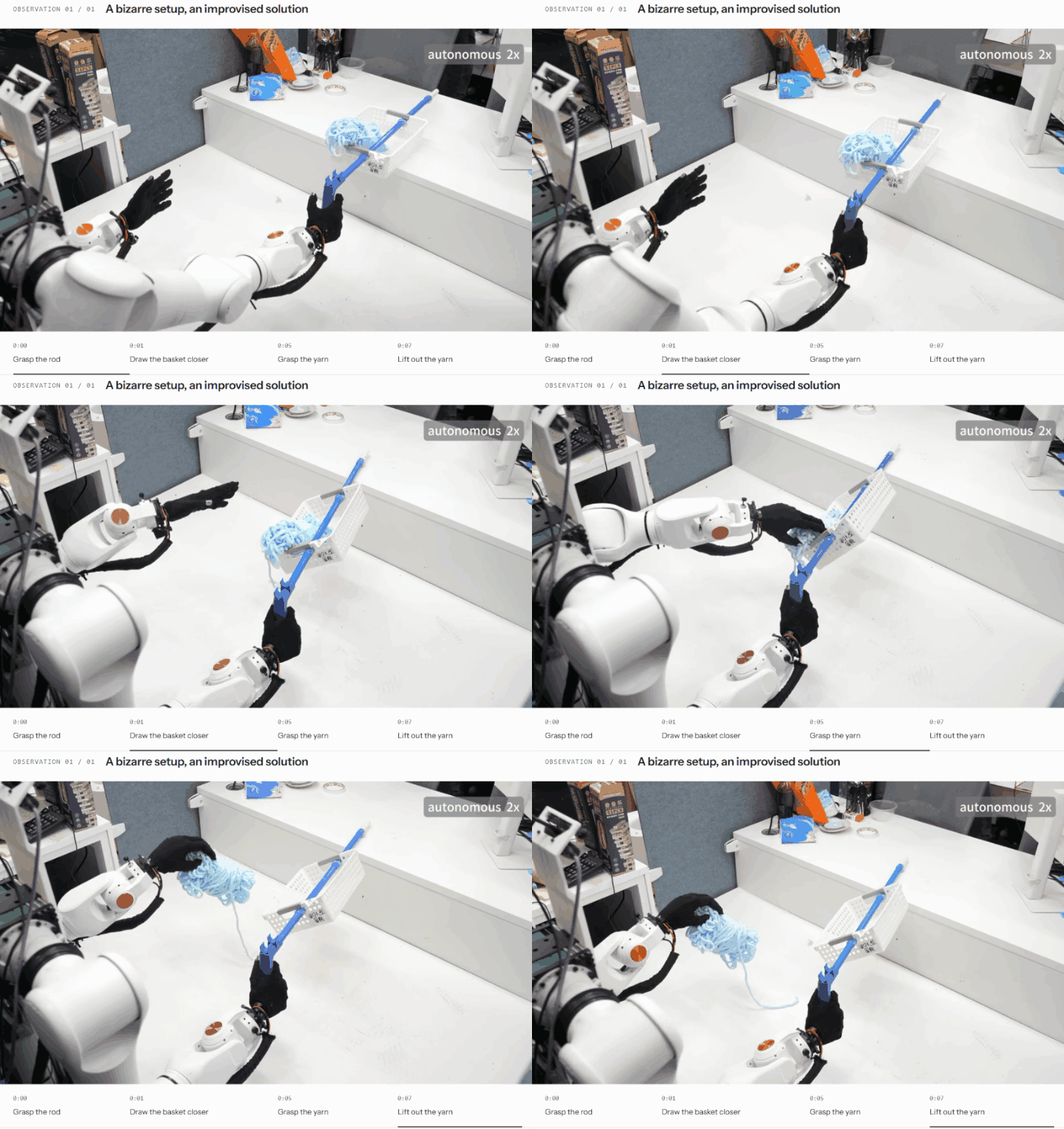
In one staged setup, a basket containing yarn was placed on a high platform out of reach, with a long rod threaded through the handle. The instruction was only: 「Try to grasp the yarn」. Natura-1 first grabbed the rod and pulled the basket closer, then used one hand to stabilize the rod while the other removed the yarn.
In another case, the model failed to pinch a playing card from the edge. It then pushed the card toward the edge of the box so part of it hung over, and picked it up with both hands. According to the team, those intermediate steps did not appear in the robot demonstration data.
The company said that when the data scale was smaller, the model would miss a grasp and still keep moving according to the original plan. After the scale increased, it began to adjust in time and try again. Nature Will told Jiqizhixin: 「We did not deliberately collect demonstrations of this kind of failure recovery in real-robot post-training, but the model still showed recovery ability. Our view is that large-scale human pretraining data contains rich experience of adjustment and retrying, and the model learned from that how to respond to changes during manipulation.」
The team also added a caveat: 「This is a phenomenon we observed while scaling up training. The exact source and mechanism of the capability still need further study.」
Where the capability comes from
Nature Will argues that long-horizon dexterous manipulation and zero-shot generalization do not happen by accident. Human experience may be abundant, but it is only raw material. Turning it into robot action requires data, models, and infrastructure to be designed together.
- Data provides language and action supervision for each recording.
- The model is responsible for extracting as much learning signal as possible from each trajectory.
- Infrastructure has to support large-scale training and still finish inference within 100 milliseconds.
The training set behind Natura-1 consists of a filtered 1 million hours of first-person human experience, including about 61.7 million clips, 318,000 tasks, and 14,000 scenes. It is mainly built from controlled collection, with internet first-person video added in.
The team said it uses a structured task taxonomy and agent workflow analysis to find coverage gaps and shift collection priority toward scarce regions. Raw recordings go through cleaning, deduplication, action reconstruction, and hierarchical language annotation before becoming video-language-action trajectories. On an internal benchmark, Nature Will said its in-house action reconstruction pipeline reduced joint position error by 41% compared with existing open-source methods.
The company said the choice of human data and the choice of dexterous hands are really one decision. Nature Will told Jiqizhixin: 「Many tools and operating methods in home and industrial settings are designed around human hands. We want robots to adapt to those tools, rather than redesigning tools and workflows every time they enter a new setting.」
It also said first-person human data is easier to collect at scale, and dexterous hands preserve richer hand-motion information than compressing human action into the open-close pattern of a gripper.
Infrastructure
“Make everything scalable” is the team’s stated technical principle.
On the data side, a lakehouse system manages tens of petabytes of data. A Kubernetes-based parallel pipeline can produce 350,000 hours per week, with throughput growing roughly linearly with compute. The design goal, the company said, is that when data volume increases by 10 times, adding about 10 times the resources should still keep processing time close to the original level without rebuilding the whole system.
On the training side, Nature Will said its in-house framework achieves more than 50% model compute utilization across hundreds of GPUs, and its custom attention operator delivers more than six times the throughput of an optimized FlexAttention.
On the inference side, a service framework rewritten in Rust brings end-to-end latency under 100 milliseconds, which the company says is enough for real-time robot control.
The team said the logic is the same as in large language model infrastructure: data and model scale will keep growing, so the system has to be prepared for that growth in advance.
Model design
Natura-1 arranges each task segment as a single sequence of language, image, video, and action tokens and models it autoregressively on top of a standard MoE Transformer.
The core idea is to treat video and action as two projections of the same physical state. Action labels are scarce, while video is abundant. The model uses past video as memory, predicts future video, and applies flow matching to train video and action together so that each trajectory yields more supervision.
To keep the model from relying only on visual input and ignoring instructions, pretraining also uses fine-grained descriptions to make language carry more of the load, so different intents lead to different prediction outcomes.
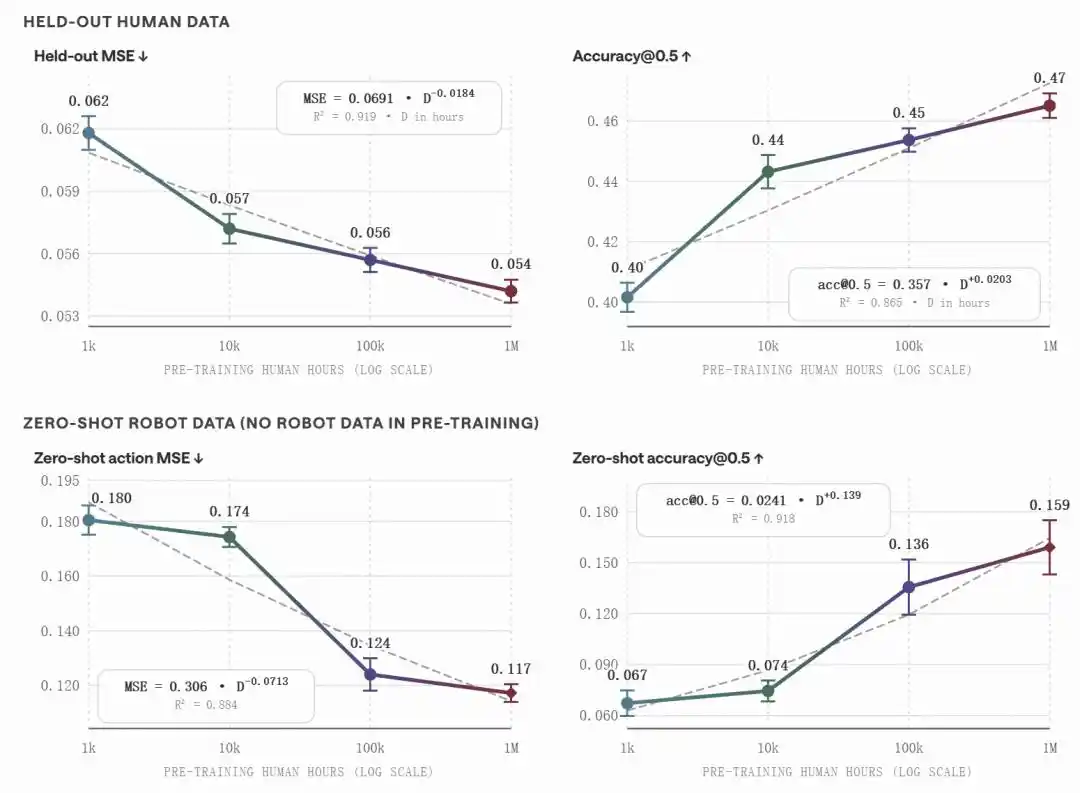
According to the scaling curves shared by the company, when training experience increased from about 44,000 hours to 1 million hours, the model’s action prediction mean squared error, or MSE, on held-out human data fell by 47.7%. On held-out real-robot data using the same weights, the error fell by 67.7%. Nature Will said these are prediction errors under teacher forcing rather than task success rates, but they still indicate that gains from larger human experience datasets transfer to robot performance.
What comes next
Nature Will says Natura-1 offers early evidence that dexterity and generality can coexist. Looking ahead, the team told Jiqizhixin: 「Our most important goal is to keep improving the model’s generalization across different tasks and scenes, and to make it complete complex real-world tasks more reliably.」
The company said it wants to move from “being able to complete some steps” to “completing the whole task stably and efficiently.” To get there, it plans to add tactile information into both data and models, pretrain on larger-scale datasets, reduce the adaptation cost of transferring to robots, and make the model run on cheaper hardware. The team said it expects this to be a long-term effort.
In the broader industry context, the route Natura-1 is taking is moving from a bet made by a small number of teams toward a view shared by more of the field. In June, a study called HumanScale compared two kinds of pretraining data at the same scale and found that first-person human video could outperform teleoperated real-robot data, with the clearest advantage in out-of-distribution generalization. Dyna Robotics, which released DYNA-2 in August, has also said its next step is to scale training to 10 million hours.
As 1 million hours becomes less unusual, the competition shifts. The questions become whether the same human video can be reconstructed into actions more accurately and labeled into language more effectively, how much adaptation is needed when the model reaches a robot, and what kind of embodiment should carry that experience.
Natura-1 is making one of the hardest bets in that set: using a high-degree-of-freedom dexterous hand to absorb human experience, and letting one model face tasks it has not practiced. How far that route goes will depend on whether dexterous hands can improve in stability and cost, and whether the scaling curve of human experience keeps extending.
In a world shaped for human hands and used by human hands, Nature Will has now put forward an early answer that can be tested.