
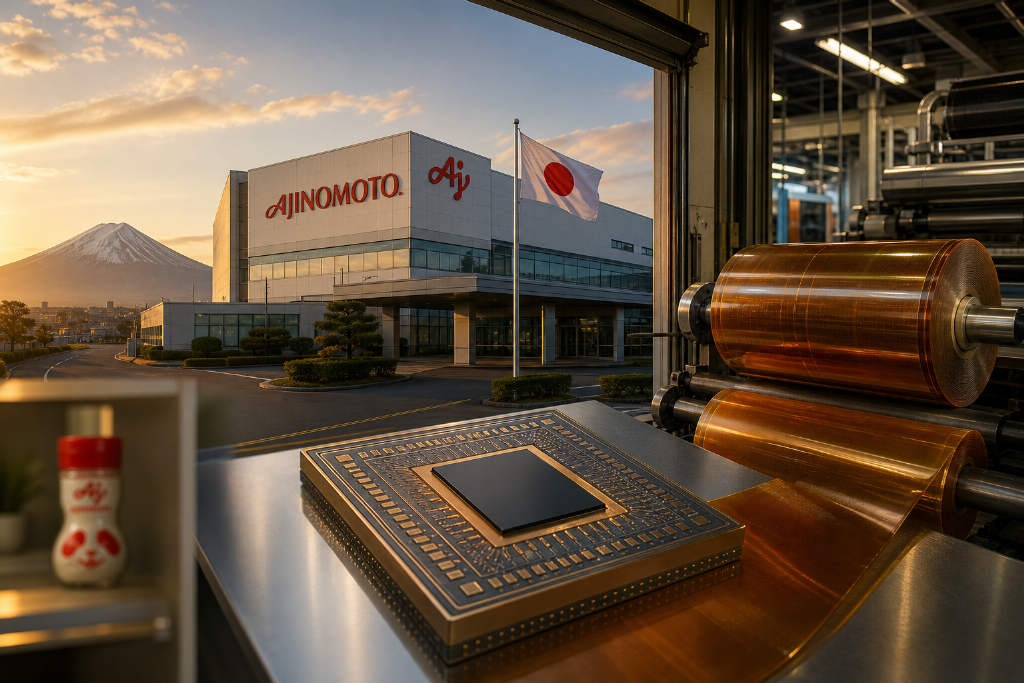
Ajinomoto, the Japanese company widely associated with food products and seasonings, said a semiconductor materials business that makes up about 8% of group revenue contributed 32% of profit in its latest quarter. At the center of that result is ABF, an insulating film used in chip substrates. Ajinomoto said more than 95% of the global market for insulating films in high-performance semiconductors is tied to its product.
A small revenue share, a much larger profit contribution
In second-quarter results released in August, Ajinomoto said the functional materials business, which includes electronic materials, posted revenue of JPY 33.1 billion and business profit of JPY 19.1 billion. That works out to a margin of 57.7%.
Over the same period, the company’s seasonings and food business recorded JPY 238.7 billion in revenue and JPY 41.0 billion in profit. In other words, the semiconductor materials unit produced close to half the profit of the core food business with roughly one-seventh of the revenue.
ABF started with a request from a CPU maker
ABF stands for Ajinomoto Build-up Film. It is an interlayer insulating material used in IC substrates. In chip packaging, signals have to move from nanometer-scale circuitry to millimeter-scale circuit boards, and that transition depends on multi-layer substrates. Each added copper wiring layer needs an insulating layer between them, and ABF fills that role.
Ajinomoto began studying epoxy resin applications in the 1970s using byproducts from its monosodium glutamate fermentation process. The turning point came in 1996, when a CPU manufacturer approached the company and asked it to develop a film-type insulating material using its amino acid technology. At the time, the industry relied on coating-type inks, a process that was slower and more vulnerable to impurities, making it hard to keep up with continued chip miniaturization.
Four months later, the first ABF sheet was created, and mass production began in 1999. Shigeo Nakamura, one of the researchers involved in development, had estimated at the time that the product might sell for about 10 years. Instead, it has lasted for more than two decades and is still gaining speed.
Ajinomoto puts ABF share above 95%
Ajinomoto said ABF holds more than 95% of the global market for insulating films used in high-performance semiconductors. Production is handled by subsidiary Ajinomoto Fine-Techno, and nearly all capacity is located in Japan.
The AI buildout has strengthened demand. New AI accelerators use larger packages, with substrate stacks rising from single-digit layers to 12 to 20 layers. Line widths need to be pushed below 15 microns, while the coefficient of thermal expansion must stay within an error range of 2 ppm per degree Celsius. If that control slips, large packages can warp under heat and solder balls underneath can crack. On the same substrate area, an AI chip consumes much more ABF than a PC processor.
The quarterly figures reflected that shift. Revenue in the functional materials business rose 54% from a year earlier, while business profit climbed 77%. Ajinomoto also raised its full-year group business profit forecast to JPY 202.0 billion, with JPY 65.5 billion expected to come from this business, despite its roughly 8% share of revenue.
Company says gains came from mix, not pricing
Ajinomoto said during its earnings briefing that the increase came from an improved product mix rather than price hikes.
ABF accounts for only a small portion of the bill of materials in an AI chip, but without it an entire production line may not be able to ship. The report described that combination, low cost and hard to replace, as the company’s strongest moat. It also noted that if prices rose enough to materially hurt customers, those customers would have more reason to fund alternatives.
Alternatives are emerging as Ajinomoto expands capacity
Possible substitutes are already in development. Japanese peer Sekisui Chemical has worked on similar materials for more than 20 years, though the report said it has remained focused on the low-end market. U.S. startup Thintronics has raised a $20 million Series A round and received support from the U.S. National Science Foundation, targeting the same category of material.
A longer-range challenge could come from glass substrates. In January this year, Intel put Clearwater Forest into mass production using glass substrates and said interconnect density improved 50% while large packages no longer warped. Taiwan Semiconductor Manufacturing Co. plans to build a pilot line in 2026 and start volume production in the second half of 2028.
Counterpoint estimates the panel-level packaging and glass substrate market will grow from $650 million in 2024 to more than $8.1 billion by 2030.
Ajinomoto’s response is to add capacity. The company has already invested JPY 25 billion in Gunma and Kawasaki, and said it will spend another JPY 25 billion by 2030 to raise ABF capacity by 50%. In May, it also secured land for a third plant in Kani, Gifu Prefecture, at about JPY 1.2 billion. Construction is set to begin in 2028, with production scheduled for 2032.