


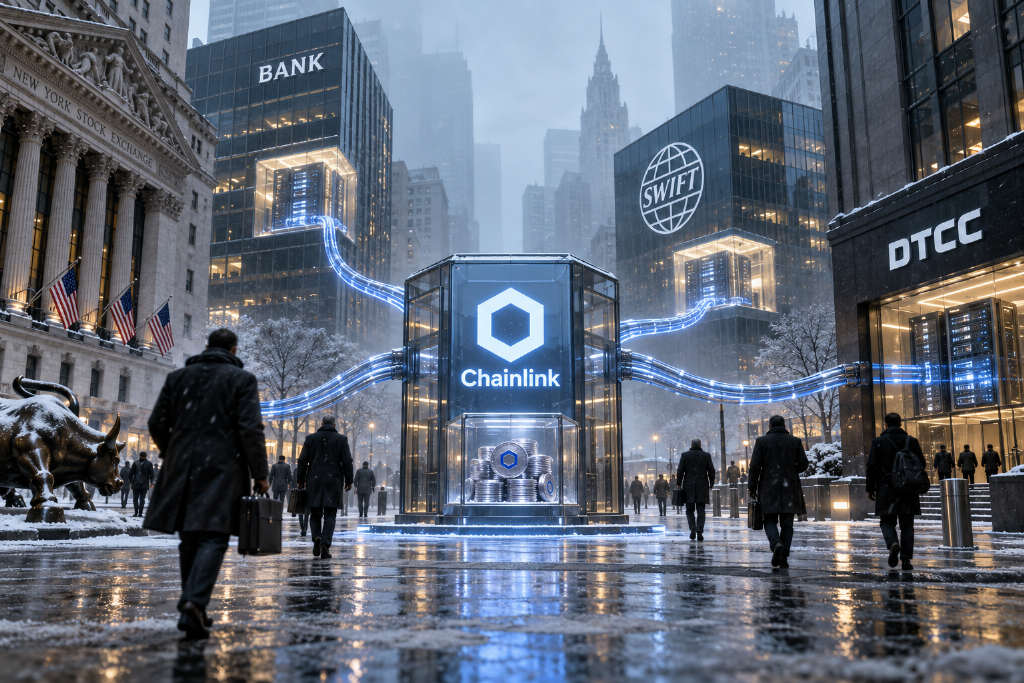
Alea Research argues that financial infrastructure is splintering across more blockchains, not less, and that this is actually making Chainlink stronger in tokenized finance.

In the report, Alea says tokenization often gets sold as a path toward one common blockchain for global financial assets. But the market structure it lays out is nothing like that. Banks are building their own tokenized deposit chains. Swift is running a shared-ledger model with major member banks. And DTCC is already handling production-grade tokenized securities activity on both Besu and Canton.
More chains mean more demand for connectivity
The report’s main point is blunt: every new blockchain creates another connection banks have to secure and manage. Institutions do not want to sit around waiting for one chain to win. But they also do not want to give up control of private keys, compliance rules, or internal risk controls.
Alea says Chainlink is selling the layer that fixes that. It describes Chainlink Runtime Environment, or CRE, as a workflow-management layer that lets banks hook existing systems into multiple blockchains while keeping signing authority and compliance boundaries in-house.

Swift’s setup is one example in the report. Under that design, each bank keeps its tokenized deposits on its own infrastructure, while a shared blockchain is used to match and net interbank obligations. Alea says Swift and its member institutions built that blockchain together, and 17 banks, including ANZ, BNP Paribas, Citi, HSBC, Standard Chartered, and UBS, are getting ready for payment pilots on it.
DTCC is following a similar path in securities markets. Alea says DTCC’s July activity ran across a group of private Besu chains and one public Canton chain, a structure meant to improve resilience, scalability, and flexibility.
One of the report’s big headline claims is simple: more blockchains mean more connectivity services to sell. Swift opened its shared blockchain to members in July, with 17 banks preparing payment pilots. That same month, DTCC carried out its first production-grade trades in tokenized U.S. securities on Besu and Canton. Every added chain needs real-time pricing, asset transfer, and business-workflow links to other chains.
Collateral management is the first major workflow moving over
Alea points to collateral management as the first major workflow making the shift. The logic, it says, is pretty direct: assets that can move instantly at night are the same assets that can answer a margin call at night.

It highlights July 15, when DTCC put that use case into production. In that transaction, J.P. Morgan submitted tokenized assets to satisfy margin requirements at CME Group. DTCC named Chainlink among more than 30 institutions involved in that batch of transactions, and the report says CRE orchestrated the workflow around J.P. Morgan’s margin transfer.
The bigger rollout is still ahead. DTCC’s Collateral AppChain is described as a shared platform for collateral providers, receivers, tri-party agents, and custodians. Alea says it will use CRE and Chainlink data standards to handle asset eligibility checks, valuation, margin calculation, collateral optimization, settlement, and related post-trade processes. The AppChain is expected to go live in the fourth quarter.
The report also points to comments from Chainlink co-founder Sergey Nazarov, who said on The Rollup podcast that blockchain fragmentation works in Chainlink’s favor because every new chain needs a neutral bridge to connect with others. Alea also quotes Nazarov calling collateral management “the killer app that traditional finance has been waiting for our industry to deliver.”
At the Bank of England’s Synchronisation Lab, Chainlink showed how CRE could synchronize central bank money with tokenized assets. Alea treats that as another sign that Chainlink is moving past pure oracle services and into workflow orchestration inside financial infrastructure.

On Sept. 30, Chainlink and DTCC staged a live demonstration at Sibos and launched Fulcrum. The report says the product lets financial institutions compare financing terms across venues and route a transaction to whichever venue they choose. In Alea’s view, that pushes Chainlink further into banks’ daily funding operations instead of leaving it as a standalone pricing feed.
CCIP 2.0 is framed as a control layer for banks
Alea says banks are not just paying for cross-chain transport. They are paying for control over risk rules. Since Sept. 28, Chainlink’s Cross-Chain Interoperability Protocol 2.0, or CCIP 2.0, has let financial institutions attach their own validators and compliance rules to each asset transfer.
The report says cross-chain transfers still need signatures from Chainlink’s default committee of 16 node operators. But now institutions can add their own validators on top, with compliance rules traveling alongside the asset across chains.
That feature set has already attracted issuers, according to the report. After finishing a security review, Wyoming signed a multi-year agreement naming CCIP as the exclusive cross-chain channel for its Frontier stable token. BitGo moved Wrapped Bitcoin, or WBTC, to CCIP, and Nethermind became a node operator on the network. Chainlink’s figures, as cited by Alea, show that the value of tokenized assets migrated to CCIP topped 100 million within four months.

Monthly volume on CCIP jumped too. The report puts September volume at $1.35B, up 52.7% from $0.89B in June 2026. It also says September was the strongest month since April, with CCIP 2.0 going live in the final three days of the month.
Distribution matters here too. Alea says Bottomline and Infosys are helping push CCIP and CRE into banks through software channels institutions already use. Bottomline, which provides Swift connectivity services to many banks, launched Global Pay Connect so bank clients can reach multiple blockchains through Chainlink using the connection setup they already have. Infosys agreed to help financial institutions deploy and maintain their own on-chain validator nodes.
So, in the report’s view, Chainlink gets a path straight into the software stack banks already use every day.
Oracle share and the LINK reserve mechanism
Alea says Chainlink secures roughly three-fifths of the total value protected by oracle networks, putting that figure at $11.6B, ahead of the combined total of Chronicle, RedStone, and Pyth.

On revenue, the report splits things into two payment streams. Banks and market infrastructure operators usually pay Chainlink through off-chain commercial contracts. DeFi applications and public blockchains pay fees on-chain. Node operators get paid for service, and stakers receive a 4.5% base staking yield from a reward pool capped at 45 million LINK.
Payment Abstraction converts protocol revenue into LINK and deposits it into the Chainlink reserve. Alea describes that reserve as the main channel through which business revenue gets translated into token value. One chart in the report shows deposits happening every Thursday, with the reserve balance rising steadily since the first deposit on Aug. 7, 2025.
As of Sept. 30, the reserve held 6.05 million LINK, up 34.3% in the quarter. The report also says the reserve has received LINK deposits every Thursday for 62 straight weeks, averaging about 100,000 per deposit, equal to annualized inflows of about 5.2 million.
The report’s timeline shows the reserve contract holding 370,000 LINK at the end of September 2025. One year later, that number had climbed to 6.05 million LINK, or 0.79% of the 766.8 million circulating supply. In the second quarter, the reserve bought 1.71 million LINK at an average price of $13.79 per token. In the third quarter, it absorbed 1.54 million LINK at an average price of $15.53.

Alea also models what bank contracts could mean for the reserve. Using the third-quarter median deposit size of 100,000 and a Sept. 30 closing price of $25.36, the report estimates annual additions of about 4.1 million LINK, equal to 0.54% of circulating supply. If weekly deposits doubled at the same price, annual absorption would rise to 1.08% of circulating supply. If the token price fell 25%, the annual absorption ratio would increase to 0.72% because the same dollar amount would buy more LINK.
Fourth-quarter milestones are approaching
The report says Link:NYC is scheduled for Oct. 29, and DTCC has set the formal launch of the AppChain for the fourth quarter. Alea also says the next production milestones are close. DTCC plans to launch tokenized services in October, and the collateral AppChain is expected before year-end.
The report’s takeaway is straightforward: banks are still building their own chains, while Swift and DTCC keep adding shared ledgers. Every extra chain raises the strategic value of the connectivity layer. Alea says Chainlink has already embedded that layer into DTCC’s collateral stack, Swift’s shared blockchain, and the software vendor networks banks already depend on.
