
This article was originally published by Bit.Fan. For more cryptocurrency news and market insights, visit www.bit.fan.
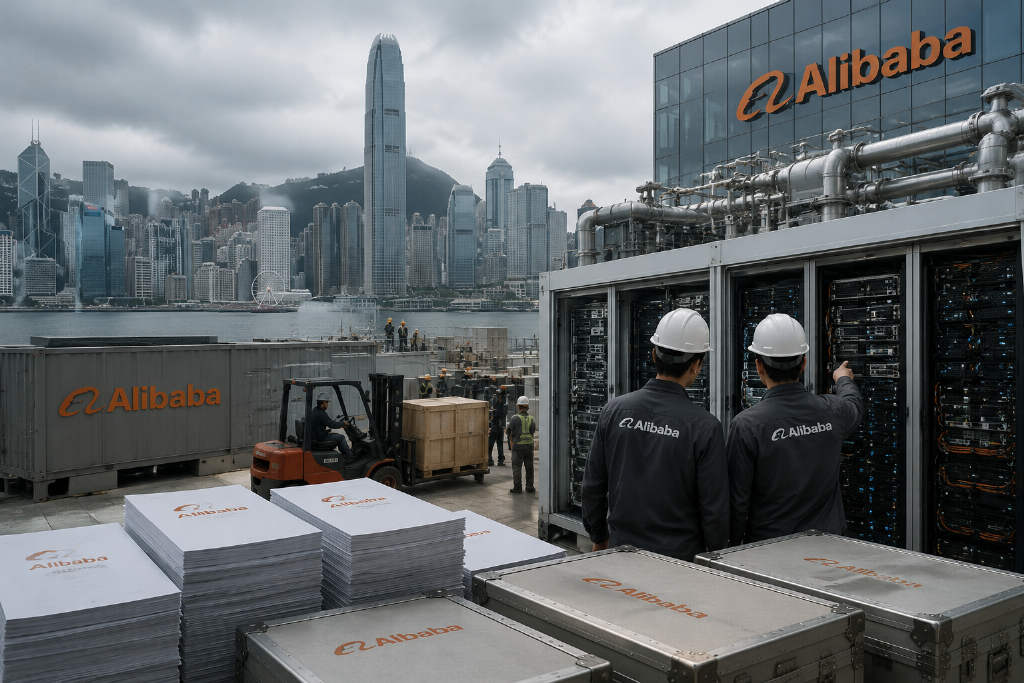
Alibaba, Zhipu and MiniMax all raise capital as China’s AI race turns asset-heavy
N
News EditorAlibaba said it will place 710 million new shares at HK$112.70 each, raising HK$80 billion, with the net proceeds going entirely into full-stack AI capabilities and infrastructure. Over the past two months, Zhipu, MiniMax, Deepexi and QuantGroup have also tapped the market through IPOs, follow-on placements or new financings. The article argues that surging AI demand, tighter supply in memory and compute, and rising capital spending are pushing the sector into a far more capital-intensive phase. Alibaba’s move is notable because it comes despite cash of RMB 474.5 billion on its balance sheet at the end of June. Zhipu and MiniMax, both newly listed in Hong Kong, have already started to pursue A-share paths, showing how short the funding window may be for AI companies that need to keep buying chips, building data centers and funding model development. Upstream suppliers such as memory makers are capturing more of the economics, while application-layer AI firms continue to bear heavy losses.
Alibaba said on the night of Aug. 23 that it will place 710 million new shares at HK$112.70 each, raising HK$80 billion, or about $10.2 billion. The company said the net proceeds will be used entirely for full-stack AI capabilities and AI infrastructure. It is Alibaba’s first share placement since its 2019 Hong Kong listing.
The move came even though Alibaba held RMB 474.5 billion in cash as of the end of June. It was also not an isolated case. Over the past two months, a string of AI companies and listed groups have raised money again, and the pace has been hard to miss.
Zhipu, the large-model company that listed on the Hong Kong Stock Exchange on Jan. 8, raised HK$4.348 billion in its IPO. Less than five months later, on June 1, it announced plans to return to the STAR Market and seek another RMB 15 billion. In July, it also completed a Hong Kong follow-on offering that raised HK$31.41 billion.
MiniMax, which listed in Hong Kong one day after Zhipu, raised HK$5.54 billion in its IPO. At the end of May, it engaged CICC to begin A-share listing counseling. Then, on the second day after its lock-up expired in July, it announced another HK$16 billion financing round, with 80% of the proceeds earmarked for compute and model R&D.
Other companies have joined in as well. Deepexi, which listed in Hong Kong in October last year, raised about HK$500 million in an August placement. QuantGroup completed a HK$60 million subscription in July, and said 70% of the funds would go into a physical-AI foundation model and smart hardware.
The backdrop is straightforward: demand is exploding, while supply is getting more expensive.
According to China’s National Data Administration, average daily token usage across the country surpassed 140 trillion in March 2026. At the beginning of 2024, the figure was about 100 billion. That is more than a thousandfold growth in two years.
The workloads are no longer limited to early adopters. Factories, logistics operations and drug discovery projects are now paying for AI services, turning AI into something closer to utilities than toys. The consumption is continuous.
Supply is moving in the opposite direction. Global memory makers have been prioritizing advanced capacity for HBM, or high-bandwidth memory, and DDR5 used in AI servers, squeezing the supply of standard DRAM and NAND.
The result: standard DRAM contract prices rose 90% to 95% quarter over quarter in the first quarter, while NAND rose 55%, which TrendForce says is the largest single-quarter increase on record.
Wells Fargo estimates global DRAM demand will grow 26% in 2026, while supply will rise only 21%. UBS says the DRAM shortage should last at least through 2028. Downstream, cloud providers including Alibaba Cloud and Tencent Cloud have also raised prices for AI compute services.
That has pushed AI companies to spend more on chips and capacity. Alibaba’s capital expenditure in the second quarter was RMB 67.7 billion, up 75% year on year. For the first half, its capex reached RMB 190 billion. Tencent’s Q2 2026 capex hit RMB 52.8 billion, up 176%, bringing first-half spending to RMB 84.7 billion, already above last year’s full-year total. Baidu’s Q2 2026 capex was RMB 11.4 billion, up 201%.
ByteDance is not listed, but estimates cited in the article put its 2026 AI infrastructure spending at RMB 200 billion, including about RMB 85 billion for chips and RMB 90 billion for AI data centers. Alibaba’s three-year RMB 380 billion AI investment plan had already consumed RMB 190 billion by the end of June.
The article’s broader point is that China’s AI arms race has moved from slogans to cash burn.
Three signals stand out.
First, the upstream suppliers selling the “shovels” are capturing more of the economics than the downstream companies digging for gold. When Alibaba, Tencent and ByteDance spend aggressively, the beneficiaries are chip makers, server vendors, optical-module suppliers, liquid-cooling companies and memory manufacturers.
Global semiconductor capex is expected to reach $200 billion in 2026, with memory makers leading the spending. CXMT filed its STAR Market application in July and plans to raise RMB 29.5 billion, making it the largest A-share IPO of 2026. The company reported RMB 33 billion in net profit for Q1 and guided for up to RMB 75 billion in first-half net profit.
Yangtze Memory Technologies Co. completed its IPO counseling filing in May and submitted its prospectus to the STAR Market on the evening of Aug. 21. The prospectus shows Q1 2026 revenue of RMB 47.042 billion and net profit attributable to shareholders of RMB 33.379 billion. Its NAND Flash gross margin reached 78.73%.
Yangtze Memory said in the prospectus that the massive KV-cache data generated during large-model inference is shifting from HBM to tiered storage on SSDs, with NAND Flash absorbing low-frequency cold-cache data to ease HBM capacity constraints.
By contrast, application-layer AI companies remain under earnings pressure. Zhipu reported 2025 revenue of RMB 724 million, R&D spending of RMB 3.18 billion and adjusted net loss of RMB 3.182 billion. MiniMax reported an adjusted net loss of about $251.1 million, or roughly RMB 1.73 billion. Deepexi lost nearly RMB 2.2 billion across 2024 and 2025 combined.
Second, the A-plus-H fundraising route is becoming standard for top-tier AI companies. Hong Kong’s Chapter 18C rules gave unprofitable AI firms a listing path, and many chose Hong Kong first. Now the STAR Market is also becoming more open to new economy names, including AI and embodied intelligence companies, even without profits, as long as they meet specific requirements.
Hong Kong serves international long-term capital, while the STAR Market connects companies with renminbi funding. Zhipu and MiniMax both started their A-share plans less than half a year after listing in Hong Kong, which shows that the need for capital is not one-off. It is about catching a narrow funding window.
Third, AI in China has moved from a light-asset startup model into a heavy-investment era. The old internet playbook favored lean teams and fast iteration. AI is different. Large-scale GPU clusters, data centers, power supply and liquid cooling are fixed costs that cannot be cut away.
Alibaba’s HK$80 billion placement is explicitly for AI only, not for e-commerce expansion, acquisitions or share buybacks. Zhipu’s proposed RMB 15 billion STAR Market raise includes RMB 12 billion for a general-purpose foundation model project, RMB 2 billion for a MaaS platform and RMB 1 billion for working capital.
The article also says Zhipu’s MaaS annual recurring revenue was about RMB 1.7 billion in 2025, up 60 times in 12 months. After a 83% price increase for its API in Q1 2026, usage still rose 400%. Even so, as compute supply keeps coming onstream, costs remain high and losses are still difficult to fix in the near term.
For leading foundational AI companies, money has gone from being a bonus to being oxygen. Without the ability to keep raising, firms will struggle under the combined pressure of scarce compute and more expensive chips. The next test, the article says, will come around 2027, when domestic compute capacity is expected to come online in scale. At that point, the key question will be who can sell tokens at a workable price and survive the gross-margin battle in B2B services.
The article is based on a WeChat public account post from IT Juzi, authored by Wu Meimei.
300
Disclaimer:
The market information, project data, and third-party content displayed on this platform are for industry information sharing only and do not constitute any form of investment advice or return commitment.
Cryptocurrency trading carries high risks. Users should fully assess their risk tolerance and make independent decisions. All profits, losses, and legal responsibilities are borne by the users themselves.