
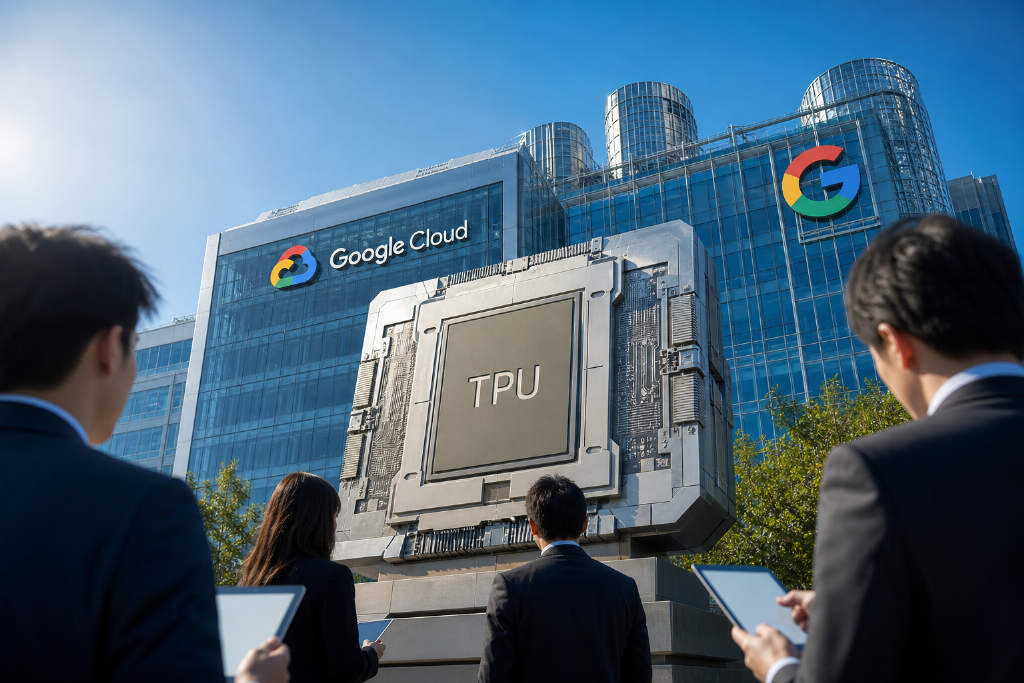
Morgan Stanley said Google Cloud could contribute about 50% of Alphabet’s total EBIT by 2028, putting the business at the center of the company’s profit mix. In its Aug. 24 research note, the bank argued that Alphabet is turning Tensor Processing Units, or TPUs, from an internal cost center into an external profit engine.
The firm raised its assumption for revenue per gigawatt from Google’s external TPU sales, described in the note as 1P sale, to $27 billion from $20 billion. It also lifted its gross margin assumption to 30% from 20%. After the revision, Morgan Stanley forecast TPU-related cloud revenue of $84 billion in 2027 and $108 billion in 2028, 35% and 37% above its prior estimates. The bank kept its Overweight rating on Alphabet and maintained a $400 price target, saying that represented 16% upside from the current share price.
The note tied the revision to recent media reports. Morgan Stanley said Google had committed to supplying roughly 1 million TPUs to a customer, which the bank estimated at about 1.3GW and around $35 billion in revenue. A custom chip agreement between Google and Marvell also supported the view that TPU pricing should be higher than the bank had previously modeled.
TPUs move beyond internal workloads
Morgan Stanley said TPUs were originally designed for Google’s internal AI workloads but are now becoming an important source of outside revenue. The key change in the bank’s model is a higher average selling price per rack.
It estimated that a TPU v8 rack sells for about $1.7 million, while a TPU v9 rack sells for about $1.9 million, a premium of roughly 10%. For 2027, the bank projected sales of about 31,000 v8 racks and about 6,100 v9 racks, for combined shipments of 3.2GW. It then projected shipments to rise to 4.2GW in 2028.
The increase in the gross margin assumption to 30% reflects what Morgan Stanley sees as stronger pricing power in TPU systems. The bank said it had previously underestimated Google’s bargaining power in the custom chip market. In its view, Google’s TPUs are competitive on performance, while customers are showing strong demand for dependable AI compute supply.
Based on the new assumptions, Morgan Stanley expects revenue tied to external TPU sales to reach about $84 billion in 2027 and then climb to $108 billion in 2028. It also raised its forecast for Google Cloud’s 2027 revenue growth to 118% from 106%, while keeping its view that cloud EBIT growth in 2028 will remain elevated.
Cloud margin mix is shifting
The report said TPU sales have a two-sided effect on Google Cloud margins. They add a large amount of incremental revenue, but the assumed 30% gross margin is below the core cloud business’s incremental profit margin of about 50%. As TPU sales scale up, the overall cloud margin structure changes with them.
Morgan Stanley broke down the cloud profit model in detail. It said the core cloud business should keep an incremental profit margin of around 50%, but pressure from TPU sales and SpaceX cloud services would trim reported cloud margins slightly. Under its model, total reported cloud margin falls from 38% to 37% in 2027 and from 41% to 40% in 2028. Even so, the bank still expects Google Cloud to account for about half of Alphabet’s total EBIT in 2028, making it the company’s largest profit contributor.
The bank said investors should not focus too narrowly on short-term changes in cloud margins. In its view, the added revenue from TPU sales more than offsets the effect of lower blended margins, and Google Cloud’s absolute profit should continue to grow quickly.
Valuation hinges on three catalysts
Morgan Stanley said its $400 price target implies average earnings per share of about $16.84 across 2027 and 2028 and a price-to-earnings multiple of roughly 24x. It said that compares with about 19x implied by the current share price, leaving room for multiple expansion.
The bank described the higher TPU sales forecast as the starting point rather than the end of a rerating case. It listed three catalysts that could determine whether Alphabet achieves that valuation reset: the release of Gemini 4 between late 2026 and early 2027, which it said would directly affect market share in search and cloud; continued efficiency gains in models that could lower inference costs and widen the range of affordable AI services; and the productization of GenAI, which would decide whether AI capabilities can be turned into scalable, priced commercial products.
In Morgan Stanley’s framework, the base case assumes compound annual growth rates in revenue and EBIT of 25% and 31%, respectively, from 2024 to 2027, with a target P/E multiple of 24x. In the bull case, valuation could reach $460. In the bear case, it could fall back to $225.
The note added that the $400 target implies about 22x expected 2028 earnings, roughly a 22% premium to the peer median of 18x. Morgan Stanley said that premium is justified because Alphabet has a broader product portfolio in AI-driven platform innovation, with search, YouTube, cloud and Waymo all benefiting from stronger AI capabilities.
Source note and disclaimer
The TechFlowPost article said the piece was a整理 and interpretation by Chaoxiang Research of a third-party brokerage report from Morgan Stanley dated Aug. 24, 2026, combined with public market information. It also stated that the ratings, target price, earnings forecasts and related judgments cited in the article were the views of the brokerage analysts and represented only the position of their institution, not the view of Chaoxiang Research, and did not constitute investment advice.
The article also carried a risk reminder stating that markets involve risk, decisions should be made independently, and the piece should not be used as a basis for buying or selling any security.
