

TechFlowPost on July 29 published a translated analysis originally written by WuBlockchain that examines one of the least transparent pieces of altcoin market structure: what a token project actually means when it says a portion of supply has been “allocated to market makers.”
The article argues that the key questions are usually hidden from retail participants. Were those tokens lent or sold? At what strike price can the market maker exercise its option? When the agreement ends, must the tokens be returned, or can they be purchased outright? According to the piece, those terms can shape an altcoin’s price path for months, yet they rarely appear in public tokenomics documents.
MOVE is presented as a rare look inside the box
The article uses Movement Labs and its MOVE token as the clearest recent example. It says that in the spring of 2025, a few months after MOVE launched, the market saw a familiar sequence: token generation was followed by a price peak, market makers were accused of persistent selling, the project denied the claims, and the market’s price action became the final verdict in the eyes of traders.
What made the case unusual, the article says, was that the market-making arrangement itself did not stay private. Chat records, term sheets, market-maker positions, strike prices and borrowed token amounts reportedly emerged over time through Twitter, investigative reports and community discussion. That gave the industry a concrete example of how a standard structure based on token loans plus call options can turn what looks like a liquidity service into a channel for low-cost post-listing distribution.
The piece says MOVE should not be read as an exception. It argues that many altcoins face steady sell pressure outside formal unlock schedules for the same reason, but in most cases the details remain buried in PDFs, private Signal chats and unwritten understandings shared only by projects and their market makers.
From there, the article broadens the discussion. It says much of crypto’s structural evolution over the past decade can be described as the gradual transfer of powers once held by a small group to a much wider set of participants. Perpetual futures opened leverage to retail traders. Protocols such as Shortit are trying to do the same for short exposure. Putting market-maker loan terms on-chain, the article says, would attack the last major asymmetry by exposing primary-market information that still sits behind closed doors.
Three asymmetries in altcoin price discovery
The article’s core claim is that altcoins look like financial assets but often trade without the disclosure framework that underpins traditional capital markets. In a U.S. IPO, investors can at least see the shape of the table: SEC review, underwriting, roadshows, lockups, listing rules and insider sale disclosures all impose public constraints.
Altcoins work differently. From launch through secondary trading, many of the variables that directly shape price expectations are not subject to mandatory disclosure. Effective circulating supply, the identity and inventory of market makers, option strike prices and unlock calendars are often invisible to the public.
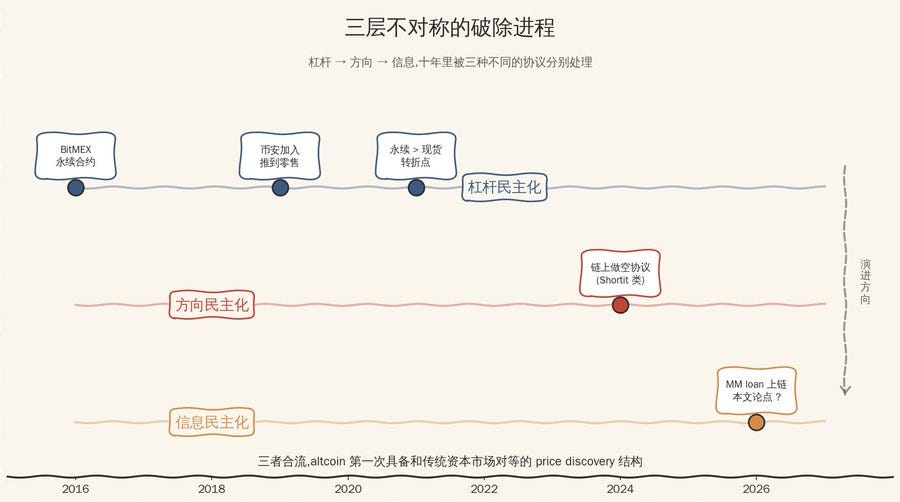
The article groups that opacity into three layers.
The first is leverage asymmetry. In crypto’s earlier years, especially before 2017, spot trading was close to the only option available to most retail traders. Even if they had the right market call, they could express it only through unlevered spot positions. Projects, venture funds and market makers, by contrast, could use OTC loans, derivatives desks and proprietary capital to scale the same directional view much more aggressively.
The second is directional asymmetry. Before perpetual futures became standard, crypto was effectively a long-only market. BTC and ETH could be shorted in limited ways, but most altcoins could not. That created a one-way incentive structure where nearly every participant benefited first from higher prices: projects, VCs, market makers, promoters, media and secondary buyers all leaned in the same direction.
The third is information asymmetry. Even if a trader has leverage and a shorting tool, that still does not answer the key timing problem. The trader does not know the actual sellable supply, the number of tokens lent to market makers, the strike price embedded in the agreement or the price ranges where a market maker’s behavior becomes economically rational. The article says projects know, VCs know, market makers know, but retail usually does not.
Taken together, those three gaps produced the enduring power structure of the altcoin market over the past decade. Projects, early investors and market makers controlled both the tools and the information, then passed price risk on to participants who entered later with less access.
Perpetual futures widened access to leverage
The first structural shift in the article’s framework is the rise of perpetual futures.
It points to 2016, when BitMEX launched perpetual swaps in Seychelles. The product had no expiry and used a funding-rate system to anchor futures prices to spot. Traditional finance has no exact equivalent, because classic futures contracts expire and their term structure shapes hedging and arbitrage behavior. By removing expiry, BitMEX standardized indefinite leveraged exposure in a form that could be margined, custodied and liquidated more easily.
Before that, retail traders who wanted leverage were largely stuck with margin spot on centralized exchanges: borrowing funds to buy tokens in a cumbersome system with opaque costs and primitive liquidation design. Institutions were already operating differently through proprietary books, OTC financing and cross-exchange arbitrage.
The article says leverage itself was never the innovation. The change was access. BitMEX offered as much as 100x leverage, and Binance’s entry in 2019 pushed the same model much further into the global retail market. The interface was compressed into a simple long-or-short decision, with margin ratios calculated automatically and liquidation queues visible to users.
By the 2021 bull market, the article says, the transition was clear: daily trading volume in perpetual futures had surpassed spot volume, and price discovery in crypto had shifted toward the perp market.
The article also pushes back on the idea that perps should be framed only as a machine for liquidating retail traders. It says that view is only half right. Liquidations did become more common, but perps also gave non-institutional traders a tool to make leveraged bets under the same broad structure used by professionals. The cost of democratized leverage was that everyone now faced the same liquidation mechanics.
Still, that solved only part of the problem. Perps improved leverage access and, for large crypto assets, directional access too. They did not eliminate the directional gap for the vast majority of altcoins, and they did nothing on their own to fix the information gap.
On-chain shorting is aimed at the second gap
The article then turns to short exposure. It says that if a trader in 2023 believed a given altcoin was overvalued, whether it was a newly listed Layer 1 token, a GameFi asset detached from fundamentals or an AI agent token whose narrative had faded, there were often few practical ways to short it.
Centralized exchanges list derivatives for only a small slice of the market. Beyond the top 50 by market cap, many altcoins have no derivatives at all, or only a single thin contract. A trade worth just tens of thousands of dollars might move the market 5%. Funding rates can stay positive against shorts, forcing them to pay a repeated carrying cost every eight hours, and liquidation thresholds can be punishing. Even with the right view, a trader may find the position unattractive in practice.
Spot borrowing is also limited. The article says centralized exchanges have little reason to maintain lending markets for long-tail tokens with shallow liquidity and elevated lender risk.
That leaves altcoins in what the piece describes as a structurally long-only state. In such a market, every marginal incentive points upward. Projects want the price higher. VCs want the price higher. Market makers want it higher, at least until the option is exercised. Influencers, media outlets and secondary-market buyers all benefit from upside. If almost nobody can express the bearish side through a tradable position, negative information cannot be incorporated into price with the same force.
This is the problem protocols such as @youcanshortit are trying to address, according to the article. The basic design is straightforward: a lending pool lets token holders lend assets to short sellers, who pay a transparent borrow rate determined by pool supply and demand rather than by exchange black boxes. The stablecoins received from selling the borrowed tokens remain in the protocol as collateral. If the token rises, the position is liquidated. If it falls, the short seller profits.
The article compares that to securities lending in traditional finance, with one major difference. In crypto, it has to run on-chain and be open to retail because centralized venues do not have the economics to provide that service for a large universe of long-tail assets.
It also argues that the value of democratized shorting is easy to underestimate. The point is not only that traders can make money on falling prices. Once a token can be shorted with transparent costs, overextended narratives can be challenged by bearish capital, while excessively negative narratives can be challenged by short covering. The market starts to look less like one-way promotion and more like two-sided debate.
The standard market-making template: token loan plus call option
The article says the third asymmetry, and the one still least visible, is information around market-maker borrowing arrangements.
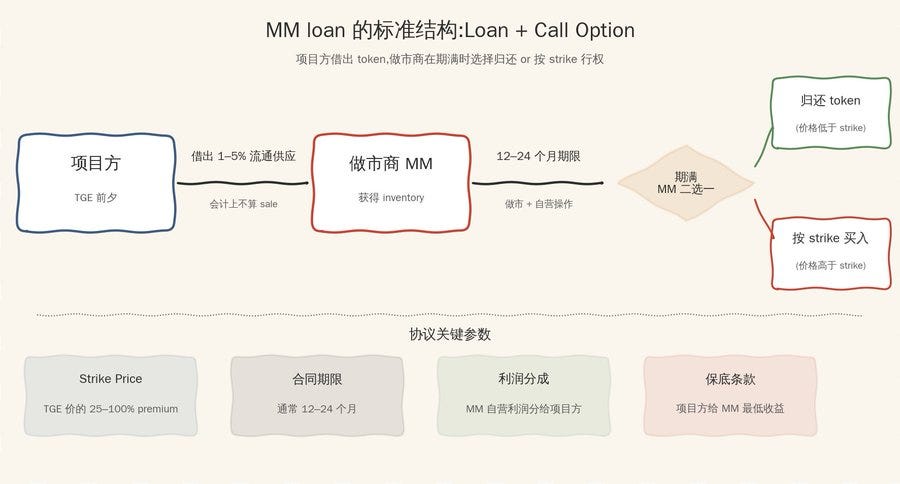
To explain why that matters, it breaks down the standard structure between altcoin projects and market makers. In the article’s telling, these agreements almost always follow the same template: a token loan paired with a call option.
Shortly before TGE, a project lends a set number of tokens to the market maker, often equal to 1% to 5% of circulating supply. The accounting label matters. The project is not “selling” the tokens, so it does not need to report sales proceeds. In tokenomics material, that allocation can still appear under headings such as “market maker allocation” or “liquidity reserve.”
The agreement usually lasts 12 to 24 months. At maturity, the market maker has two choices: return the same number of tokens or purchase them at a pre-agreed strike price. In financial terms, the article says, that is effectively a European call option. Strike prices are commonly set 25% to 100% above the TGE price.
Other clauses may sit on top, including profit-sharing, downside protection and formal market-making obligations, but the underlying frame remains the same.
The piece argues that the structure is attractive to both sides. The project gets immediate post-listing liquidity without directly selling supply and without spoiling the optics of its tokenomics story. The market maker gets inventory up front, pays little or no initial cost for it and receives upside optionality.
If the token trades below the TGE price, the market maker can simply return tokens at expiry rather than absorb the type of impairment a conventional buyer would take. If the token rises, the market maker can exercise the option and keep the upside. That means the project bears the opportunity cost of future appreciation, while the market maker captures a large portion of the upside and shoulders comparatively little downside. The article says this asymmetric payoff helps explain why market making has been such a profitable crypto business in recent years, despite how little retail investors understand its underlying agreements.
How the structure can create persistent sell pressure
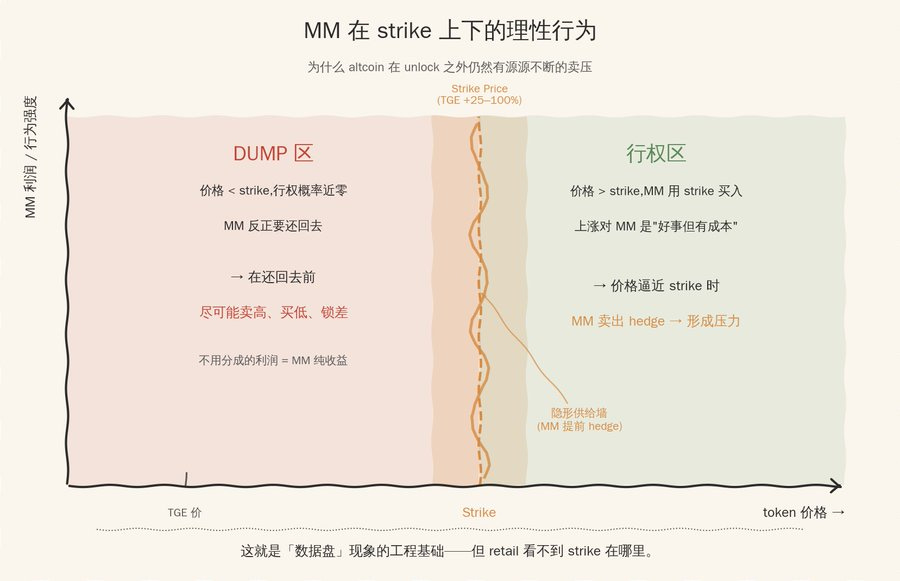
Once the agreement is understood, the article says, the next step is straightforward: examine what a rational market maker would do at different price levels.
When spot trades far below the strike price, the chance of exercising the option approaches zero. The article gives a simple illustration: if the token is at $0.50, a market maker has little reason to buy at a $2 strike. In that scenario, borrowed tokens have limited long-term ownership value because they ultimately need to be returned. The rational move is to sell first and buy back later at a lower price, capturing the spread before repayment. Every round of selling high and buying back lower monetizes the project’s borrowed inventory.
As spot approaches the strike, incentives become more complex. If price rises above the strike, the market maker may need to purchase the borrowed tokens at expiry. Upward price action is helpful, but exercise is not free. The article says the rational response can be to sell in advance as a hedge against future exercise obligations. In market terms, that behavior can create an invisible wall of supply near the strike and suppress clean breakouts above it.
Together, those two mechanisms can produce one of the most common and least understood patterns in altcoins: persistent, uneven sell pressure even when no public unlock event appears on the calendar. According to the article, that pressure may not come from the project or its venture backers. It may come from market makers holding tokens the project has “lent” out. In tokenomics documents, those assets still sit under liquidity-related labels. In trading terms, they are already part of effective circulating supply.
The article ties that dynamic to what many traders describe as price control. When a token appears pinned inside a range, with repeated ceilings on the way up and recurring buyers on the way down, an option-driven market-making model may be operating in the background. The public simply cannot see the parameters.
What should be disclosed on-chain
If market-maker borrowing is one of the market’s most important black-box variables, the article says the next question is what should actually be disclosed.
Its answer is not full transparency on every operational detail. A market maker’s quoting logic and risk controls are part of its trading edge. Publishing those would damage the business model itself. Instead, the article argues for a minimum set of fields that directly affect retail price expectations without exposing proprietary algorithms.
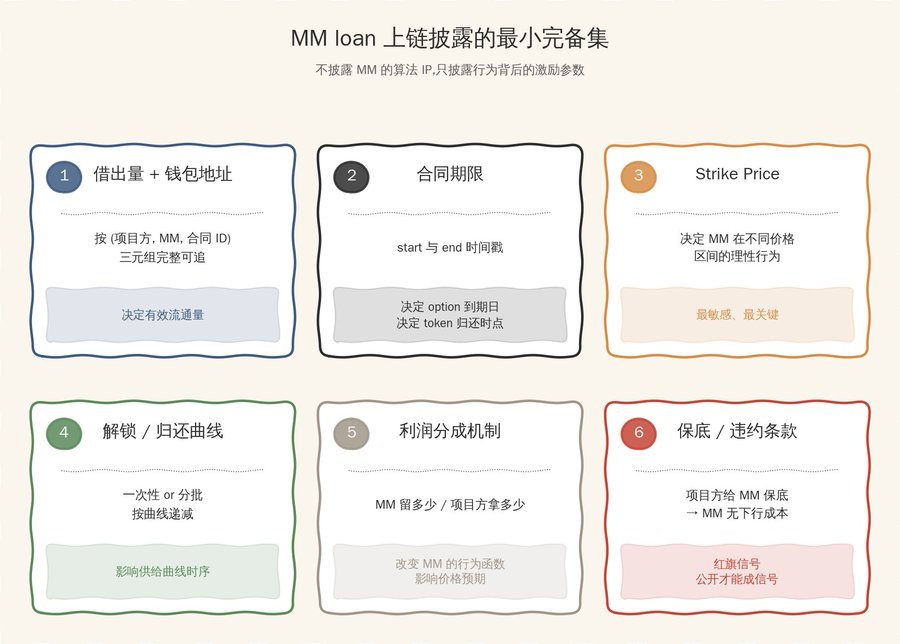
It lists six items:
- the amount of tokens lent and the associated wallet addresses
- the contract term
- the strike price
- the unlock and repayment schedule
- the profit-sharing arrangement
- any floor protection and default clauses
The article says those six fields would be enough for analysts and traders to infer how a market maker is likely to behave across different price zones using ordinary financial logic. The exact execution path could remain private. The incentive parameters behind it would not.
On the technical side, the article says implementation is not the hard part. A standardized template, a contract that requires each token-lending arrangement to be recorded in an on-chain registry and an indexing service that analysts can query could all be built with a few hundred lines of EVM code. The real obstacle is incentives: why would projects and market makers choose to publish those terms?
What changes if disclosure becomes standard
The article outlines several immediate effects if those disclosures become real.
First, sell-pressure structure becomes legible. Reported circulating supply in tokenomics documents would, for the first time, be separated from the number of tokens lent to market makers. Retail traders could then calculate what the article frames as actual sellable supply:
reported circulating supply + tokens lent to market makers = actual sellable supply
Second, price action near strike levels would start to be priced in earlier. Once the strike is public, the article says, it becomes a new technical level for altcoins, something close to an institutional cost basis in equities but more precise because it is written into a contract. Combined with shorting tools such as Shortit, traders could build more symmetric positions around those levels.
Third, accountability becomes easier to assign. At present, when a token falls sharply, a project can call it market action and a market maker can call it passive hedging. Under a disclosure regime, each outflow from a market-maker wallet would connect back to a public contract. Selling pressure could be tied to a specific project-market-maker pair. That would put reputational cost into the decision process in a more direct way.
Fourth, and in the article’s view most important, disclosure could create a transparency premium. Once some projects start publishing terms voluntarily, those that do not may be priced as worst-case versions of the same model, similar to how proof-of-reserves functions as a signal. Traders may assume undisclosed deals involve larger token loans, lower strikes and more generous downside protection, then apply a discount accordingly. Disclosure would stop being just a burden and start functioning as a valuation signal.
The article also notes that this is the ideal version of the story. Implementation in practice would be difficult.
A market shaped by leverage, shorts and information
In its final section, the article brings the three themes together: leverage, direction and information.
Democratized leverage lets retail traders scale a view when they think they are right. Democratized shorting gives them a way to position for downside. Democratized information tells them where and when the crucial incentive points lie. Only when all three are available at once, the article says, do retail participants finally have a complete toolkit to compete at the same table as institutions.
That would change price discovery itself. For years, the article argues, altcoin pricing has been dominated by two forces: narrative and liquidity. The actors able to attract attention or deploy capital had the strongest influence. Retail traders mostly received the narrative and provided the liquidity that others could later sell into.
Break those asymmetries, and the center of gravity shifts from “narrative plus liquidity” to “information plus expectations.” Traders would still see KOL calls and price charts, but they would also see readable market-maker contracts, transparent borrowing pools and option strikes that can be modeled. Narratives would not disappear. They just would not get to move prices alone.
Disclosure would not end coordination, but it could raise its cost
The article does not present transparency as a final solution. It says sophisticated players would still search for ways around a new regime, whether by splitting option structures into off-chain sub-agreements, dispersing strike exposure through multi-leg derivatives or replacing direct token lending with DAO governance-token structures. In finance, rule changes regularly produce new forms of avoidance.
What changes, in the article’s account, is the marginal cost of doing so. Today, a project and a market maker can design a contract that disadvantages retail holders at almost no external cost because few people can see it. Once disclosure exists, the market can identify and price excessively aggressive terms. Contract design itself becomes a public game. Coordination may survive, but the payoff falls.
The article also argues that market composition would change. It points back to MOVE as one example, then says many projects launched over the past three years have relied on a similar business model built around low float, high fully diluted valuation, aggressive market making and narrative-driven price support. Under a disclosure regime, those tokens would be repriced against their real supply curves much faster, eroding the basis of that model.
Projects with real demand, voluntary disclosure and on-chain market-making structures, by contrast, could receive a valuation premium, a more stable retail holder base and a longer market life. The article says there are few such projects today, but secondary-market incentives could increase their number over time.
It closes with one more possibility: the emergence of on-chain market-making protocols themselves. If all key parameters in a market-making arrangement must be recorded on-chain, part of the market-maker role could become protocolized. Projects could configure terms through public templates, while smart contracts handle the market-making process and token repayment automatically. That would move the business away from relationships and information asymmetry and toward protocol design and standardization, reshaping the structure of the altcoin market-making industry.