
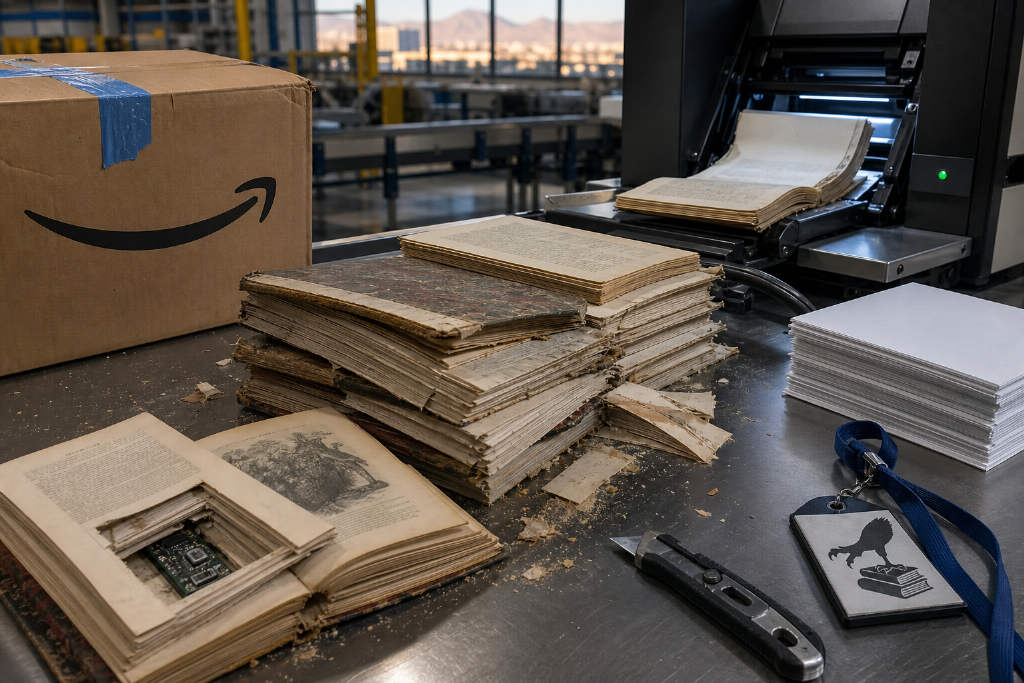
Independent tech publication 404 Media said it placed a tracking device inside a shipment of rare books and watched the package travel to an Amazon facility in Las Vegas, where the company scans printed books and destroys them in the process to train AI models.
The investigation was published Monday. According to 404 Media, it is the first report to publicly identify where bulk book purchases tied to AI training are ending up.
The shipment’s final stop was Amazon’s VGT3 team. Employees told the outlet that the group receives massive shipments of printed books, cuts the bindings off so pages can move through scanners faster, and destroys the books in the process. The report added that the team’s logo shows a dinosaur clutching a book in its claws.
Why printed books are in demand
404 Media said books printed before 2022 contain text that is not widely available online and, crucially, is not machine-written. The report said training a model on its own output risks “model collapse,” a decline in quality caused by repeated recursive loops.
On that basis, pre-2022 printed books have become a source of what the report described as clean text for AI training.
Amazon is not alone
The report said Amazon is not the only company involved. It described a growing trade that supplies AI labs with physical books that are stripped, scanned, and discarded. It also pointed to Anthropic’s internal “Project Panama,” which had already digitized millions of books through destructive scanning.
Copyright disputes are already in court
The rush for clean text has also led to litigation. The report said a federal judge ruled that training AI on legally purchased books can qualify as fair use, a partial win for Anthropic. Meta and OpenAI have made similar arguments.
Pirated copies are being treated differently. According to the report, Anthropic agreed to a $1.5 billion settlement over scanned pirated titles, and Salesforce now faces a class action over alleged book piracy.
How booksellers’ suspicions were confirmed
Over the past year, booksellers noticed a spike in bulk orders and suspected AI companies were behind them, the report said. The buyers were described as not being price-sensitive and selecting titles that appeared random. 404 Media said those suspicions were confirmed when an AirTag revealed the shipment’s destination.
Amazon’s response
Amazon said it “purchases books through commercial channels to help develop and improve the products and services our customers use.”