
By Yuan Xinyue. Edited by Wang Jing. Produced by Zimubang.

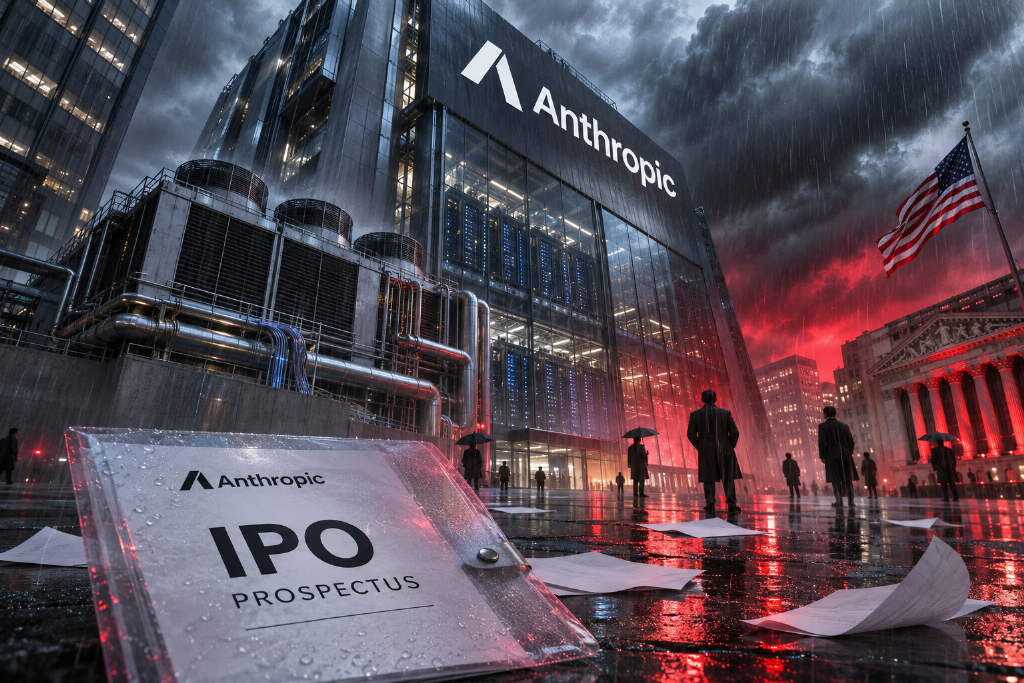
Anthropic’s planned initial public offering, once viewed as a potential record-setter for global capital markets, is entering a far more difficult pricing process. Core employees have moved to OpenAI, the company has nearly $900 billion in long-term computing purchase and lease commitments, and valuation expectations have fallen from $2 trillion to a range as low as $1.1 trillion.
The offering matters beyond Anthropic’s own fundraising plans. It could give public markets one of their first direct tests of how to value a frontier AI model developer against revenue, profitability, computing costs and balance-sheet commitments. The sharp technology-stock sell-off in early November and growing political scrutiny of data-center construction have made that test more demanding.
A market sell-off puts Anthropic at the center of IPO pricing
US equities suffered a broad decline on Nov. 5. The Dow Jones Industrial Average fell 1,833 points, or 3.44%. The S&P 500 dropped 4.36%, its largest one-day decline since the US tariff shock in April 2025. The Nasdaq Composite fell 5.52%, its steepest daily drop in 19 months.
AI-related companies were among the hardest hit. The Philadelphia Semiconductor Index dropped about 12.3%, its biggest one-day decline since March 2020. Nvidia fell about 9%, AMD lost about 17%, CoreWeave declined about 10% and Nebius fell about 15%. CoreWeave and Nebius were each down by about half from their Oct. 6 highs. Microsoft fell 3.6%, while Amazon and Alphabet each declined 2.2%.
Technology stocks recovered the following day. The Nasdaq rose 1.09% and the Philadelphia Semiconductor Index gained about 4.2%, but the Nasdaq still ended the week down about 3.4%. Anthropic has no live public share price because it is not listed, yet its planned offering is being judged against the same market repricing.
According to foreign media reports, traders on the prediction market Kalshi put the probability of Anthropic completing an IPO this year at below 60%, down from nearly 90% before the US midterm elections. Some potential investors have also questioned whether the company can reach the previously discussed valuation of about $1.5 trillion.
Concerns over data-center construction have added to the pressure on AI-related stocks. The next US Congress and local governments could restrict new AI data centers, while electricity use, water consumption and pressure on local infrastructure have become important political issues. UBS estimates that about 30% of data-center capacity scheduled to be added in the US by 2028 could be affected by potential construction pauses.
Anthropic is both a major buyer of computing capacity and a developer selling AI services to businesses and consumers. Investors must assess whether the industry’s large AI spending commitments can become recurring revenue and profit. When comparable technology stocks fall, institutions may seek a lower offering price or commit less capital even if they continue to support Anthropic’s long-term prospects.
A $100 billion fundraising plan meets timing and valuation doubts
Anthropic was previously expected to raise as much as $100 billion. An offering of that size would require strong demand from institutional investors. If demand is insufficient, the company could reduce its valuation, scale back the fundraising target or wait for more stable market conditions.
Foreign media reported on Nov. 5 that some potential investors doubted Anthropic could begin its roadshow during the week of Nov. 9 and complete a listing in November. Some investors considered the previously discussed valuation of about $1.5 trillion too high and wanted a larger discount. Anthropic declined to comment.
The company has not announced a final offering price or listing date. Its prospectus says only that it plans to conduct a public offering as soon as practicable after its registration statement becomes effective with the US Securities and Exchange Commission. The earlier November timetable came mainly from reports citing people familiar with the matter.

Valuation pressure began before the November sell-off. The $2 trillion expectation appeared only briefly in September. At an investor day on Oct. 14, Anthropic disclosed third-quarter financial data to potential investors. Revenue rose about 45% quarter over quarter to $16.8 billion, but that was well below the roughly 145% quarter-over-quarter growth reported for the second quarter.
On Oct. 15, media reports said some investors had reduced their IPO valuation expectation from about $2 trillion to $1.5 trillion. That represented a $500 billion reduction before the company had reached the public market. Some commentary also argued that Anthropic may have missed a more favorable listing window. A June offering, during a period of faster revenue growth, might have received a higher valuation, according to those reports.
Anthropic updated its prospectus on Nov. 2 with additional third-quarter results. The filing reported quarterly revenue of $16.956 billion, up about 47% from the previous quarter, and long-term computing purchase and lease commitments of $895.4 billion. Reports on the same day said institutions preparing to participate in the IPO wanted the valuation held between $1.5 trillion and $1.6 trillion.
That discounted range is now being questioned as well. Foreign media reported that some potential investors were discussing valuations between $1.2 trillion and $1.3 trillion, while others were considering a level as low as $1.1 trillion.
Some investors are also waiting for Anthropic’s October revenue figure to determine whether growth can accelerate again after the third-quarter slowdown. The October figure was not separately disclosed in the prospectus update published on Nov. 2.
Claude Code loses key employees to OpenAI
The valuation reset has coincided with staff departures. Claude Code lost three important members within two weeks, including former product head Cat Wu and Austin Lau, Anthropic’s first employee in a growth role. Both later joined OpenAI.
Wu announced her departure on Nov. 3, US time, ending about two years at Anthropic. She helped Claude Code develop from an internal experimental tool into a commercial product and became one of its most recognizable members. Two days later, she announced that she had joined OpenAI to manage product work for a core product, reporting to Tibo Sottiaux.
Lau announced his move to OpenAI on the same day. He had helped build Claude’s user-growth system and worked to bring more users to the product. Anthropic had highlighted his work in January, including his use of Claude Code to develop marketing tools that reduced advertising-material production time from 30 minutes to 30 seconds.
The moves came as Anthropic and OpenAI compete for enterprise customers. Wu helped take Claude Code toward commercialization, while Lau worked to bring Claude to more users. Both are now at Anthropic’s direct competitor.
Anthropic recently emphasized its talent advantage in its prospectus. The company said its overall “regretted attrition rate” was about 1% over the 12 months ended Sept. 30. That figure did not include core employees who left from late October onward.
The departing employees did not give an explanation directly tied to the IPO’s prospects. Wu also explicitly said the possibility of selling company shares early was not a factor in her decision to leave.

Anthropic and OpenAI compete for the same financing pool
OpenAI is also accelerating its fundraising effort. Foreign media reported on Oct. 19 that the company was seeking about $30 billion, hoping to secure investor capital before Anthropic’s listing and targeting a valuation above $1.4 trillion.
By Oct. 30, OpenAI’s fundraising target had fallen to about $20 billion, while its valuation target had been reduced to $1.25 trillion. On Nov. 6, OpenAI was reported to have completed an initial financing of about $11 billion, with the remaining capital still being raised.
OpenAI is trying to raise money before Anthropic reaches the public market. Anthropic is seeking a record-setting IPO. The two companies are competing for many of the same investors and face similar resistance to high valuations.
Anthropic remains one of the few companies in the current AI listing wave still pursuing a public offering. Other AI companies that had been preparing to list this year have mostly stepped back from the financing race. As of Oct. 22, data-center operator Switch, AI infrastructure company Nscale and SoftBank-backed SB Energy had delayed their IPOs. Nvidia-backed Firmus and Blackstone-backed AirTrunk REIT had withdrawn or paused their issuance plans.
Reports said some of those companies were unwilling to compete with Anthropic for institutional capital and investor attention. Many large investors still view Anthropic as one of the few ways to invest directly in a frontier AI company. Two weeks later, Anthropic’s own offering schedule was being questioned.
Listed chipmakers and cloud companies provide public-market valuation references. OpenAI and Anthropic, which directly develop frontier models, do not yet have the same type of listed-market benchmark. Anthropic could become the first frontier AI model company to list in the US, making its offering especially important for the sector.
If the IPO proceeds, even at a lower valuation, public investors will have a direct way to price a frontier AI company using its revenue growth, profitability and computing costs. The result would give other private AI companies, including OpenAI, a comparison point.
Nearly $900 billion in computing commitments weighs on the filing
A delay would not immediately leave Anthropic short of cash. Its latest prospectus showed that the company held about $131.9 billion in cash and short-term investments as of Sept. 30, providing a substantial financial buffer.
A prolonged delay would be more difficult if other financing channels also tighten. Anthropic has signed nearly $900 billion in long-term commitments for computing purchases and leases. About $69.8 billion of those commitments is expected to come due by the end of September 2027.
If financing costs continue to rise and new capital becomes harder to secure, Anthropic may have to slow its expansion or revise parts of its investment plan. Data-center operators, chip suppliers and financial institutions that depend on the company’s future orders could also be affected.
Missing one listing window would not prevent Anthropic from waiting for another. A broad change in how public markets value the AI sector, though, could make the next opportunity less favorable than the current one.




