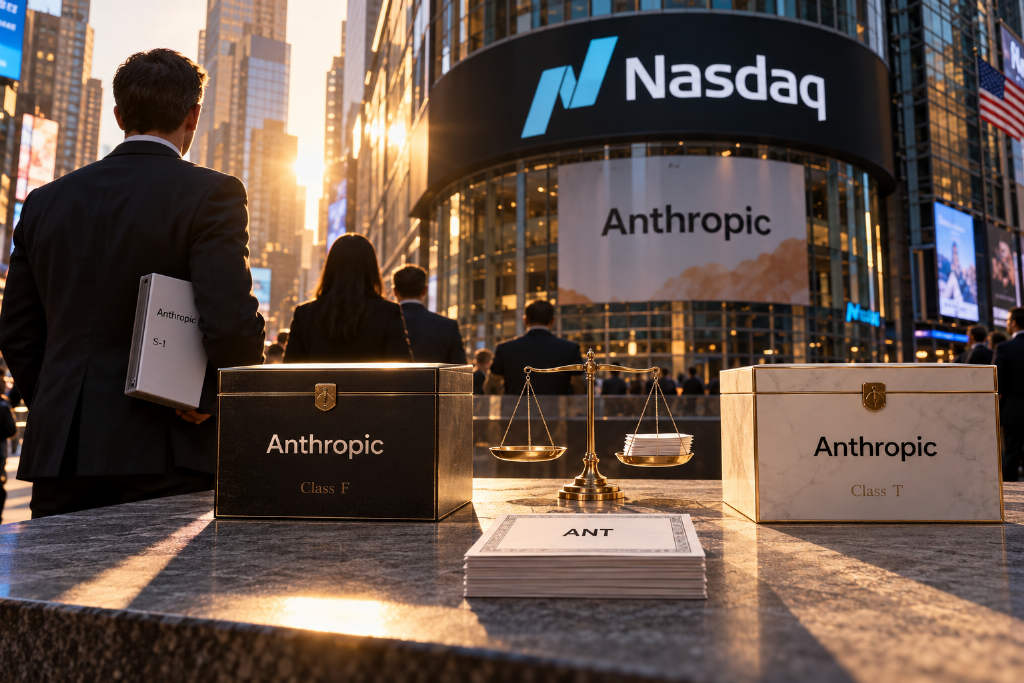
Anthropic filed its S-1 publicly on Oct. 26 Eastern Time to list on Nasdaq, with the offering price and share count still left blank. The filing shows that investors who buy ANT in the public market would receive Class A common stock, carrying one vote per share, but all Class A shares together can represent no more than 49.9% of the company’s total voting power.
The other 50.1% is locked in the hands of the company’s seven co-founders through a single Class F share held by Founder LLC. A separate control mechanism sits with the long-term benefit trust, or LTBT, which holds the company’s only Class T share and can appoint four of the seven board seats.
How Anthropic split the company into five share classes
Class A is the stock public investors would be able to buy. Each share carries one vote and participates pro rata in dividends and liquidation proceeds. The founders’ personal holdings are also in Class A, although the filing leaves ownership and voting percentages blank because the final share count has not been set.
Class N has the same dividend and liquidation rights as Class A but carries no voting rights, except where voting is legally required. The filing identifies strategic partners as the main holders, naming Amazon and Google as each owning more than 5% of the equity. The 846,840,960 shares Anthropic donated to its public-benefit subsidiary are also Class N. If Class N shares are sold in the public market, or transferred to a non-Class N holder whose stake does not exceed 9.99%, they automatically convert into voting Class A shares.
Class T consists of a single share held by the long-term benefit trust. It has no dividend rights and exists to appoint and remove Class T directors. After the IPO, those directors will hold four of the board’s seven seats.
Class F also consists of a single share and is issued to Founder LLC. Its initial members are seven co-founders, including Dario Amodei and Daniela Amodei. The filing notes that Benjamin Mann, who is often described as a co-founder, is not part of that group. Class F has no economic rights, but its voting power always equals 50.1% of the company’s total voting power. The filing says that if the company issues another 1 million Class A shares, Class F would automatically gain about 1.004 million additional votes, preventing dilution.
Class E is reserved for employees. It cannot be transferred, carries no economic rights, and will have 0 shares outstanding at the time of listing. Employees receive one share for every six months of service, while founders do not. Each Class E share has one vote, but only on two matters: disputes over nominations for one specific Class T board seat, and amendments to the trust terms.
Two separate control layers
The first layer is the LTBT. It is made up of five trustees with no financial interest in the company, and four trustees are currently in place. New trustees are chosen by majority vote of the sitting trustees. The filing says company leadership works closely with trustees in practice when selecting candidates.
The trust has two main powers. It can appoint and remove four Class T directors, and it creates an extra gate for major transactions such as a merger or sale of all assets because those matters must first go through the board, where trust-appointed directors hold a majority. The filing also says the trust does not take part in day-to-day management or strategy, and Class T has no economic rights.
Still, in cases involving liquidation, a sale of more than 50% of voting power or economic interests, a transfer of control over AI models above a capability threshold, or a bankruptcy filing, the company only needs to give prior written notice to the trust. That notice period can also be waived.
The second layer is the founders. Founder LLC decides how to cast the Class F vote on a one-person, one-vote basis among its seven members, with a majority required. If the group cannot reach a majority, or if most members abstain, Class F votes in proportion to the actual Class A vote, effectively taking no separate position.
That single Class F share determines the board’s other three seats, amendments to the charter, and shareholder votes on any merger. In practice, that means a takeover would need to clear both the board, where the trust controls a majority of seats, and the shareholder vote controlled by the founders.
The sunset terms are not symmetrical
Class T has no expiration date. Eliminating it would require amending the trust terms. If trustees oppose the change, approval would also be needed from founders, employees, and Class A shareholders.
Class F, by contrast, can expire automatically. If Founder LLC has fewer than three members for 90 consecutive days, a 450-day transition period begins. At the end of that period, all Class F and Class E shares are redeemed for no consideration, and the board shifts to staggered three-year terms.
Members can leave Founder LLC through resignation, death, incapacity, removal for cause, or if their Class A holdings fall below 2% of the amount they held at the time of listing. The filing summary does not list leaving the company itself as a trigger, and says the details depend on the Founder LLC agreement.
What this means for ANT buyers
Anthropic states plainly in its risk factors that Class A holders will generally be unable to influence shareholder votes or board elections unless the founders fail to form an internal majority. The filing also says the multi-class structure could keep the company out of some indexes, which would prevent passive index funds from buying the stock.
Because the trust can appoint a majority of the board, Anthropic qualifies as a “controlled company” under Nasdaq rules and may rely on exemptions from requirements such as having a majority-independent board. The company says its board is currently majority independent and that it only expects to use the exemption for the nominating and corporate governance committee, but that is a statement of current practice rather than a binding governance obligation.
Anthropic is also a public benefit corporation, or PBC. Directors are required to balance shareholder financial interests, the interests of those affected by the company’s conduct, and the company’s public-benefit purpose. The filing warns that this could lead the company to forgo revenue, citing examples such as banning the use of its models for fully autonomous weapons and mass surveillance.
For shareholders who want to sue to enforce those duties, Delaware law requires ownership of 2% of the shares or stock worth $2 million, whichever is lower. At Anthropic’s scale, the practical threshold is at least $2 million, leaving little room for small retail holders to bring such claims.
In short, buying ANT would give investors exposure to Anthropic’s economic growth, while control of the company remains with the long-term benefit trust and the seven co-founders.