

Anthropic released Claude Haiku 5.5 on Oct. 7, calling it the fastest, most capable and lowest-priced small model in the Claude family so far. Entry pricing starts at $0.1 per million input tokens, down 90% from Haiku 4.5.
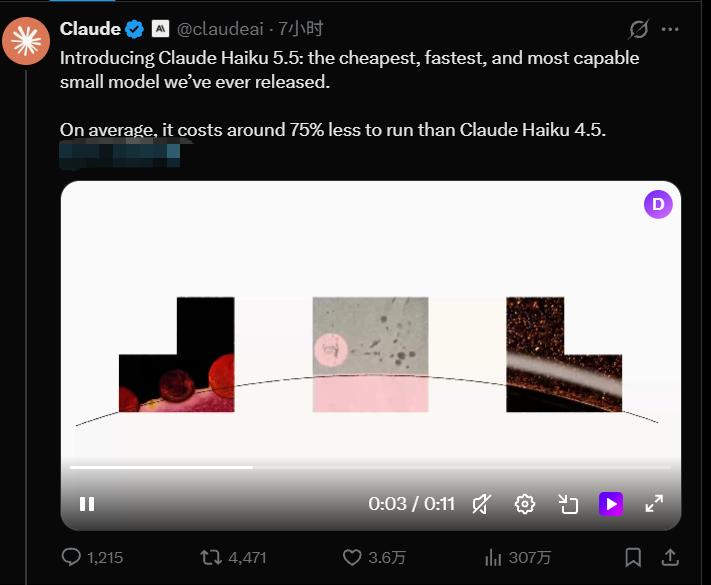
The company said Haiku 5.5 adds adjustable reasoning effort, supports a 1 million-token context window, and can generate up to 128,000 output tokens. Its arrival also completes Anthropic’s Claude 5.5 refresh in 15 days: Opus 5.5 on Sept. 22, Sonnet 5.5 on Sept. 28, and now Haiku 5.5 on Oct. 7.
Benchmark results topped GPT-6 Luna in several tests
Anthropic’s published benchmark results show a sharp jump from the prior Haiku model, with Haiku 5.5 beating OpenAI’s GPT-6 Luna in some categories.
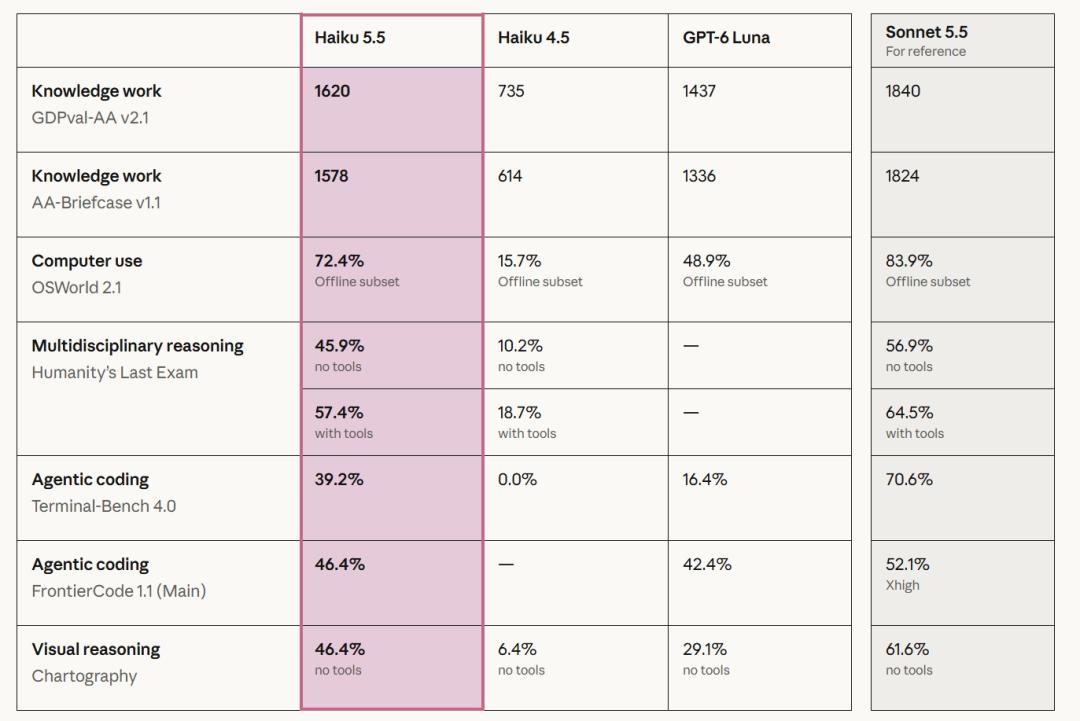
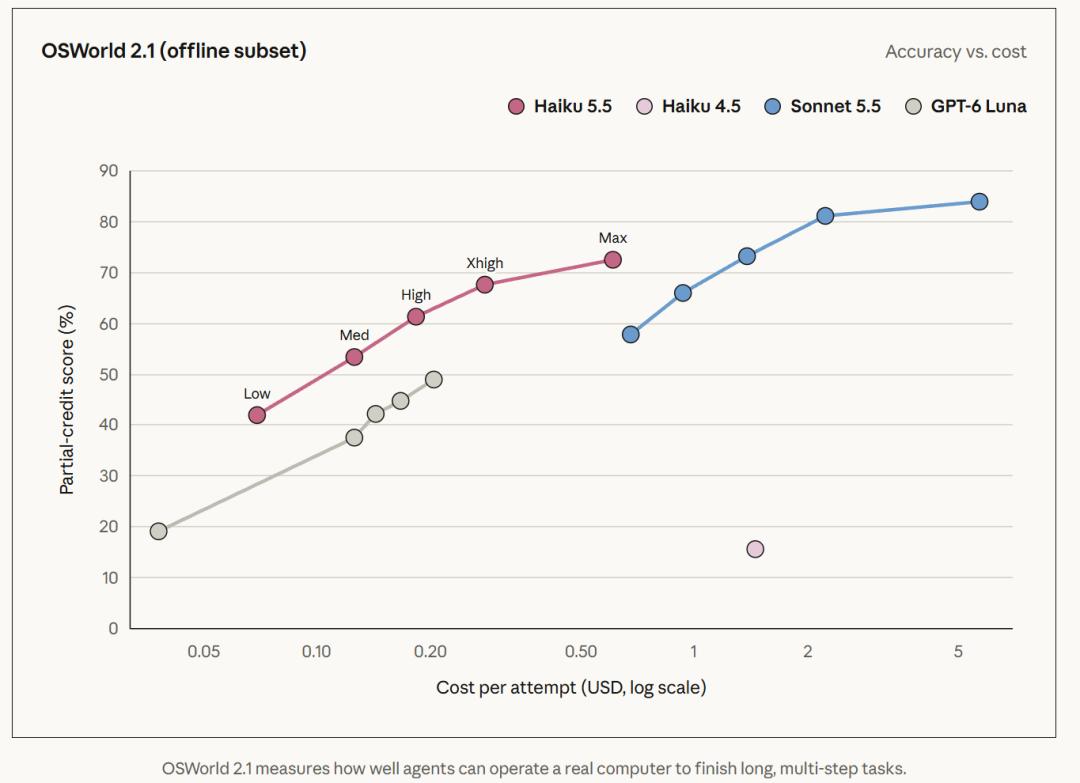
In the OSWorld 2.1 offline task subset, which measures an AI agent’s ability to operate a real computer across apps and multi-step workflows, Haiku 5.5 posted a 72.4% success rate. Haiku 4.5 scored 15.7%, while GPT-6 Luna came in at 48.9%.
For knowledge work, Haiku 5.5 scored 1620 on GDPval-AA v2.1, above GPT-6 Luna’s 1437. In Terminal-Bench 4.0, Anthropic listed Haiku 5.5 at 39.2% and GPT-6 Luna at 16.4%.
Those top-line numbers come with an important caveat. Haiku 5.5’s strongest benchmark results often require more reasoning compute. The model is the first in the Haiku line to offer adjustable reasoning effort, letting developers tune how much compute the model uses through an effort parameter.
VentureBeat noted that Anthropic’s 39.2% Terminal-Bench result corresponded to maximum reasoning effort. At medium reasoning effort, the score dropped to about 20%, and medium is the default setting for Haiku 5.5.
Artificial Analysis reported a similar pattern. In its Intelligence Index, Haiku 5.5 scored 43 at maximum reasoning effort and 34 at medium effort. Average cost per task in that same evaluation was about $0.21 at maximum effort and about $0.05 at medium effort.
In Artificial Analysis’ own Terminal-Bench 4.0 testing, Haiku 5.5 scored 33% at maximum effort and 15% at medium effort. The outlet said those numbers differ from Anthropic’s because the evaluation setup is not the same.
For more demanding agent coding work, Sonnet 5.5 still holds a clear lead. Anthropic said Sonnet 5.5 reached 70.6% on Terminal-Bench 4.0. The company also said Sonnet and Opus remain better suited for complex agent coding tasks, while Haiku is aimed at high-frequency, clearly scoped work.
API pricing drops sharply, but tokenization changes matter
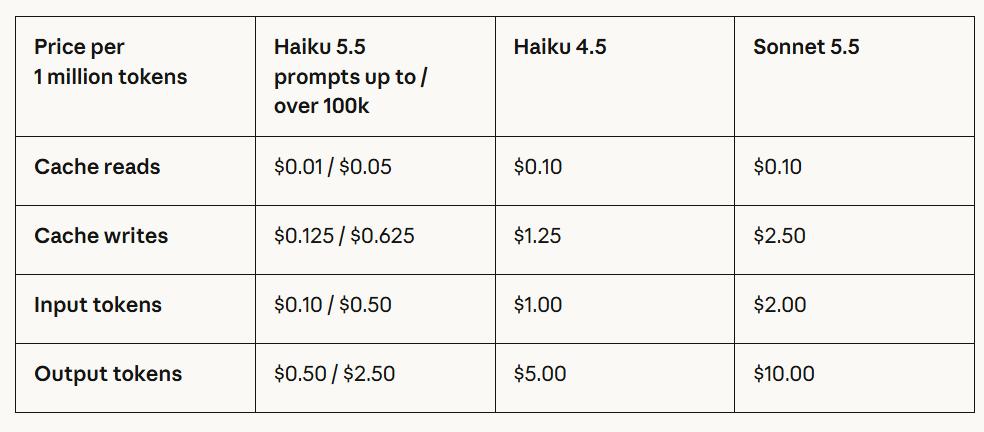
Pricing is central to this launch. Anthropic set two API price tiers for Haiku 5.5.
For requests with prompts of 100,000 tokens or less, input and output pricing is down 90% from the prior generation. Above that threshold, pricing is still 50% lower than Haiku 4.5. Anthropic said about 90% of Haiku 4.5 requests were within 100,000 tokens, and estimated average task costs for similar work could fall by about 75% after accounting for prompt length and token consumption.
There is another detail in the pricing comparison. Haiku 5.5 uses a new tokenizer. Anthropic’s developer documentation says the same piece of text may produce about 30% more tokens than on Haiku 4.5, depending on the content. That means a 90% cut in API unit pricing does not automatically translate into a 90% drop in total bill per task.
Haiku 5.5 also goes directly against GPT-6 Luna on list pricing. OpenAI’s quoted Luna base rates are also $0.1 per million input tokens and $0.5 per million output tokens, and the cache read price matches Haiku 5.5’s low-price tier.
The long-context threshold is different, though. Haiku 5.5 moves into a higher pricing tier once prompts exceed 100,000 tokens. GPT-6 Luna does not trigger long-context pricing until input exceeds 272,000 tokens. That leaves Luna with a unit-price advantage for requests between 100,000 and 272,000 tokens.
VentureBeat also listed contemporaneous API prices from Google. Gemini 3.5 Flash-Lite was priced at $0.3 per million input tokens and $2.5 per million output tokens, while Gemini 3.8 Flash was priced at $0.75 and $3.75. Those numbers reflect the competition now forming around low-cost model APIs.
Anthropic positions Haiku 5.5 for high-volume agent workloads
Anthropic said Haiku 5.5 is designed for document summarization, information classification, database queries, context compression, and subagent roles inside more complex agent workflows.
The use case is straightforward: as agent systems become more complex, one task often requires many model calls. Sending every step to a larger model can raise costs quickly. Anthropic used several customer examples to show where a smaller model fits.
Financial AI company Rogo said its workflow uses a more capable large model to build a financial presentation. When handling a specific slide, a Haiku 5.5 subagent enters a company’s 10-K filing, finds the required business revenue figures, and passes the result back to the main model. Rogo said Haiku 5.5 reached a balance across accuracy, speed and price that works for heavy repeated use.
Enterprise content management platform Box shared early testing results as well. Compared with Haiku 4.5, Haiku 5.5 improved by 11 points in Box’s internal evaluation and cut latency by about 50%. Box said that makes the new model suitable for cost reporting, financial summaries and recurring reviews at scale, though it did not publish the full evaluation standard.
Asana tested the model on agent tasks including bug classification, project setup and large portfolio search. Based on results it disclosed, Haiku 5.5 reduced task completion latency by more than 30% compared with the model currently in use, and improved single-turn agent reasoning speed by as much as 2.5x.
Another example came from AlphaSense. Its Ask in Document feature processes about 8 million calls a week, mainly answering specific questions about one or several documents. Across 400 test queries, Haiku 5.5 scored 0.84 in AlphaSense’s internal evaluation, versus 0.76 for Haiku 4.5.
Anthropic presented these figures as early customer feedback. Workloads, comparison models and scoring methods were not fully aligned across companies.
Sonnet 5.5 also gets a price cut
Alongside Haiku 5.5, Anthropic lowered Sonnet 5.5 pricing. Starting Oct. 7, Sonnet 5.5 cache read fees were reduced 50%, from $0.2 per million tokens to $0.1 per million tokens.
Anthropic said that change could lower costs for most agent workloads by about 20%, with the actual figure depending on how much an application reuses cached context. For agents that repeatedly read long conversation history, tool instructions and task context, cache costs directly affect long-run operating expense.
The company also added monthly API credits for Claude Max and Team subscribers: $100 for Max 5x users, $200 for Max 20x users, and up to $500 shared for Team users. Those credits can be used for model calls on the Claude platform.
For developers, Haiku 5.5 is available through Anthropic API, Amazon Bedrock, Google Cloud and Microsoft Azure under the model ID claude-haiku-5-5. Anthropic also updated its Python and TypeScript SDKs, adding beta browser-use and computer-use support.
The Claude 5.5 lineup is now fully segmented
With Haiku 5.5 in place, Anthropic’s product split inside the Claude 5.5 series is more defined. Opus 5.5 is aimed at high-difficulty, complex reasoning work. Sonnet 5.5 covers everyday complex tasks and coding. Haiku 5.5 targets jobs that need quick response, high call volume and tighter cost control.
From Sept. 22 to Oct. 7, Anthropic took 15 days to finish this update cycle, with all three models emphasizing capability and cost efficiency. Based on the figures Anthropic and cited outlets disclosed, Haiku 5.5 enters the market with a lower list price, adjustable reasoning tradeoffs and benchmark strength in some agent, knowledge-work and computer-operation tests.