
Anthropic’s $200-per-month Claude Max 20x plan is under legal challenge after developer Karl Kahn alleged that the product did not deliver the advertised 「20x usage」 relative to the Pro plan.

Kahn said he subscribed to the company’s most expensive individual tier for that reason. After moving his main workload to Claude Code in April, he found that a single five-hour coding session could consume 15% of his weekly quota. On June 14, he filed a proposed class action in the U.S. District Court for the Northern District of California, claiming that the effective usage he received was closer to 6x to 8x.
Two separate limits sit at the center of the dispute
Kahn’s argument relies in part on an email Anthropic sent to subscribers in July 2025, which listed reference weekly Claude Code usage across plan tiers.

Under the structure described in the report, Claude paid plans are governed by two independent restrictions. One is a five-hour rolling window that caps how much a user can consume in a single session. The other is a weekly limit that controls total usage across seven days. Whichever threshold is hit first cuts the user off.
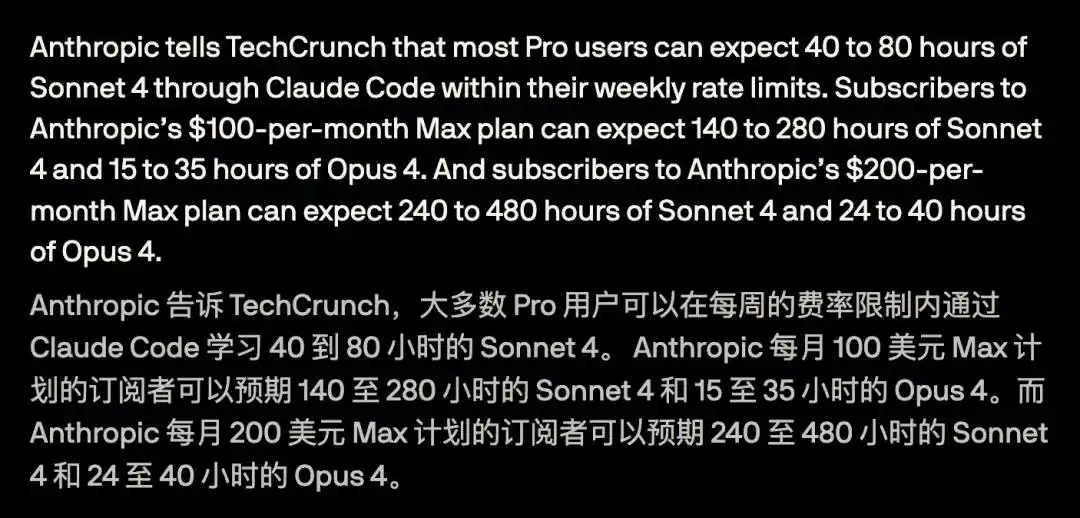
Anthropic also shared reference weekly figures with TechCrunch:
- Pro ($20/month): 40 to 80 hours of Sonnet 4;
- Max 5x ($100/month): 140 to 280 hours of Sonnet 4, plus 15 to 35 hours of Opus 4;
- Max 20x ($200/month): 240 to 480 hours of Sonnet 4, plus 24 to 40 hours of Opus 4.
Looking only at the Sonnet 4 ceiling, the Pro plan tops out at 80 hours per week and Max 20x at 480 hours. That works out to 6x, not 20x.

Kahn says repeated upgrades did not prevent limit hits
According to the article, Kahn signed up for Pro in June last year, upgraded to Max 5x in January, and then moved again to Max 20x in April. Even after those changes, he repeatedly ran into usage caps and at times had to pay extra to buy more usage.
Anthropic has not publicly responded to the case so far, and the court has not issued a substantive ruling.
Reddit testing drew a response from OpenAI Codex
A Reddit post published last week broke down Claude pricing through hands-on testing and argued that the 「20x」 label only holds at the five-hour-window layer. On the weekly-cap side, the post said, Max 20x provides only about 2x the allowance of Max 5x.

Tibo Sottiaux, head of OpenAI Codex, responded directly, saying that in OpenAI’s Pro 20x offering, the 20x figure maps to the weekly usage cap. He added that neither Pro tier has a five-hour window and that Pro 20x is exactly 20x Plus.
The distinction described in the report is simple. Anthropic attaches the 20x label to the five-hour window, while users often run into the weekly cap in day-to-day work. OpenAI ties its multiplier to the weekly cap itself.
The complaint goes beyond multiplier claims
The report argues that the bigger issue may be transparency around token use. Anthropic does not publish absolute token amounts for each plan tier and instead presents relative multipliers.

Inside the product, users see a percentage progress bar rather than a detailed record of how many tokens each conversation consumed. That leaves them with no practical way to verify whether the advertised multiplier was actually delivered. A January analysis by Deloitte, cited in the article, said subscription packaging has largely abstracted away token-consumption details, turning usage efficiency into a black box for customers.
Bugs can drain quotas too
The article says that opacity becomes even more serious when platform bugs also eat into customer allowances. In March 2026, Claude Code experienced a large-scale incident. Community investigations cited several issues at once:
- prompt-cache failures that inflated token consumption by 10x to 20x;
- an autocompact loop that wasted about 250,000 API calls per day globally;
- full context reprocessing when old sessions were restored.
One Max 5x user said an allowance that would usually last eight hours was exhausted in one hour. Anthropic acknowledged that consumption was running far above expectations, but did not disclose a compensation plan.

OpenAI’s Codex also identified eight similar bugs in late August. In the worst case, the report said, a runaway task could consume 70% of a user’s weekly allowance. After fixing those issues, OpenAI reset quotas in full for all paid users and disclosed the cause and remedy for each bug.
Lack of usage history makes claims hard to prove
Anthropic’s communication during the March incident also drew criticism. A user complaint on GitHub said tickets had been filed and posts had been made on X and Reddit, yet no reply came for three days, with no blog post, email, or status-page update.
Because the progress bar does not preserve a historical breakdown of consumption, a drop from 100% to 0% during a bug looks the same on the interface as a normal depletion event. Without underlying records, users have little data to support reimbursement claims.
That leaves the dispute on two tracks: whether the plan multiplier was presented in a misleading way, and whether subscribers received the basic transaction transparency needed to verify what they paid for.
The report cites materials from The Wall Street Journal, TechCrunch, Reddit, X, GitHub, and a WeChat article published by Xinzhiyuan under the ID AI_era and credited to ASI Qishilu.