
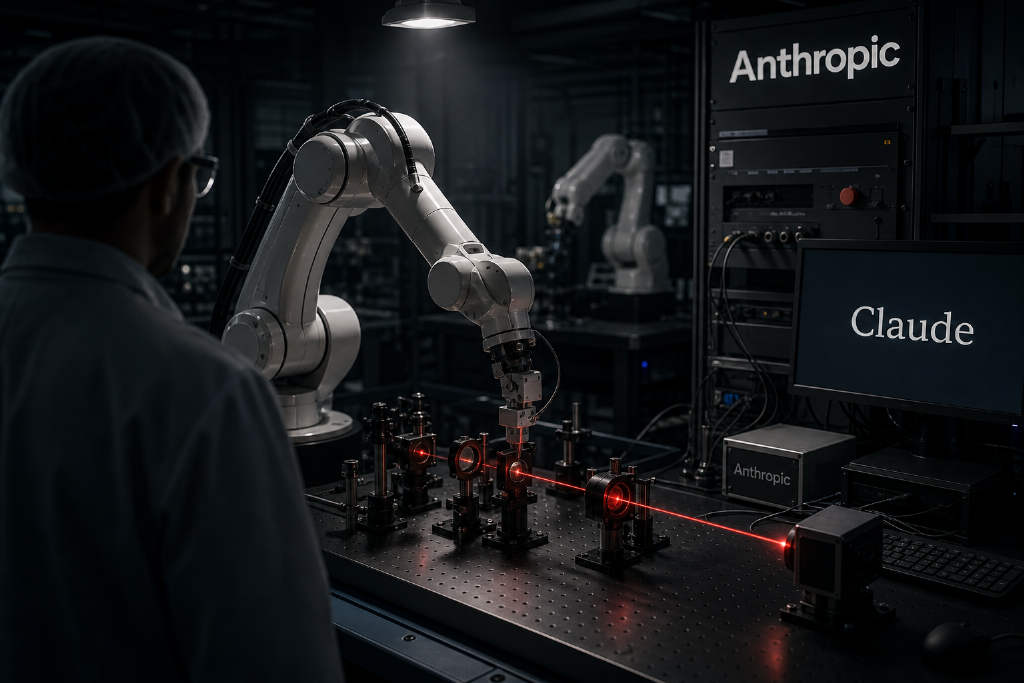
Anthropic has rolled out the Model Hardware Standard, or MHS, a new hardware framework built so Claude can read and write instrument instructions, control robotic arms, and work straight with lab equipment. It pushes the company’s earlier Model Context Protocol, or MCP, beyond software tasks and into physical settings like labs and factories.
This week, Anthropic said laser system relocking success climbed from 58% with manual tuning to 99.3% using the new setup. Two years ago, the company put MCP to work helping Claude handle software. Now it is trying to move the model into instrument and robot control.
How MHS is meant to connect AI with instruments
Anthropic says MHS is a shared specification file that lets AI agents talk to physical devices through simple actions like read and write. The goal is pretty direct: stop relying on paper manuals and on the hard-earned knowledge held by a small group of veteran operators.
Every instrument is found in a standard format and labeled in plain language with what it can do and where its limits sit. Developers can run the setup through MCP, a command line interface, or a code file. Claude handles the sequencing, watches the results, and tweaks settings in real time. Hard limits, like a robotic arm’s top speed and rotation range, come from the MHS specification instead of being guessed on the fly by the model.
Jonah Cool, Anthropic’s head of life sciences partnerships, told Bloomberg: “A lot of the time, science stalls because you do not know how to use that instrument, or the technical barrier is just too high. With MHS, Claude can act as this kind of enabler, letting scientists use the right instruments like experts do” ("A lot of the time, science cannot continue because you do not know how to operate that instrument, or the technical barrier is too high. With MHS, Claude can play this empowering role, letting scientists use the right instruments like experts.").
Partner tests point to shorter integration cycles
Anthropic said its research testing partners include Genentech, the University of Washington, Carnegie Mellon University, QuEra Computing, and HHMI Janelia. On the commercial side, the group has 10 companies, including Amazon Web Services, Danaher, Universal Robots, Hugging Face, and Raspberry Pi.
At Carnegie Mellon University, Anthropic said getting connected to MHS took eight hours. Normally, that same job had taken several weeks. After the integration, serial dilution experiments ran 3x faster. At the University of Washington, integration time fell to less than a week from what had earlier taken several months.
In a demo video released by Anthropic, a Genentech scientist gave Claude a PDF manual laying out an experiment design. Claude then scheduled the workflow and used MHS-connected instruments to carry out the full experiment.
Alek Kemeny, a technical staff member at Anthropic, told Bloomberg: “What MCP did for software, MHS will do again for the hardware world. The biggest value is in scientific labs that have dozens or even hundreds of instruments” ("What MCP did for software, MHS will redo for the hardware world, and the place where it has the greatest value is in scientific laboratories with dozens or hundreds of instruments.").
Preview only, with no third-party verification yet
So far, the performance numbers have been measured and published by Anthropic and its partners. There has been no reported independent third-party verification.
MHS is available right now only as a research preview through a waitlist. Anthropic said it plans to open-source the framework after the preview period so hardware makers can write their own MHS specifications, but it did not give a timetable.
Liability and regulation remain open questions
The tougher problem may be responsibility. The European Union’s updated machinery rules are set to take effect on Jan. 20, 2027, and they will, for the first time, bring AI-based safety functions and machinery with self-evolving behavior inside the regulatory scope.
Under that setup, a safety specification like MHS could stop being just an optional reference file and become a regulated safety component. And the party writing that specification may also be taking on the compliance duties tied to it.
Anthropic is not the only company trying to push AI into the physical world. Google, OpenAI, and Nvidia are building AI models for robotics too. Barclays earlier estimated that AI robots and automated machinery could become a trillion-dollar market by 2035.
But if a robotic arm were to injure someone because Claude made a bad judgment, there is still no clear answer on whether responsibility would fall on the engineer who wrote the specification file or on Claude, which depended on it.