

Anthropic is running into customer pullback at a sensitive point in its IPO process.

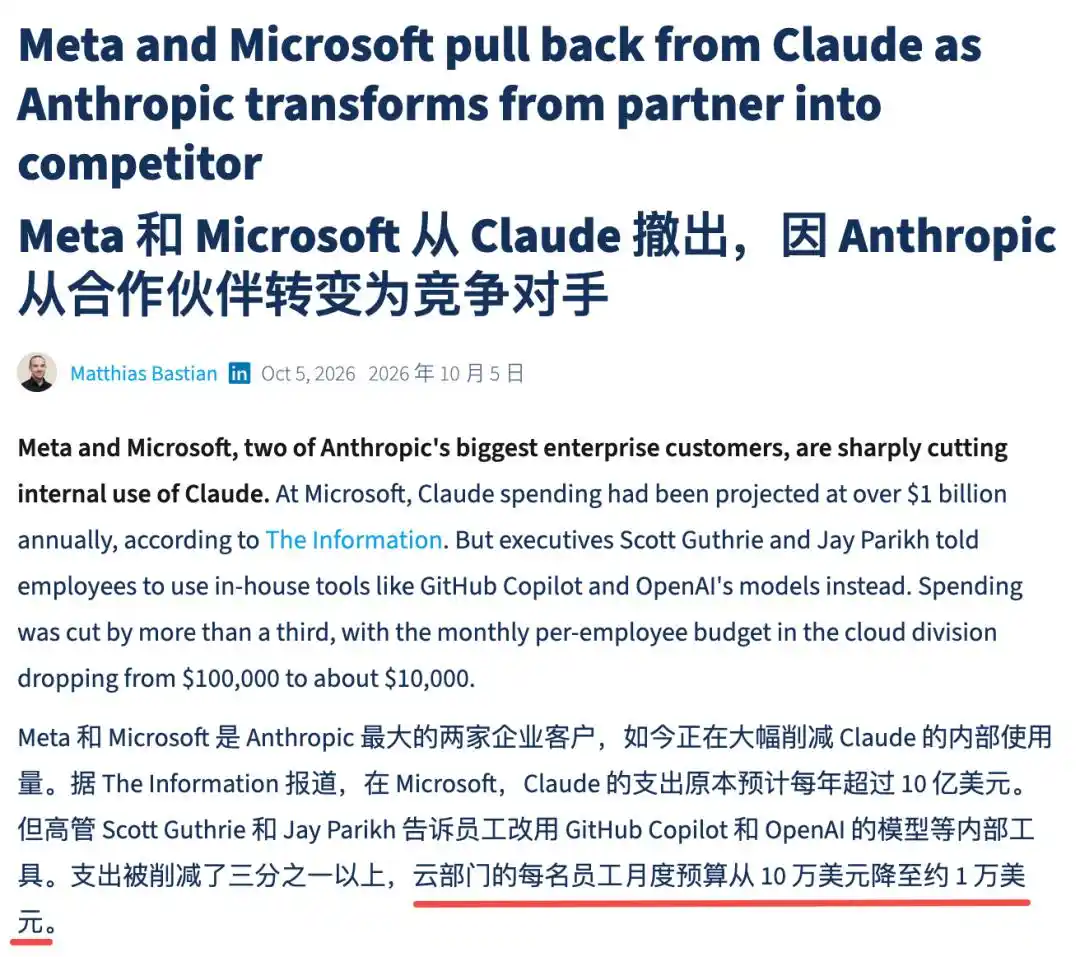
According to The Information, Microsoft has cut more than one-third from what had been projected as an internal Claude budget of more than $1 billion this year. Meta has also reduced internal Claude Code adoption, with the number of employees using the tool falling from about 60,000 to about 30,000.
Heavy usage turned into a large bill
The report says Microsoft opened Claude Code to thousands of engineers in its Experiences and Devices division in December last year. Even without a formal push, the tool spread quickly, and token consumption doubled in the first few months.
Monthly token costs ran between $500 and $2,000 per engineer, adding up to millions of dollars across the team.
Microsoft Cloud and AI chief Scott Guthrie and executive Jay Parikh then told staff to use less Claude and move toward GitHub Copilot and Microsoft’s own models.
The Decoder separately reported that monthly Claude allowances in Microsoft’s cloud division were cut from $100,000 per person to about $10,000, a roughly 90% reduction. By May 2026, Microsoft had canceled most Claude Code licenses and required teams to complete migration before the June 30 fiscal year-end.
Microsoft AI CEO Suleyman said Anthropic’s offering was 「extremely expensive」 and that the goal was to reduce spending sharply until it was fully eliminated.
Meta cuts users as internal tools gain ground
Meta’s retrenchment appears even steeper. The report says internal Claude Code users dropped from about 60,000 to about 30,000.
Layoffs of 10% explain only part of that decline, according to the article. A larger factor is the rise of Meta’s own alternatives. Its internal coding tool MetaCode now has more than 30,000 users, while Muse Code, which is set for external testing starting in August this year, already has more than 6,000 internal users.
Meta’s in-house Muse Spark model has also improved quickly, reducing the need for Claude inside the company.
Even after the user base was cut in half, Meta still spent more than $105 million on Claude Code over the past 28 days. The report also described an internal dashboard nicknamed 「Claudeonomics」 that showed 60 trillion tokens consumed over 30 days.
That cost structure is especially hard to manage in agent-style workflows, where the model reads code, runs tests, and revises output over long sessions. As tools get better, more employees use them, and tasks become more complex, token-based pricing can scale into a much larger bill.
IPO timing puts customer concentration in focus
The timing adds pressure.
Anthropic secretly submitted an S-1 to the U.S. Securities and Exchange Commission in June. In its public prospectus released in September, the company said two unnamed customers accounted for about 25% of revenue combined. Market speculation has pointed to Microsoft and Meta.
Based on earlier reporting, Anthropic could begin its formal roadshow as early as the middle of this month as it pushes toward a Nasdaq listing. If two customers tied to roughly one-quarter of revenue are both cutting back at the same time, investors are likely to pay close attention to concentration risk and the durability of future growth.
The prospectus also showed about $31.4 billion in non-cancelable infrastructure purchase commitments between Anthropic and Microsoft. That leaves an awkward picture: Microsoft is trying to save money on Claude, while Anthropic still has to spend heavily on Microsoft cloud infrastructure.
From supplier to competitor
The deeper issue is how Anthropic is now perceived by its largest customers.
A year ago, the company was largely seen as a model supplier. Customers could buy access and plug the tools into their own workflows. That framing is changing. Claude Code can write code, revise documents, and run processes on its own, while Claude Cowork is moving closer to office software territory.
For Microsoft, that touches a business anchored by Office. For Meta, the company is building Muse into a service for enterprise customers. In both cases, paying a supplier that is edging toward competing products becomes harder to justify.
The report also said Meta wants to limit Anthropic’s access to its training data. As models move closer to core business functions, concerns over data, process control, and strategic dependence become harder to ignore.
The shift goes beyond two companies
The same pattern is showing up elsewhere.

In July, Alibaba fully stopped using Claude Code and shifted to its own Qoder, according to the report. In September, Nvidia, Palantir, and Booz Allen also tightened usage. Nvidia was said to prefer its own Nemotron when handling proprietary information.
The reasons vary. Some companies are reacting to cost, some to data security, and some to distillation concerns. The direction is similar: large companies want tighter control over code-related work.
Anthropic has responded with pricing and policy changes
Anthropic has not stood still.
The report says the company launched Fable 5.1 in early September without changing base pricing, but cut cache read costs by 75%. It said that lowered total costs by about 25% for typical workloads, and by as much as 45% for heavily agentic tasks.
Anthropic also revised a data retention policy that had drawn criticism, allowing enterprises to keep data on their own infrastructure in an effort to address security concerns.
Still, the article argues that lower prices only ease part of the tension. For major customers, the issue is not just that Anthropic is expensive. It is also that the vendor is starting to look like a competitor.
AI coding is entering a cost-accounting phase
Over the past two years, the AI industry focused on model strength and how long agents could work independently. Now finance teams are asking a different question: how much does each line of code actually cost?
Microsoft’s experience captures that shift. Claude Code became popular enough that usage doubled on its own, and the bill rose with it. The company then pulled back most licenses. Engineers may like the tool, but budget limits still decide whether deployment continues at scale.
The report suggests this is splitting the market into two layers. Cheaper, controllable models that are good enough will take a large share of routine work. The strongest models may be reserved for the hardest tasks.
The article cited reporting from The Information. The MarsBit piece also said the Chinese source version came from the WeChat account Xinzhiyuan, written by ASI Qishilu and edited by Suoluomen.