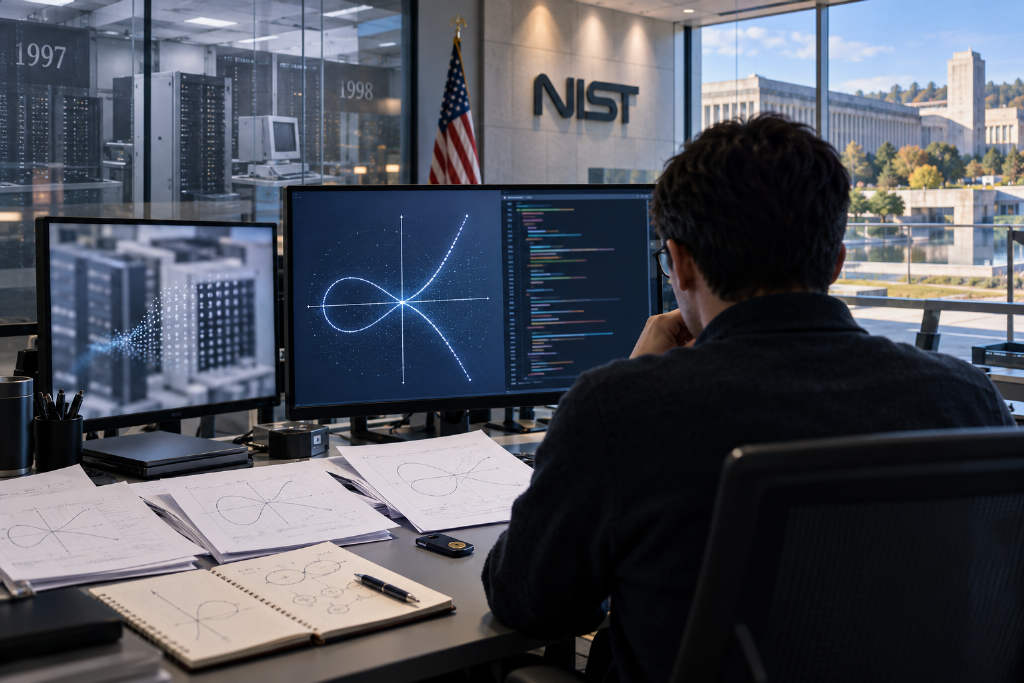
Anthropic said its AI model Claude solved a 25-year cryptography mystery in less than 30 minutes by tracing a set of numbers supplied by the U.S. National Security Agency in the late 1990s to an ordinary random number generator that used 1997 and 1998 timestamps. The numbers had long drawn suspicion because the National Security Agency never explained where some of the seeds used to generate elliptic curves later adopted by the U.S. National Institute of Standards and Technology in 2000 came from. Those concerns intensified after Edward Snowden’s disclosures that the NSA had tried to weaken cryptographic standards. The issue had been discussed by cryptographers Neal Koblitz and Alfred Menezes in a 2015 paper, pursued for years by security researcher Steve Weis, and turned into a bounty challenge in 2023 by Filippo Valsorda and others. Anthropic said Claude traced five NIST curve seeds to the lrand48 random number generator in an older C software library and reproduced the widely used P-256 curve sequence, finding an exact match for the published seed at candidate No. 1842. The company said the result sharply reduces the likelihood of a hidden weakness and that users of NIST curves do not need to make changes. Bitcoin is not affected because its wallets use the simpler secp256k1 curve. The $36,864 bounty will be donated to Internet Security Research Group, the nonprofit behind Let’s Encrypt.
Anthropic said its AI model Claude solved a 25-year cryptography puzzle in less than 30 minutes, tracing a set of numbers supplied by the U.S. National Security Agency, or NSA, in the late 1990s to an ordinary random number generator that used 1997 and 1998 timestamps.
The numbers had long been suspected of concealing a backdoor. In 2000, the U.S. National Institute of Standards and Technology, or NIST, adopted a set of elliptic curves provided by the NSA, but the agency never explained where some of the numbers used to generate those curves, known as seeds, came from.
A dispute that lasted for years
Suspicion around the seeds deepened after Edward Snowden disclosed that the NSA had tried to weaken cryptographic standards. Cryptographers Neal Koblitz and Alfred Menezes discussed the controversy in a 2015 paper, and security researcher Steve Weis spent years looking for an answer.
In 2023, Filippo Valsorda and others also set up a bounty tied to the question.
Claude linked the seeds to lrand48
According to Anthropic, Claude traced five NIST curve seeds to lrand48, a random number generator in an older C software library, and reproduced the sequence for the widely used P-256 curve. It found an exact match to the published seed at candidate No. 1842.
Anthropic said that result sharply reduces the chance that a hidden weakness was embedded, and users of NIST curves do not need to make any changes.
Bitcoin not affected
Bitcoin is not affected by the finding, the report said, because its wallets use the simpler secp256k1 curve, leaving little room to insert a weakness covertly.
The $36,864 bounty will be donated to Internet Security Research Group, the nonprofit organization behind Let’s Encrypt.
This article was originally published by Bit.Fan. For more cryptocurrency news and market insights, visit www.bit.fan. Disclaimer:
The market information, project data, and third-party content displayed on this platform are for industry information sharing only and do not constitute any form of investment advice or return commitment.
Cryptocurrency trading carries high risks. Users should fully assess their risk tolerance and make independent decisions. All profits, losses, and legal responsibilities are borne by the users themselves.