

Anthropic released Claude Sonnet 5.5 on Monday, an update to Sonnet 5 from June. The company said the mid-tier model runs more than 30% faster than its predecessor.
Anthropic described Sonnet 5.5 as strongest on well-scoped everyday work, bug fixing, and creating polished documents, slides, and spreadsheets. It also said the model has a strong eye for design.
Pricing stays flat while undercutting Opus 5.5
Pricing remains at $2 per million input tokens and $10 per million output tokens. The article noted that tokens are the chunks of text an AI model reads and writes, typically a bit shorter than a word, and companies are billed by the million.
That keeps Sonnet 5.5 at half the listed price of Opus 5.5. Anthropic also said Sonnet 5.5 uses nearly one-third fewer tokens per task, which means it ends up cheaper to run than Sonnet 5.
Coding benchmarks put Sonnet 5.5 ahead of Opus 5.5
The model’s standout results came in coding. On Terminal-Bench 4.0, Sonnet 5.5 scored 70.6%. The benchmark measures whether an AI agent can complete complex professional tasks by typing commands on its own, with results expressed as the share of tasks completed. Opus 5.5 scored 66.4%, while Sonnet 5 posted 10.3%.
Put simply, the cheaper model completed more jobs. Artificial Analysis, an independent testing firm, reported similar ordering in its own version of the benchmark: 63.6% for Sonnet 5.5, 59.6% for Opus 5.5, and 59.1% for OpenAI’s GPT-6 Astra.
In a Sept. 28 post, Artificial Analysis said Claude Sonnet 5.5 (max) made major gains on Terminal-Bench and ranked among the top models on both Terminal-Bench 4.0 and Terminal-Bench-Science. It said the model scored 64% on Terminal-Bench 4.0, a 50-point gain over Claude Sonnet 5 (max), and slightly above the roughly 60% level posted by Opus 5.5 and GPT-6.
Effort settings change both performance and cost
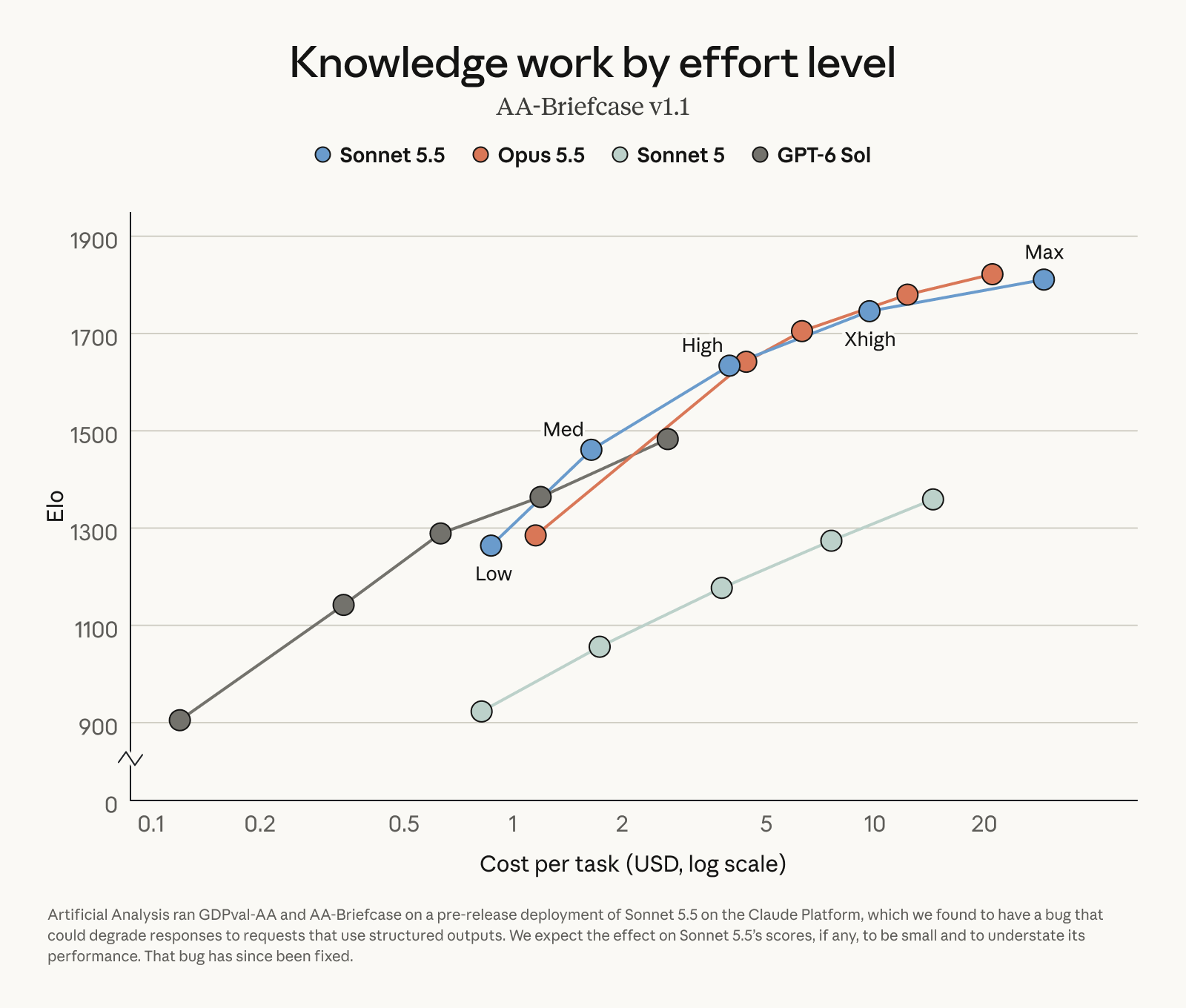
Scores also vary with the effort setting, a control that makes the model think longer in exchange for a better answer and a higher bill. Anthropic said Sonnet 5.5 at High effort matches GPT-6 Sol on FrontierCode for about one-fifth of the cost per task.
On GDPval-AA, which grades real-world professional work across 44 occupations using an Elo system, Sonnet 5.5 scored 1844 and Opus 5.5 scored 1846, making the result effectively a tie. GPT-6 Sol scored 1487.
OpenAI matched pricing, but max-effort usage is expensive
Rivals are at similar price points. OpenAI cut GPT-6 Sol to $2 per million input tokens and $10 per million output tokens last week. Its mid-tier GPT-5.6 Terra is listed at $2 and $12. Anthropic did not publish Terra benchmark results.
The catch is output volume. Artificial Analysis said Sonnet 5.5 wrote about 193,000 tokens per test task at max effort, the highest figure it has measured and roughly 60% more than Opus 5.5. That pushed cost to about $7.60 per task, around 50% above Sonnet 5, which cuts against Anthropic’s claim of savings of up to 30%.
Anthropic said those savings come from lower settings. At Medium effort, the default in its apps, the company said Sonnet 5.5 can beat Sonnet 5’s best coding score for less than one-tenth of the cost. Artificial Analysis said High effort offers the best value. For everyday users, the article said, that means near-flagship coding performance at a fraction of the price as long as the setting stays low.
Testing caveats and the next model in line
Anthropic’s benchmark table is self-reported, while Artificial Analysis tested a pre-release build that had a bug. Anthropic said it expects that issue changed little or may have slightly understated the model’s scores.
Anthropic also said Opus 5.5 remains clearly stronger for complex work that requires sustained judgment.
Claude Haiku 5.5, aimed at high-volume and cost-sensitive applications, is due in the coming weeks.



